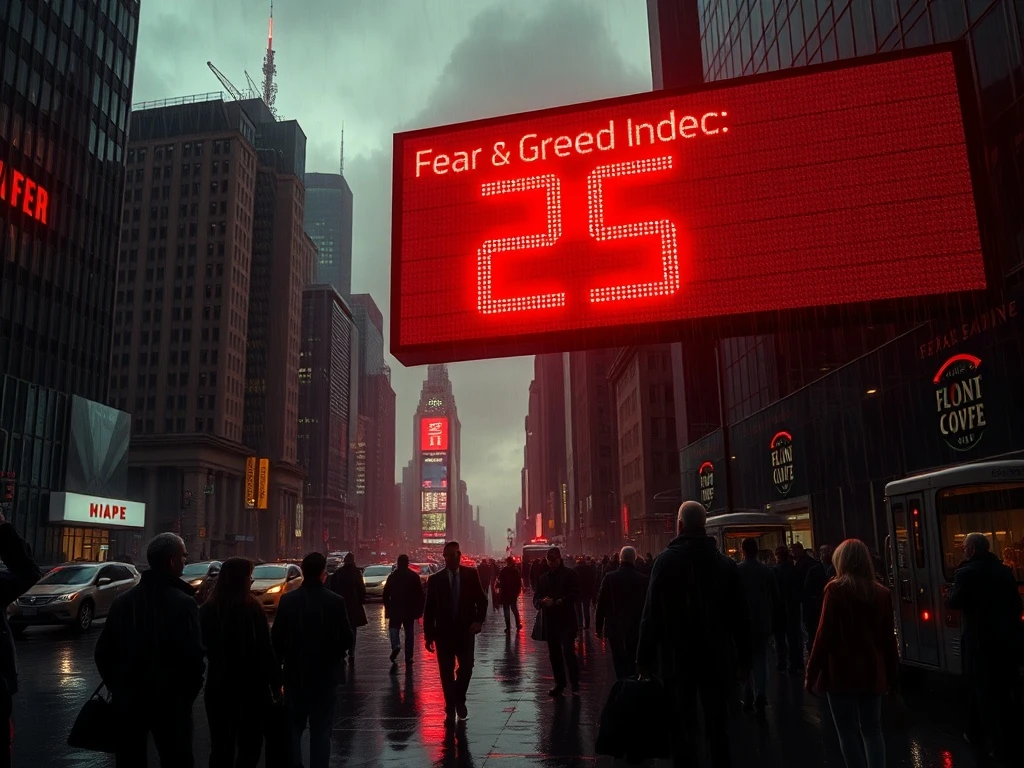
The cryptocurrency market continues to navigate turbulent waters as the widely watched Crypto Fear & Greed Index registers at 25, maintaining its position in the extreme fear territory despite a slight daily increase. This persistent sentiment reading, reported by data provider Alternative on April 15, 2025, signals ongoing investor apprehension despite recent market movements. Market analysts closely monitor this psychological barometer because it often precedes significant price movements and reflects underlying market health beyond simple price charts.
Crypto Fear & Greed Index Mechanics and Current Reading
Alternative’s Crypto Fear & Greed Index operates on a straightforward yet comprehensive scale from 0 to 100. A reading of 0 represents maximum fear, while 100 indicates extreme greed. The current reading of 25 falls squarely within the extreme fear category, which typically spans 0 to 25 on the scale. This measurement represents a one-point increase from the previous day’s 24, showing minimal improvement in overall market sentiment. The index’s calculation incorporates six distinct data sources, each weighted according to their historical correlation with market psychology.
Market volatility contributes 25% to the final score, reflecting price swings and uncertainty. Trading volume accounts for another 25%, indicating participation levels and conviction. Social media sentiment analysis comprises 15%, capturing public discussion tone and frequency. Survey data from retail and institutional investors adds another 15% through direct sentiment measurement. Bitcoin’s market dominance contributes 10%, showing capital concentration in the largest cryptocurrency. Finally, Google search trends for cryptocurrency terms complete the remaining 10%, indicating public interest levels.
Historical Context and Comparative Analysis
Historical data reveals that extreme fear readings often coincide with market bottoms or consolidation periods. For instance, during the 2022 cryptocurrency winter, the index spent 47 consecutive days below 25, reaching a low of 6 in June 2022. Conversely, during the 2021 bull market peak, the index reached 95 in November 2021. The current 25 reading represents the 12th consecutive day in extreme fear territory, suggesting sustained caution among market participants. This persistence distinguishes the current sentiment from temporary fear spikes that typically last only a few days.
| Date | Index Value | Sentiment Category |
|---|---|---|
| April 14, 2025 | 24 | Extreme Fear |
| April 13, 2025 | 23 | Extreme Fear |
| April 12, 2025 | 22 | Extreme Fear |
| April 11, 2025 | 25 | Extreme Fear |
| April 10, 2025 | 27 | Fear |
Market Implications of Extreme Fear Sentiment
Extreme fear readings typically correlate with several market behaviors and characteristics. First, trading volume often decreases as participants adopt wait-and-see approaches. Second, volatility frequently increases due to lower liquidity and heightened sensitivity to news. Third, Bitcoin dominance usually rises as investors seek relative safety in the largest cryptocurrency. Fourth, altcoin markets typically underperform during extended fear periods. Fifth, institutional activity often slows as risk committees implement stricter protocols. These patterns create self-reinforcing cycles that can prolong fear conditions.
Market structure analysis reveals additional insights during extreme fear periods. Exchange reserves frequently increase as investors move assets from cold storage to trading platforms, potentially signaling preparation for selling. Derivatives markets show reduced leverage as traders de-risk positions. Funding rates in perpetual swap markets often turn negative, indicating bearish sentiment among derivatives traders. Spot market order books display thinner liquidity, particularly on the bid side, making prices more susceptible to downward pressure from relatively small sell orders.
Expert Perspectives on Current Market Psychology
Financial psychologists note that extended fear periods create interesting behavioral dynamics. Dr. Elena Rodriguez, behavioral finance researcher at Stanford University, explains, “Prolonged fear conditions often lead to what we call ‘sentiment anchoring.’ Investors become anchored to negative outcomes, overlooking positive developments. This creates potential opportunities when sentiment eventually shifts, but timing such shifts remains challenging.” Her research indicates that sentiment indicators like the Crypto Fear & Greed Index provide valuable contrarian signals when combined with fundamental analysis.
Market technicians emphasize specific chart patterns that frequently accompany extreme fear readings. These include extended consolidation ranges, repeated tests of support levels, and decreasing volatility compression. Seasoned traders often watch for divergence between price action and sentiment indicators. For example, if prices stabilize or rise while the fear index remains elevated, this divergence might signal impending sentiment improvement. Conversely, if prices continue falling while the fear index fails to reach new lows, this could indicate capitulation nearing completion.
Component Analysis of the Current Reading
Breaking down the index’s components reveals nuanced insights about current market conditions. Volatility metrics show elevated but not extreme readings, suggesting controlled rather than panicked price movements. Trading volume data indicates moderate participation, neither showing capitulation-level selling nor enthusiastic buying. Social media analysis reveals cautious discussion with reduced hype and increased technical analysis sharing. Survey responses show retail investors expressing concern while institutional respondents cite regulatory uncertainty as their primary worry.
Bitcoin dominance currently stands at approximately 52%, reflecting moderate concentration in the largest cryptocurrency. This represents a slight increase from previous months but remains below historical peaks above 70%. Google search volume for cryptocurrency terms shows steady but unexceptional interest, lacking the spikes associated with major bull markets or crisis events. The balanced nature of these components suggests the current extreme fear reading stems from persistent concerns rather than acute crisis conditions.
- Volatility Component (25%): Measures price swings across major cryptocurrencies
- Volume Component (25%): Trades relative to historical averages
- Social Media (15%): Sentiment analysis across platforms
- Surveys (15%): Direct investor sentiment polling
- Bitcoin Dominance (10%): BTC’s market share percentage
- Search Trends (10%): Google search volume for crypto terms
Regulatory and Macroeconomic Context
The current sentiment exists within specific regulatory and macroeconomic environments. Regulatory clarity continues evolving across major jurisdictions, with some regions implementing clearer frameworks while others maintain ambiguous stances. Macroeconomic conditions show mixed signals, with inflation concerns persisting alongside growth uncertainties. Traditional financial markets exhibit their own volatility, creating cross-market correlations that influence cryptocurrency sentiment. Interest rate policies from major central banks directly impact risk asset appetites, including digital assets.
Institutional adoption continues progressing despite sentiment challenges. Major financial institutions maintain blockchain research and development initiatives. Corporate treasury allocations to Bitcoin show stability rather than expansion. Regulatory-approved cryptocurrency products attract steady but not spectacular inflows. Infrastructure development proceeds with exchanges enhancing security and compliance measures. These fundamental developments provide counterpoints to negative sentiment, suggesting underlying strength despite surface-level fear.
Historical Precedents and Pattern Recognition
Historical analysis reveals that extended fear periods often precede significant market movements. The 2018-2019 bear market featured multiple extended fear periods before the subsequent recovery. The March 2020 COVID-19 crash produced extreme fear readings that marked major buying opportunities. However, not all fear periods immediately precede rallies—some simply indicate ongoing bear markets. Distinguishing between these scenarios requires examining additional factors including on-chain metrics, macroeconomic conditions, and technological developments.
Seasoned market participants employ specific strategies during extreme fear conditions. Some implement dollar-cost averaging to accumulate positions at potentially favorable prices. Others maintain higher cash positions while waiting for clearer signals. Risk management becomes paramount, with position sizing adjustments and stop-loss placements receiving increased attention. Educational content consumption typically increases as investors use slower markets to enhance their knowledge. Community engagement often shifts from price speculation to technological discussion and fundamental analysis.
Conclusion
The Crypto Fear & Greed Index reading of 25 confirms ongoing extreme fear in cryptocurrency markets despite a slight daily improvement. This sentiment indicator provides valuable psychological context beyond price charts alone. Market participants should consider multiple factors when interpreting this reading, including component breakdowns, historical patterns, and fundamental developments. While extreme fear conditions present challenges, they also create potential opportunities for informed investors who maintain perspective and discipline. The index will continue serving as a crucial barometer as markets navigate evolving conditions through 2025 and beyond.
FAQs
Q1: What does a Crypto Fear & Greed Index reading of 25 mean?
The reading of 25 indicates extreme fear in cryptocurrency markets. This represents the lowest sentiment category on the 0-100 scale, where 0-25 signifies extreme fear, 26-46 indicates fear, 47-53 shows neutrality, 54-74 reflects greed, and 75-100 represents extreme greed.
Q2: How often does Alternative update the Crypto Fear & Greed Index?
Alternative updates the index daily, typically reflecting market conditions from the previous 24 hours. The provider also offers historical data dating back to February 2018, allowing for long-term sentiment analysis and pattern recognition across market cycles.
Q3: Can the Crypto Fear & Greed Index predict market movements?
While the index cannot reliably predict short-term price movements, it provides valuable contrarian signals at sentiment extremes. Historically, prolonged periods of extreme fear have often preceded market recoveries, while extreme greed has frequently preceded corrections.
Q4: How does Bitcoin dominance affect the Crypto Fear & Greed Index?
Bitcoin dominance contributes 10% to the index calculation. Higher Bitcoin dominance typically increases fear readings because investors often concentrate capital in Bitcoin during uncertain periods, viewing it as relatively safer than altcoins.
Q5: What other indicators should investors consider alongside the Crypto Fear & Greed Index?
Investors should consider on-chain metrics like exchange flows and holder distribution, technical analysis of price charts, fundamental developments including adoption metrics, regulatory updates, and macroeconomic conditions for comprehensive market assessment.
Related News
- Bitcoin Correction Intensifies as Geopolitical Storm and Fed Leadership Crisis Create Market Turmoil
- Presidential Crypto Ban Sparks Controversy: Democrats Target Trump’s $1.4B Digital Asset Earnings in CLARITY Act Amendment
- Coinbase Listing Roadmap Unveils Strategic Pivot with Doodles (DOOD) and Moonbirds (BIRB) Additions