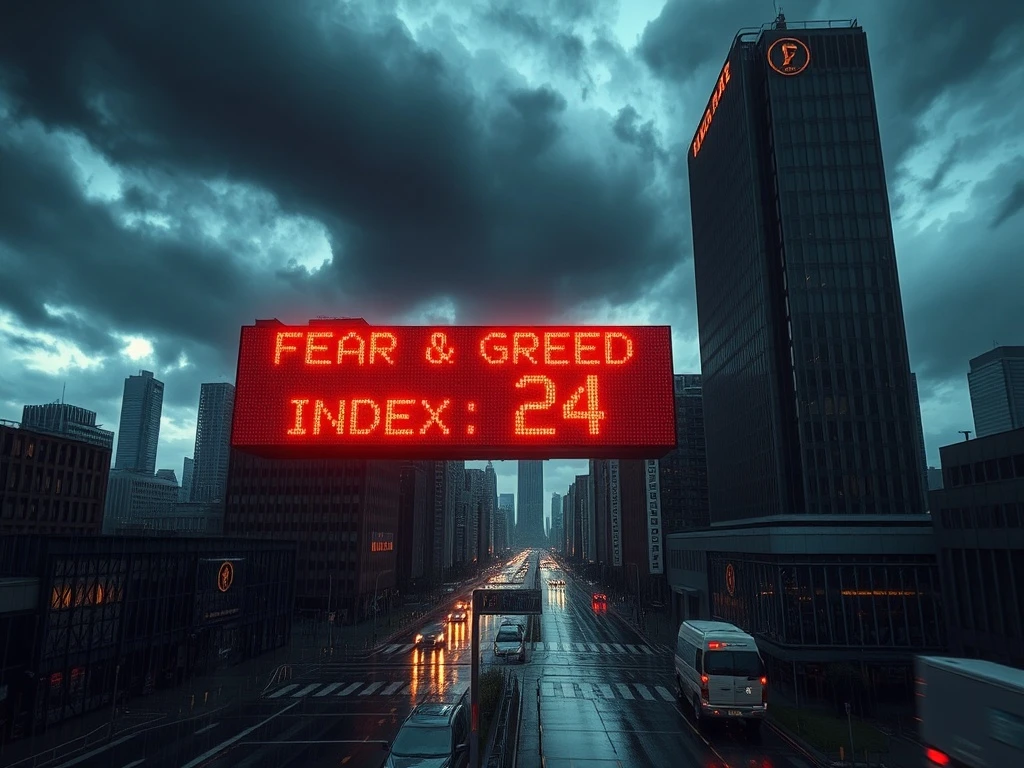
Global cryptocurrency markets entered a pronounced state of anxiety on March 21, 2025, as the widely monitored Crypto Fear & Greed Index recorded a sharp eight-point drop to a score of 24, officially pushing investor sentiment into the ‘Extreme Fear’ territory for the first time this year. This critical shift, reported by data provider Alternative.me, provides a quantifiable measure of the prevailing dread among digital asset traders and serves as a crucial barometer for understanding current market psychology.
Decoding the Crypto Fear & Greed Index Plunge
The Crypto Fear & Greed Index functions as a composite sentiment indicator, distilling multiple market data points into a single, understandable figure. Consequently, its recent descent from a ‘Fear’ reading of 32 to an ‘Extreme Fear’ level of 24 warrants detailed examination. The index operates on a scale from 0 to 100, where 0 signifies maximum fear and 100 indicates extreme greed. A score of 24 sits deep within the red zone, historically associated with potential market bottoms or periods of significant capitulation.
This metric derives its value from a sophisticated, weighted formula. The calculation incorporates six primary components:
- Volatility (25%): Measures current price fluctuations against historical averages. Increased volatility typically correlates with higher fear.
- Market Volume (25%): Analyzes trading volume and momentum. Sudden sell-offs on high volume often drive the index lower.
- Social Media (15%): Scans Twitter and Reddit for sentiment and discussion volume.
- Surveys (15%): Polls market participants directly for their outlook.
- Bitcoin Dominance (10%): Tracks Bitcoin’s share of the total crypto market cap. Rising dominance can signal a ‘flight to safety’.
- Google Trends (10%): Monitors search interest for terms like ‘Bitcoin crash’ or ‘crypto bear market’.
The simultaneous deterioration across several of these factors precipitated the index’s latest decline. Analysts immediately began scrutinizing the underlying causes.
Contextualizing the Extreme Fear Reading
To fully grasp the significance of a score of 24, one must consider historical precedent. For instance, the index famously hit a nadir of 6 during the COVID-19 market crash of March 2020. It also registered profound fear during the collapse of the Terra-Luna ecosystem in May 2022 and the FTX bankruptcy in November 2022. Comparatively, the current reading, while severe, remains above those historic panic extremes.
Several concurrent events likely contributed to the sentiment shift in March 2025. Firstly, regulatory uncertainty in major economies continued to create headwinds. Secondly, macroeconomic pressures, including persistent inflation and higher interest rates, reduced risk appetite across all asset classes. Thirdly, technical analysis showed Bitcoin breaking below key support levels, triggering automated sell orders and liquidations in leveraged derivatives markets.

Market data from the period reveals a clear pattern. Trading volume for Bitcoin and major altcoins spiked by over 40%,
primarily on sell-side pressure. Simultaneously, the volatility index for major cryptocurrencies surged, indicating heightened price swings and trader nervousness. On-chain data further showed an increase in coins moving to exchanges, a behavior often preceding sales.
Expert Analysis on Market Psychology
Financial psychologists and veteran traders often interpret the Fear & Greed Index as a contrarian indicator. Historically, prolonged periods of ‘Extreme Fear’ have frequently preceded market recoveries, as weak hands exit and assets become undervalued. However, this pattern is not a guarantee. The index measures sentiment, not fundamentals, and sentiment can remain depressed for extended periods during structural bear markets.
Industry observers note that the index’s current composition, which now includes more sophisticated social media parsing and broader survey data, makes it more resilient to manipulation than in its earlier years. Its fall to 24 reflects a genuine, data-driven consensus of negative outlook among a diverse set of market participants. This consensus creates a feedback loop; news of the ‘Extreme Fear’ reading itself can amplify cautious behavior among investors.
Potential Impacts and Trader Considerations
The shift to ‘Extreme Fear’ has immediate and longer-term implications for different market actors. For retail investors, it often signals a high-stress environment where emotional decision-making can lead to selling at a loss. For institutional players and algorithmic funds, such readings adjust risk models and may dictate reduced position sizes or increased hedging activity.
Market analysts emphasize several key considerations during such phases:
- Risk Management: Paramount above all else. This includes reviewing portfolio allocations and leverage.
- Historical Context: Understanding that fear is a normal part of market cycles.
- Fundamental Analysis: Differentiating between price-driven panic and deterioration in a project’s core technology or adoption.
- Liquidity Awareness: Recognizing that market depth may shrink, making large orders more impactful.
The table below contrasts key market characteristics during ‘Extreme Fear’ versus ‘Extreme Greed’ phases, based on historical data:
| Market Characteristic | During Extreme Fear (Score 0-25) | During Extreme Greed (Score 75-100) |
|---|---|---|
| Media Headlines | Predominantly negative, focus on losses | Overwhelmingly positive, focus on gains |
| Social Dialogue | Discussions of ‘crypto winter’ and exits | ‘FOMO’ and price prediction dominate |
| On-Chain Activity | Exchange inflows rise (selling) | Exchange outflows rise (holding) |
| Volatility Trend | High, often driven by downside moves | High, often driven by upside moves |
Conclusion
The Crypto Fear & Greed Index’s decline to 24 serves as a stark, data-centric confirmation of the severe anxiety gripping cryptocurrency investors. This move into ‘Extreme Fear’ territory encapsulates the combined weight of regulatory pressures, macroeconomic challenges, and technical market breakdowns. While historically such depths of pessimism have sometimes marked cyclical turning points, they primarily underscore the critical need for disciplined strategy and rigorous fundamental analysis. Market participants will now watch closely for stabilization or further deterioration across the index’s six core components to gauge whether this fear is a momentary spike or the precursor to a more prolonged downturn.
FAQs
Q1: What does a Crypto Fear & Greed Index score of 24 mean?
A score of 24 indicates the market is in a state of ‘Extreme Fear’. This is a quantitative measure based on volatility, volume, social media, surveys, Bitcoin dominance, and search trends, suggesting widespread pessimism and risk aversion among investors.
Q2: Is the Fear & Greed Index a reliable predictor of future Bitcoin price?
The index is a measure of current sentiment, not a direct price predictor. While extreme readings have often coincided with market turning points, it should not be used in isolation. It is best combined with technical and fundamental analysis for investment decisions.
Q3: How often is the Crypto Fear & Greed Index updated?
The index is updated daily, typically based on 24-hour rolling data. This allows it to capture recent shifts in market mood and provide a near real-time gauge of investor psychology.
Q4: What is the difference between ‘Fear’ and ‘Extreme Fear’ on the index?
The index categorizes scores from 0-100. ‘Fear’ typically spans from 25 to 45, indicating cautious and negative sentiment. ‘Extreme Fear’ covers scores from 0 to 24, signaling intense panic, potential capitulation, and significantly heightened risk aversion.
Q5: Can the Fear & Greed Index be manipulated?
While no metric is immune to influence, the index’s multi-factor design—using volatility, volume, social sentiment, surveys, dominance, and search data—makes it difficult to artificially manipulate significantly. Its methodology is designed to reflect a broad consensus of market behavior.
Related News
- Coinbase NBA Partnership: The Strategic Masterstroke Quietly Positioning COIN for Cultural Domination
- Cryptocurrency Liquidations Unleash $830M Storm as Bitcoin and Ethereum Long Positions Collapse
- Crypto Bill: Pass Now or Face Harsh Democratic Regulations, Warns White House Adviser