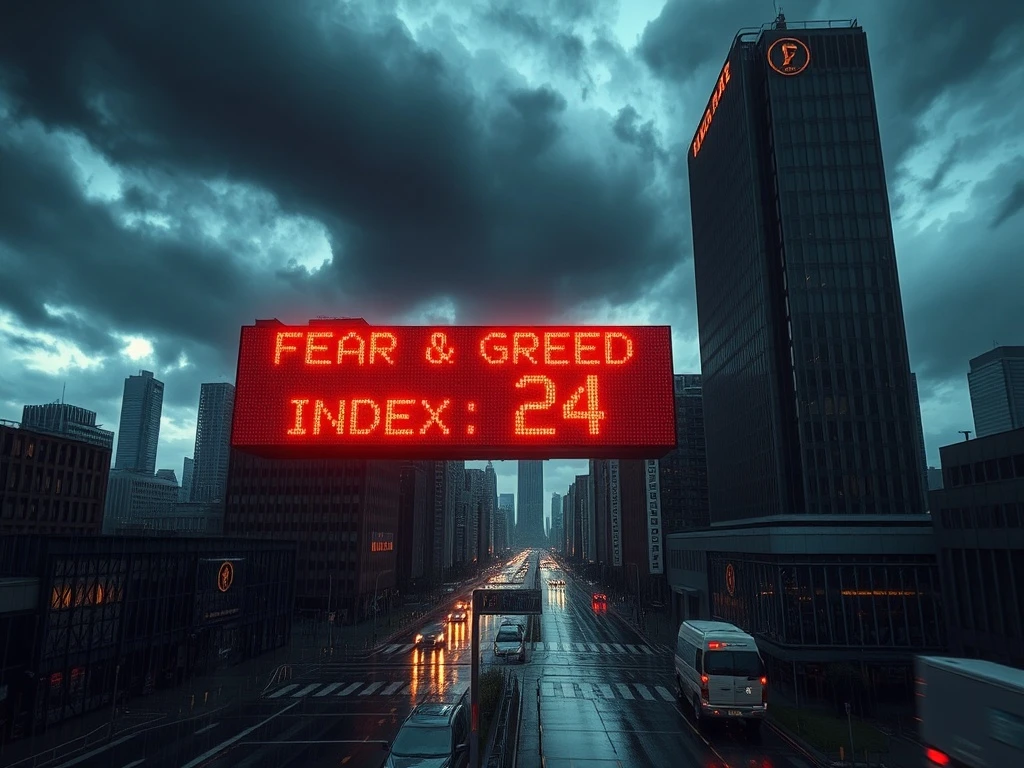
The cryptocurrency market entered another period of intense psychological pressure this week as the widely watched Crypto Fear & Greed Index plummeted to just 20, firmly planting investor sentiment in what analysts classify as ‘extreme fear’ territory. This significant drop, recorded globally on March 15, 2025, marks one of the lowest readings since the bear market of 2022 and signals profound uncertainty among digital asset investors. Market participants now face critical questions about whether this represents a capitulation event or merely another volatile swing in the ongoing maturation of crypto markets.
Crypto Fear & Greed Index Plunges to Extreme Fear Levels
Data provider Alternative.me reported the four-point decline in its benchmark sentiment indicator, pushing the index deeper into the red zone where scores below 25 indicate extreme fear. Consequently, this reading suggests that negative emotions currently dominate cryptocurrency trading decisions. The index functions as a crucial barometer, aggregating multiple market signals into a single, comprehensible number. Historically, sustained periods at these levels have often preceded significant market inflection points, though timing remains notoriously difficult to predict. Market analysts immediately began scrutinizing the component data to understand the drivers behind this pessimistic shift.
Furthermore, the index’s methodology provides transparency into why sentiment has soured. Specifically, it calculates its score from six weighted factors: market volatility (25%), trading volume (25%), social media sentiment (15%), survey results (15%), Bitcoin’s dominance (10%), and Google search trends (10%). A score of 20, therefore, reflects broad-based negative signals across most, if not all, of these metrics. For instance, increased volatility typically correlates with fear, while declining search volume often indicates fading retail interest. This multi-factor approach helps prevent the index from being skewed by any single anomalous data point.
Decoding the Components Behind the Market Sentiment
To understand the current extreme fear reading, one must examine the contributing factors. Market volatility has spiked recently, with Bitcoin experiencing daily price swings exceeding 5% on multiple occasions. Such instability naturally breeds caution among both institutional and retail investors. Simultaneously, trading volume across major exchanges has shown concerning patterns. While spot volume has contracted, derivatives markets have seen elevated activity, often a sign of speculative and nervous trading.
- Volatility (25% weight): Recent 30-day volatility for Bitcoin exceeded 70%, well above the annual average.
- Social Media (15% weight): Sentiment analysis of platforms like X (formerly Twitter) and Reddit shows a 40% increase in negative cryptocurrency mentions.
- Bitcoin Dominance (10% weight): BTC’s share of total crypto market cap has risen to 52%, suggesting a ‘flight to safety’ within the asset class.
Moreover, Google search data for terms like “Bitcoin crash” and “crypto bear market” has surged by over 200% month-over-month. This search behavior directly feeds into the index’s calculation. Surveys conducted by various crypto research firms complement this data, showing a sharp decline in short-term investor optimism. When combined, these elements create a coherent picture of a market under significant psychological stress. The convergence of negative signals across independent data sources strengthens the validity of the extreme fear classification.
Historical Context and Comparative Analysis
Placing the current score of 20 in historical context provides crucial perspective. The index hit its all-time low of 6 in March 2020 during the COVID-19 market panic. It also spent extended periods below 20 during the crypto winter of 2018-2019 and again in mid-2022 following the collapse of several major industry players. Interestingly, many major market bottoms have coincided with prolonged extreme fear readings. However, analysts caution that the index is a measure of sentiment, not a direct timing tool for market entries or exits.
| Date | Index Score | Market Context |
|---|---|---|
| March 2020 | 6 | COVID-19 Global Market Crash |
| December 2018 | 14 | End of 2018 Bear Market |
| June 2022 | 8 | Post-LUNA/3AC Collapse |
| March 2025 | 20 | Current Reading |
Additionally, comparing current sentiment to traditional finance indicators reveals interesting divergences. While the Crypto Fear & Greed Index signals extreme fear, traditional equity fear gauges like the VIX have remained relatively subdued. This disconnect may highlight the cryptocurrency market’s unique sensitivity to regulatory news, technological developments, and liquidity flows distinct from broader macro trends. Nevertheless, correlation between asset classes has increased in recent years, making pure isolation less common.
Market Impact and Trader Psychology in 2025
The persistence of extreme fear inevitably affects market behavior. Typically, retail investors become hesitant to deploy new capital, while leveraged traders face increased margin pressures. This environment often leads to lower liquidity, which can exacerbate price movements in both directions. On-chain data from Glassnode and CryptoQuant supports this observation, showing a decrease in active addresses and an increase in coins moving to long-term storage, a behavior commonly associated with ‘hodling’ through downturns.
Professional trading desks report adjusting their strategies accordingly. Many have reduced position sizes and increased their use of options for downside protection. The sentiment shift has also impacted capital flows within the crypto ecosystem. Investors have rotated out of higher-risk altcoins and into more established assets, primarily Bitcoin and Ethereum. This rotation explains the rising Bitcoin dominance component within the Fear & Greed Index calculation. Market makers have widened bid-ask spreads to account for the heightened uncertainty, increasing transaction costs for all participants.
The Regulatory and Macroeconomic Backdrop
External factors significantly influence current market psychology. The regulatory landscape for digital assets remains in flux across major jurisdictions. In the United States, ongoing deliberations about cryptocurrency legislation and enforcement actions create uncertainty. Meanwhile, global macroeconomic conditions continue to apply pressure. Persistently high interest rates in many developed economies make yield-bearing traditional assets relatively more attractive compared to non-yielding cryptocurrencies. Geopolitical tensions also contribute to risk-off sentiment across all speculative asset classes.
Industry experts from firms like CoinShares and Grayscale Investments note that institutional adoption continues despite the gloomy sentiment readings. However, the pace may have slowed temporarily. The launch of spot Bitcoin ETFs in 2024 created a new class of market participants whose behavior differs from traditional crypto natives. These ETF flows now represent a significant variable in market structure. Their response to extreme fear readings will provide valuable data for future sentiment analysis. The evolving market composition means historical patterns may not repeat exactly.
Conclusion
The Crypto Fear & Greed Index reading of 20 provides a clear, quantitative measure of the extreme fear currently pervading digital asset markets. This sentiment stems from multiple verifiable factors including elevated volatility, shifting trading volumes, and negative social discourse. While historically such levels have sometimes marked cyclical lows, they primarily reflect present psychology rather than predict future price action. Market participants should interpret this data as one important input among many, combining it with fundamental analysis and risk management principles. The index ultimately serves as a mirror to market emotion, and in March 2025, that reflection shows a market grappling with significant uncertainty and fear.
FAQs
Q1: What does a Crypto Fear & Greed Index score of 20 mean?
A score of 20 indicates ‘Extreme Fear’ according to the index’s classification. It suggests that negative sentiment and fear are the dominant emotions driving cryptocurrency market participants, based on an analysis of volatility, volume, social media, surveys, dominance, and search trends.
Q2: Who creates the Crypto Fear & Greed Index and how is it calculated?
The index is compiled by the data provider Alternative.me. It uses a weighted formula incorporating six factors: volatility (25%), market volume/momentum (25%), social media (15%), surveys (15%), Bitcoin dominance (10%), and Google search trends (10%).
Q3: Has the index been this low before?
Yes. The index reached lower levels during major market crises, notably scoring 6 in March 2020 during the COVID-19 crash and 8 in June 2022 following the collapse of the Terra/LUNA ecosystem. The current reading is comparable to periods of significant market stress.
Q4: Is the Fear & Greed Index a good tool for market timing?
Most analysts caution against using it as a sole timing tool. While extreme readings often coincide with market turning points, the index can remain in ‘extreme fear’ or ‘extreme greed’ territories for extended periods. It is best used as a sentiment gauge alongside fundamental and technical analysis.
Q5: How does Bitcoin’s market dominance affect the index?
Bitcoin dominance—its share of the total cryptocurrency market capitalization—accounts for 10% of the index score. Rising dominance often signals a ‘flight to safety’ within crypto, as investors move from altcoins to Bitcoin, which is typically viewed as less risky. This behavior is associated with fearful or cautious markets.
Related News
- Strive Seeks to Raise $150M in Strategic Move: Bitcoin Acquisition and Debt Consolidation Plan Revealed
- Crypto Market Structure Bill: US Senate Committee Unveils Crucial Revised CLARITY Act Draft
- Vietnam Crypto Exchange License Applications Open: A Transformative Regulatory Shift for Digital Assets