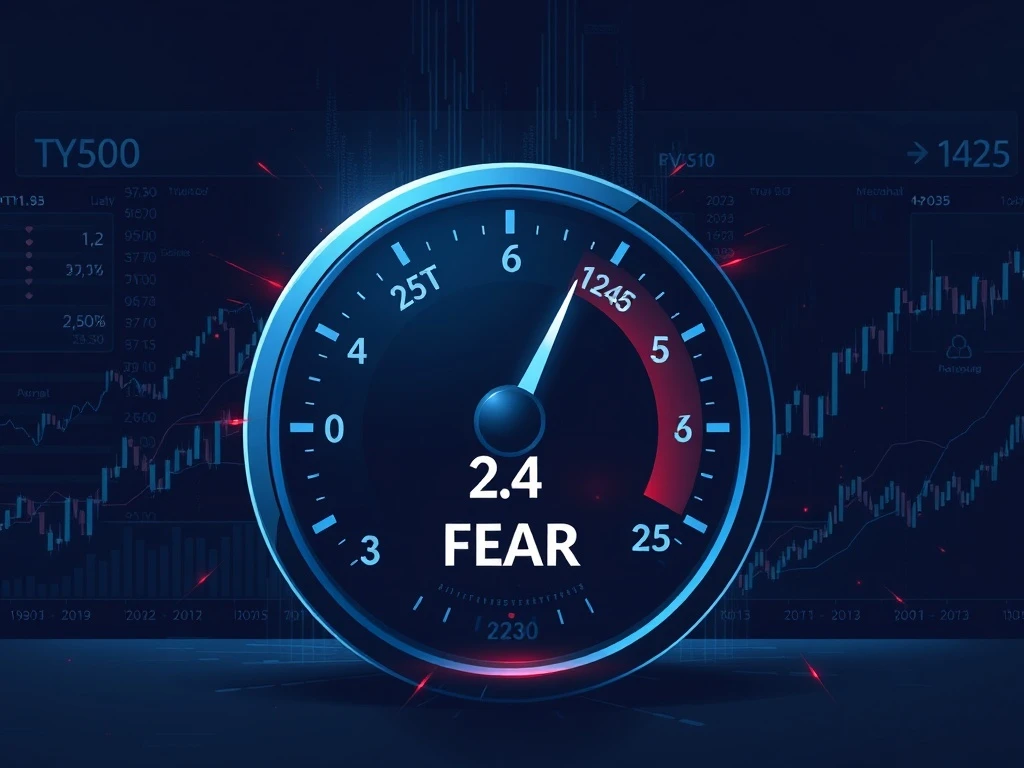
Global cryptocurrency markets witnessed a subtle yet significant shift in investor psychology this week, as the widely monitored Crypto Fear & Greed Index climbed four points to a reading of 24. Despite this uptick, the index firmly remains in the ‘extreme fear’ category, highlighting the persistent anxiety and caution dominating digital asset trading floors worldwide as of early 2025. This movement provides a crucial quantitative snapshot of market sentiment, offering investors a data-driven alternative to the noise of social media hype and short-term price fluctuations.
Decoding the Crypto Fear & Greed Index Movement
The Crypto Fear & Greed Index serves as a vital barometer for the emotional state of the cryptocurrency market. Published by Alternative.me, the index translates complex market data into a simple score from 0 to 100. A score of 0 represents ‘Extreme Fear,’ while 100 signals ‘Extreme Greed.’ The recent move from 20 to 24, while keeping the market in the red ‘extreme fear’ zone below 25, indicates a marginal reduction in panic but not a fundamental shift toward optimism. Analysts often scrutinize these incremental changes for early signals of trend exhaustion or potential reversal points.
This metric derives its value from a multifaceted calculation designed to capture various dimensions of market behavior. The formula is not based on a single data point but synthesizes information from six key sources to ensure robustness. For instance, market volatility and trading volume each contribute 25% to the final score. High volatility typically correlates with fear, while surging volume can indicate either panic selling or greedy buying. Social media sentiment and market surveys each account for 15%, capturing the narrative and crowd psychology. Finally, Bitcoin’s dominance share (10%) and trends in Google search volume for cryptocurrency terms (10%) round out the calculation, measuring both market structure and public interest.
Historical Context and Comparative Market Analysis
To fully grasp the significance of a reading of 24, one must examine the index’s historical performance. During the bull market peaks of late 2021, the index frequently registered above 75, even hitting ‘extreme greed’ levels above 90. Conversely, following major market contractions like the Terra-Luna collapse or the FTX bankruptcy in 2022, the index plunged into single digits, reflecting utter market despair. The current ‘extreme fear’ reading, therefore, exists within a recovery corridor—far from the euphoric highs but also distanced from the absolute lows of a full-blown crypto winter.
Comparative analysis with traditional finance indicators reveals interesting parallels. The VIX index, often called the ‘fear gauge’ for U.S. stock markets, has shown correlated spikes during periods of macroeconomic uncertainty that also affect crypto. Furthermore, a reading of 24 often coincides with specific on-chain behaviors. Blockchain analytics firms like Glassnode and CryptoQuant report that prolonged periods in ‘extreme fear’ frequently see an accumulation of assets by long-term holders, as weaker hands exit the market. This transfer of assets from short-term speculators to conviction holders can lay a foundation for more stable future price action.
The Mechanics Behind Market Sentiment Gauges
The construction of sentiment indices like the Crypto Fear & Greed Index relies on transparent and verifiable data sources. The 25% weight for volatility analyzes the magnitude of Bitcoin’s price swings against its moving averages. The volume component assesses whether trading activity is above or below recent norms. The social media analysis, primarily from Twitter and Reddit, uses natural language processing to score the positivity or negativity of millions of posts. The survey component aggregates data from multiple retail and institutional investor polls. This methodological rigor is what grants the index its authority among traders and financial news outlets.
Experts from firms like Arcane Research and Bloomberg Intelligence regularly reference the index in their reports. They note that while it is a contrarian indicator—meaning extreme fear can sometimes signal a buying opportunity and extreme greed a warning—it is not a timing tool. ‘The index is best used as a piece of a larger puzzle,’ states a recent market commentary from a major crypto fund. ‘It confirms the emotional backdrop against which fundamental developments, like regulatory news or protocol upgrades, are playing out.’
Implications for Investors and the 2025 Landscape
The persistent ‘extreme fear’ sentiment in early 2025 occurs against a backdrop of significant industry maturation. Regulatory frameworks in major jurisdictions like the EU (MiCA) and the U.S. are becoming clearer, and institutional adoption through spot Bitcoin ETFs has created new inflows. However, concerns over macroeconomic factors such as interest rate policies, geopolitical tensions, and the technological evolution of blockchain networks continue to inject uncertainty. This dichotomy between improving fundamentals and skittish sentiment is a defining characteristic of the current market phase.
For portfolio managers, this environment demands a disciplined strategy. Key considerations include:
- Risk Management: Extreme fear readings advise caution against over-leveraged positions.
- Dollar-Cost Averaging (DCA): Historical data shows that systematic buying during fear phases has often yielded positive long-term returns.
- Fundamental Research: Sentiment is ephemeral; the long-term value of blockchain projects depends on adoption, tokenomics, and team execution.
- Market Correlation: Observing whether crypto sentiment is decoupling from traditional stock market fear is crucial for asset allocation.
Data from cryptocurrency exchanges shows that buy orders for stablecoin pairs often increase during these periods, suggesting some investors are preparing to deploy capital when they perceive a sentiment shift. Meanwhile, derivatives markets show a reduction in leverage, as indicated by lower funding rates in perpetual swap markets, aligning with the fear narrative.
Conclusion
The Crypto Fear & Greed Index’s rise to 24, while remaining in extreme fear territory, encapsulates the cautious and transitional state of the cryptocurrency market in 2025. It reflects a market grappling with legacy uncertainties while navigating a path toward greater institutional integration and regulatory clarity. This sentiment gauge, by quantifying the emotional extremes of fear and greed, provides an essential tool for cutting through market noise. Investors who understand its components, respect its historical context, and integrate its readings with robust fundamental and technical analysis are better positioned to navigate the volatile yet opportunity-rich landscape of digital assets. The index’s current stance is a reminder that in cryptocurrency markets, data-driven discipline often triumphs over emotion.
FAQs
Q1: What does a Crypto Fear & Greed Index score of 24 mean?
A score of 24 indicates the market is experiencing ‘Extreme Fear.’ It is calculated from multiple data points including volatility, volume, and social media sentiment. While up from 20, it remains deep in fear territory, suggesting widespread investor caution and potential selling pressure.
Q2: How often is the Crypto Fear & Greed Index updated?
The index is updated daily, typically based on 24-hour rolling data. This allows traders and analysts to monitor shifts in market sentiment in near real-time as new price action, social media trends, and trading volume data are processed.
Q3: Is the ‘extreme fear’ zone a good time to buy cryptocurrency?
Historically, prolonged periods of extreme fear have sometimes preceded market recoveries, as weak hands sell and assets are transferred to long-term holders. Many investment strategies, like dollar-cost averaging, advocate for consistent investment through fear phases. However, it is not a guaranteed timing signal and should be combined with thorough fundamental research.
Q4: What is the difference between this index and traditional fear gauges like the VIX?
The Crypto Fear & Greed Index is specifically tailored to cryptocurrency markets, incorporating data like Bitcoin dominance and crypto-specific social media. The VIX measures expected stock market volatility derived from S&P 500 options. While they can correlate during broad market stress, they often diverge based on asset-class-specific news.
Q5: Can the index be manipulated?
Manipulating the index directly would be highly difficult due to its diverse data sources. It pulls from public blockchain data (volatility, volume), major social media platforms, and broad search trends. However, coordinated social media campaigns or wash trading on exchanges could theoretically influence individual components marginally, but not the aggregate score decisively.
Related News
- Bitcoin Consolidation: Traders Signal Cautious Optimism as Sharp Decline Appears Unlikely
- Pendle Team’s Strategic $3.83M Token Move to Bybit Sparks DeFi Market Analysis
- XRP Treasury Security: Evernorth’s Revolutionary t54 Infrastructure Safeguards $1 Billion in Institutional Assets