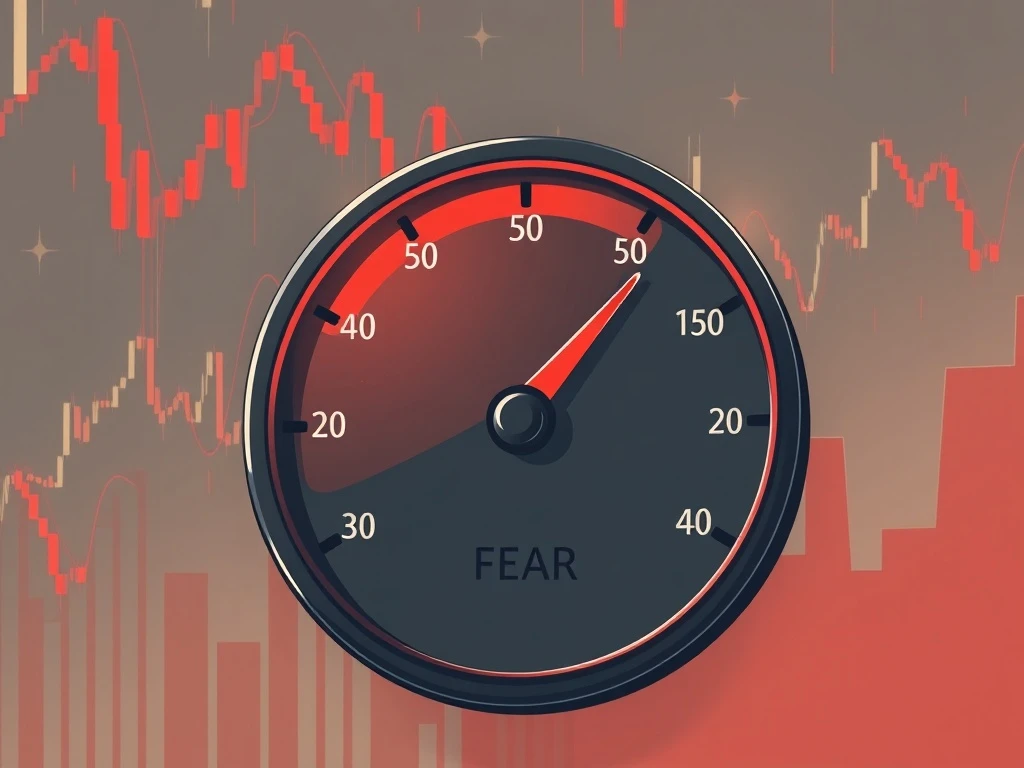
Global cryptocurrency markets remain gripped by a profound sense of apprehension as the widely monitored Crypto Fear & Greed Index registers a reading of 17, firmly entrenched in the “Extreme Fear” zone. This critical sentiment gauge, published by data provider Alternative.me, has inched up only three points from previous lows, continuing a multi-week trend that reflects deep-seated investor anxiety. Consequently, understanding this metric’s mechanics and historical implications becomes paramount for any market participant navigating these turbulent conditions.
Decoding the Crypto Fear & Greed Index and Its 17 Reading
The Crypto Fear & Greed Index serves as a composite barometer for overall market sentiment, distilling complex behavioral data into a single, comprehensible score ranging from 0 to 100. A score of 17, as recorded recently, indicates overwhelming fear dominates trader psychology. The index’s calculation relies on a weighted blend of six core market factors, each providing a unique lens on investor behavior. This methodology ensures a multi-faceted view rather than reliance on a single data point.
Firstly, market volatility accounts for 25% of the score. Heightened volatility, especially to the downside, signals uncertainty and fear. Secondly, market volume and momentum contribute another 25%, with low or declining volume during sell-offs often exacerbating fear readings. Social metrics also play a crucial role; social media sentiment from platforms like Twitter and Reddit comprises 15%, while surveys provide a direct pulse check from the community for another 15%.
Finally, broader market structure factors round out the model. Bitcoin’s dominance—its share of the total crypto market cap—makes up 10%. Rising dominance can indicate a “flight to safety” toward Bitcoin during fearful periods. Additionally, Google Trends data for search terms like “Bitcoin crash” or “crypto bear market” contributes the final 10%, quantifying public interest and concern. The convergence of these signals at depressed levels produces the alarming Extreme Fear classification.
Historical Context of Extreme Fear Phases
Placing the current 17 reading in historical context reveals significant patterns. The index has plunged into Extreme Fear territory during several major market events. For instance, readings near single digits coincided with the COVID-19 market crash of March 2020 and the collapse of the Terra-Luna ecosystem in May 2022. These periods were characterized by rapid deleveraging, panic selling, and a pervasive lack of buyer confidence.
However, a contrarian analysis of these historical episodes provides crucial insight. Notably, prolonged periods of Extreme Fear have often preceded substantial market recoveries. Following the March 2020 low, Bitcoin’s price increased over tenfold in the subsequent 18 months. This pattern suggests that while Extreme Fear signals high risk, it can also indicate potential long-term opportunity when sentiment reaches a crescendo of pessimism. Market analysts frequently monitor these extremes for signs of capitulation, a final wave of selling that exhausts downward pressure.
The Mechanics of Market Sentiment and Price Discovery
Market sentiment is not merely a reflection of price action but a key driver of it. During Extreme Fear phases, several behavioral finance phenomena typically manifest. The disposition effect sees investors hastily selling assets that have shown a profit to avoid watching gains evaporate, while holding onto losers in hope of a rebound. This can accelerate declines. Furthermore, herding behavior intensifies, as traders mimic the sell actions of others, reinforcing the negative trend regardless of underlying fundamentals.
This environment creates a feedback loop. Negative sentiment leads to selling, which increases volatility and negative social media commentary, which then feeds back into a lower Fear & Greed Index score. Breaking this cycle often requires a fundamental catalyst, such as a major regulatory clarification, institutional adoption news, or a macroeconomic shift that alters the risk-on/risk-off calculus for large investors. Until such a catalyst emerges, the market can remain trapped in a fear-dominated state.
Impact on Altcoins and Broader Crypto Ecosystem
The chilling effect of a 17 Fear & Greed reading extends far beyond Bitcoin, creating a harsh environment for alternative cryptocurrencies (altcoins). Typically, during Extreme Fear, capital flows out of higher-risk, smaller-cap altcoins and into perceived safer havens, often Bitcoin or stablecoins. This dynamic severely impacts altcoin liquidity and development. Projects may struggle with funding, and trading volumes can dry up, increasing price slippage and volatility for those still active in the market.
The table below contrasts typical market characteristics during Extreme Fear versus Extreme Greed phases:
| Market Characteristic | Extreme Fear (Index 0-25) | Extreme Greed (Index 75-100) |
|---|---|---|
| Primary Investor Emotion | Panic, Capitulation | Euphoria, FOMO |
| Typical Price Trend | Sharp declines, high volatility | Parabolic rallies, low volatility uptrends |
| Trading Volume | Spikes on sell-offs, otherwise low | Consistently high, especially on rallies |
| Media/Social Tone | Overwhelmingly negative, doom narratives | Overwhelmingly positive, “to the moon” narratives |
| Risk Appetite | Extremely low, flight to safety | Extremely high, reach for yield |
For developers and founders, an Extreme Fear climate forces a focus on fundamentals—building technology, securing partnerships, and conserving resources—rather than on marketing and token price. This can, paradoxically, strengthen projects that survive the downturn, weeding out those without sustainable models.
Navigating the Market with a Sentiment Compass
For investors and traders, the Crypto Fear & Greed Index at 17 functions more as a compass than a crystal ball. It provides critical situational awareness but should not be used in isolation. Savvy market participants combine this sentiment data with other analyses. They examine on-chain metrics like exchange flows, holder composition, and network activity. They also scrutinize macroeconomic indicators such as interest rate expectations and inflation data, which heavily influence capital allocation decisions across all risk assets, including crypto.
Furthermore, a key strategy during Extreme Fear involves disciplined risk management. This includes:
- Position Sizing: Allocating smaller portions of capital to new entries to withstand volatility.
- Dollar-Cost Averaging (DCA): Systematically investing fixed amounts at regular intervals to mitigate timing risk.
- Focus on Fundamentals: Researching project viability, tokenomics, and team strength rather than reacting to price noise.
- Emotional Discipline: Adhering to a pre-defined investment plan to avoid panic-driven decisions.
Ultimately, while the Extreme Fear signal warns of high risk and potential further downside, it also flags a market state where long-term value may be emerging for those with patience and conviction. The index does not predict the bottom, but it highlights when the market is pricing in a significant amount of bad news.
Conclusion
The Crypto Fear & Greed Index reading of 17 offers a stark, quantitative measure of the intense fear currently permeating digital asset markets. This sentiment, derived from volatility, volume, social media, surveys, Bitcoin dominance, and search trends, reflects a cautious and risk-averse investor base. Historically, such extreme readings have marked periods of both significant distress and subsequent opportunity. While the present climate demands caution and robust risk management, understanding this sentiment gauge provides a crucial framework for navigating uncertainty. The index reminds us that markets are cyclical, and today’s Extreme Fear will eventually give way to another phase, making informed, disciplined analysis more valuable than ever.
FAQs
Q1: What does a Crypto Fear & Greed Index score of 17 mean?
A score of 17 falls into the “Extreme Fear” classification (0-25). It indicates that current market data from volatility, trading volume, social media, and other sources collectively reflect overwhelming pessimism and risk aversion among cryptocurrency investors.
Q2: Who creates the Crypto Fear & Greed Index and how often is it updated?
The index is created and published by the data website Alternative.me. It is updated daily, providing a near real-time snapshot of market sentiment based on the previous 24 hours of data across its six component metrics.
Q3: Is the Extreme Fear zone a good time to buy cryptocurrency?
From a contrarian investment perspective, extreme fear can indicate that negative sentiment is overdone and assets may be undervalued. However, it is not a timing signal for an immediate bottom. It suggests a zone for careful, disciplined accumulation as part of a long-term strategy, not a guarantee of a short-term rebound.
Q4: How does Bitcoin’s market cap dominance affect the Fear & Greed Index?
Bitcoin dominance accounts for 10% of the index score. A rising dominance often occurs during fearful markets as investors sell riskier altcoins and potentially move into Bitcoin as a relative “safe haven” within the crypto space. This flight to quality contributes to a lower (more fearful) index score.
Q5: Can the Fear & Greed Index remain in Extreme Fear for a long time?
Yes, the market can remain in a state of Extreme Fear for extended periods, sometimes weeks or months, during prolonged bear markets or periods of intense negative news flow. The index reflects prevailing sentiment, which can be stubborn and slow to change without a positive fundamental catalyst.
Related News
- Bitcoin Whale’s Stunning Comeback: $63.4M Withdrawal Signals Strategic Pivot After $230M Liquidation
- DBS Bank’s Strategic Ethereum Accumulation: Singapore’s Banking Giant Amasses $61.34M in ETH Amid Institutional Adoption Surge
- FTX Users Secure Landmark Settlement with Law Firm Fenwick & West in Stunning Legal Victory