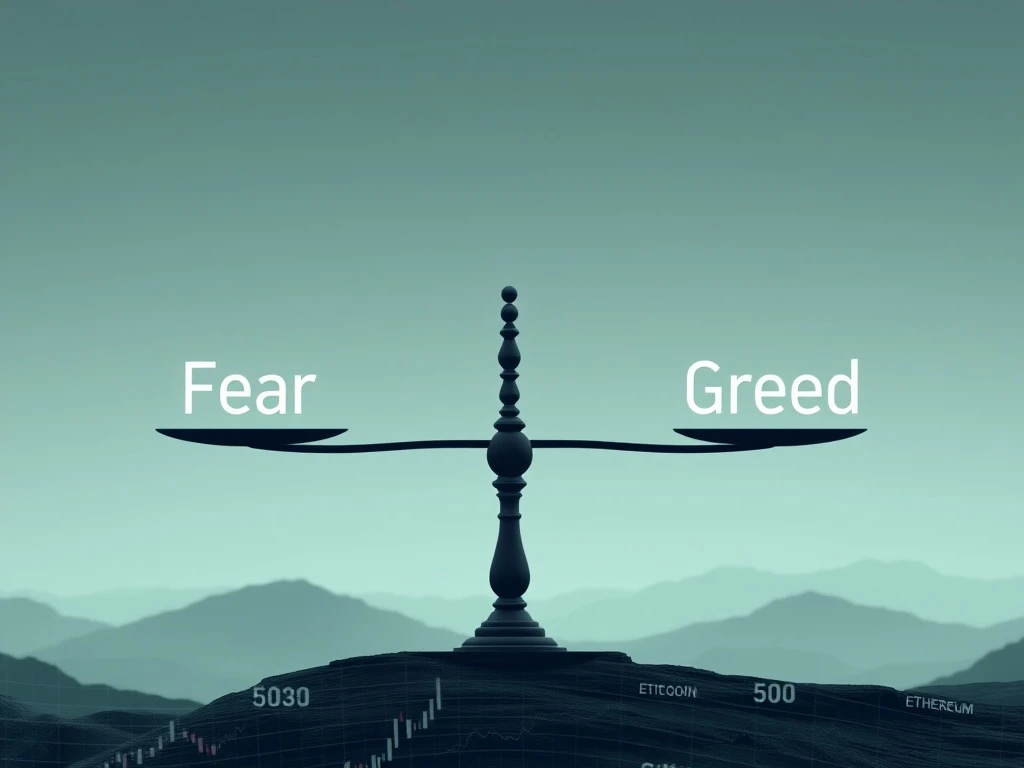
Understanding the pulse of the cryptocurrency market is crucial for every participant. The **Crypto Fear & Greed Index** offers a unique lens into this complex landscape. Recently, this key indicator registered 49, settling firmly in the neutral zone. This score, down just one point from the prior day, highlights a period of balanced sentiment among crypto investors. But what exactly does ‘neutral’ signify in the often-turbulent world of digital assets? More importantly, how does this index provide insights into prevailing **market sentiment**?
Deciphering the Crypto Fear & Greed Index
The Crypto Fear & Greed Index is a valuable tool developed by Alternative.me. It aims to quantify the collective emotional state of the cryptocurrency market. Essentially, it helps investors gauge whether the market is experiencing extreme fear or irrational exuberance. The index operates on a simple scale: a score closer to 0 indicates extreme fear, while a score near 100 suggests extreme greed. A neutral score, like the current 49, means neither strong fear nor strong greed dominates investor behavior. Consequently, it suggests a period of caution or consolidation. Understanding its components helps in interpreting its readings.
The index aggregates data from six key factors. Each factor contributes a specific percentage to the overall score. These factors are designed to capture different aspects of market behavior. Therefore, they offer a comprehensive view of sentiment. Here are the primary components:
- Volatility (25%): Measures current price fluctuations compared to historical averages.
- Trading Volume (25%): Analyzes market activity and momentum.
- Social Media (15%): Scans keywords and sentiment across various platforms.
- Surveys (15%): Gathers direct investor sentiment (currently paused by Alternative.me).
- Bitcoin Dominance (10%): Assesses Bitcoin’s market cap share relative to altcoins.
- Google Search Volume (10%): Tracks search trends for cryptocurrency-related terms.
Understanding Cryptocurrency Volatility’s Impact
One of the most significant components of the Crypto Fear & Greed Index is **cryptocurrency volatility**. This factor accounts for 25% of the index’s total score. Volatility refers to the rate at which the price of an asset increases or decreases. High volatility often signals an unstable market. When the market experiences sharp price swings, it typically indicates fear among investors. Rapid price drops, for instance, can trigger panic selling. Conversely, sudden spikes might indicate FOMO (Fear Of Missing Out) and speculative buying. Therefore, the index uses Bitcoin’s current volatility and maximum drawdowns to measure this sentiment. A highly volatile market usually pushes the index towards the ‘fear’ side. This reflects investor unease about potential losses. Conversely, low volatility, especially during price uptrends, can contribute to a more neutral or greedy score. This suggests greater confidence.
Investors often view high volatility with caution. It presents both opportunities and risks. A sudden surge in price movements, either up or down, can dramatically shift market sentiment. When Bitcoin’s price, for example, shows extreme fluctuations over short periods, the index registers higher fear. This is because such instability often leads to uncertainty. Conversely, a stable period, even if prices are slightly declining, might not trigger extreme fear. The calculation specifically looks at the current volatility compared to historical averages. This provides context. Thus, understanding this component is vital for interpreting the index accurately. It helps in recognizing periods of potential market stress or calm.
Trading Volume and Market Momentum
Another crucial element contributing to the Crypto Fear & Greed Index is **trading volume**, also weighted at 25%. This metric reflects the amount of a specific cryptocurrency bought and sold over a period. High trading volume often accompanies significant price movements. When prices rise on high volume, it typically indicates strong buying pressure and confidence. This can push the index towards greed. Conversely, a sharp price drop on high volume often signals panic selling and fear. This moves the index closer to extreme fear.
The index specifically analyzes current trading volume and market momentum. It compares these figures with historical averages. For example, if there’s high volume during a significant price increase, it suggests strong market participation. This indicates positive sentiment. However, if high volume occurs during a price decline, it points to a strong sell-off. This signifies negative sentiment. Therefore, monitoring trading volume provides direct insight into the strength behind market trends. It helps confirm whether price movements are backed by genuine interest or are merely fleeting. A neutral score, in part, suggests balanced buying and selling pressures. No single direction strongly dominates the market’s activity.
The Role of Social Media and Surveys in Sentiment
Social media sentiment plays a significant role, contributing 15% to the index. Platforms like Twitter are hotbeds for cryptocurrency discussions. The index analyzes the volume and sentiment of posts related to various cryptocurrencies. It uses algorithms to count mentions and assess whether these mentions are positive or negative. A surge in positive mentions, especially around price increases, can indicate growing optimism. This moves the index towards greed. Conversely, an increase in negative or fear-driven discussions pushes the index towards fear. This factor effectively captures the collective mood and buzz surrounding digital assets. It provides a real-time snapshot of public perception.
Surveys, historically contributing another 15%, aimed to gather direct opinions from investors. While this component is currently paused by Alternative.me, its theoretical purpose was to offer a direct measure of investor outlook. When active, surveys could poll thousands of people. They asked questions about their market expectations. This direct feedback provided a qualitative layer to the index. It complemented the quantitative data from other sources. Although not currently active, the concept underscores the importance of direct investor sentiment. Both social media analysis and surveys highlight the power of collective human emotion in driving market trends. These elements are key to understanding overall **investor psychology**.
Bitcoin Dominance: A Bellwether for the Market
The **Bitcoin Dominance** factor, accounting for 10% of the index, is crucial for understanding broader market trends. Bitcoin’s market capitalization dominance refers to its share of the total cryptocurrency market cap. When Bitcoin’s dominance increases, it often indicates a flight to safety. Investors tend to move funds from altcoins back into Bitcoin during uncertain times. This usually signals fear in the broader altcoin market. Conversely, when Bitcoin’s dominance decreases, it suggests that altcoins are gaining traction. This often happens during periods of market exuberance or ‘altcoin season,’ pushing the index towards greed.
A rising Bitcoin dominance can also imply that investors are consolidating their positions. They might be waiting for clearer market signals. This action reflects a cautious approach. On the other hand, a falling dominance, especially if accompanied by strong altcoin performance, suggests increased risk appetite. The index therefore uses Bitcoin dominance as an indicator of capital flow. It helps determine where investor confidence lies. A neutral reading in the index suggests a relatively stable Bitcoin dominance. This means no significant shift of funds between Bitcoin and altcoins is occurring. It points to a balanced allocation of capital across the market.
Google Search Volume and Retail Interest
Finally, **Google Search Volume** contributes 10% to the Crypto Fear & Greed Index. This component measures public interest in cryptocurrencies. It analyzes how often terms like ‘Bitcoin price’ or ‘cryptocurrency buy’ are searched on Google. A sudden surge in search volume for terms like ‘Bitcoin scam’ or ‘crypto crash’ can indicate growing fear. This suggests public concern. Conversely, increased searches for ‘how to buy Bitcoin’ or ‘best altcoins’ often signal rising retail interest and potential greed. This shows people are actively looking to enter the market.
Google search trends offer a glimpse into the retail investor’s mindset. These trends often precede significant market movements. For example, during a strong bull run, search volumes for buying guides typically skyrocket. This indicates widespread public enthusiasm. During a bear market, search volumes for negative terms might increase. This reflects public anxiety. The index leverages this data to capture the sentiment of a wider audience beyond active traders. A neutral reading suggests stable search interest. It means no extreme spikes in either fear-driven or greed-driven queries are observed. This indicates a balanced level of public engagement and curiosity in the crypto space.
Interpreting a Neutral Score: What 49 Means for Investors
The current score of 49 places the Crypto Fear & Greed Index squarely in the ‘neutral’ category. This position is significant. It indicates a period where neither extreme fear nor overwhelming greed dominates the market. For investors, this neutrality can be interpreted in several ways. Firstly, it suggests a lack of clear direction. The market is not experiencing panic selling, nor is it seeing irrational buying frenzies. Instead, it reflects a wait-and-see approach from many participants. This can lead to consolidation phases for various cryptocurrencies. Prices might trade within a range without significant breakouts.
Secondly, a neutral score often precedes a shift in sentiment. It can be a calm before a storm, or a period of accumulation. Smart investors might use this time for careful analysis. They might research potential opportunities. Furthermore, neutrality implies that the market is not heavily swayed by emotional decisions. Instead, it reflects a more rational, albeit cautious, outlook. This contrasts sharply with scores in the extreme fear or greed zones. Such extreme readings often suggest market inefficiencies. Thus, a neutral score suggests a more balanced, albeit uncertain, environment. It encourages a measured approach to investment decisions.
Navigating the Market with Investor Psychology in Mind
Understanding **investor psychology** is paramount when engaging with financial markets. The Crypto Fear & Greed Index serves as a practical tool for this purpose. It helps investors avoid making impulsive decisions based on widespread emotion. When the index is in ‘extreme fear,’ it often signals a potential buying opportunity for contrarian investors. This is because market bottoms frequently occur when pessimism is at its peak. Conversely, an ‘extreme greed’ reading might suggest it’s time to be cautious. It could even be a signal to take profits. Market tops often coincide with peak optimism and irrational exuberance.
A neutral score, however, presents a different challenge. It encourages investors to rely more on fundamental and technical analysis. This is rather than purely on sentiment. It’s a period for due diligence. Investors should assess projects based on their technology, team, and adoption. They should also consider market structure. The index, therefore, acts as a counter-indicator to human biases. It prompts investors to question the prevailing mood. By doing so, it helps them make more rational, long-term decisions. This proactive approach can significantly enhance investment outcomes in the volatile crypto space.
Limitations and Complementary Tools
While the Crypto Fear & Greed Index is a valuable tool, it has limitations. Firstly, it is largely Bitcoin-centric. Its components are heavily weighted towards Bitcoin’s performance and market behavior. This means it may not fully capture the nuances of the broader altcoin market. Different altcoins can exhibit distinct sentiment patterns. Secondly, the index is a snapshot. It reflects current sentiment but does not predict future price movements. It is a lagging indicator in some respects. Therefore, investors should not rely solely on this index for their trading or investment decisions.
Instead, the index should be used in conjunction with other analytical tools. Technical analysis, fundamental analysis, and macroeconomic indicators provide a more holistic view. For instance, combining the index with on-chain data can offer deeper insights. On-chain metrics reveal actual network activity and transaction volumes. Furthermore, monitoring global economic news and regulatory developments is crucial. These external factors significantly influence the crypto market. By integrating the Crypto Fear & Greed Index into a broader analytical framework, investors can make more informed and robust decisions. This comprehensive approach mitigates risks and capitalizes on opportunities more effectively.
Conclusion: A Balanced Perspective on Crypto Sentiment
The Crypto Fear & Greed Index, currently holding at a neutral 49, provides an essential gauge of **market sentiment**. It offers a balanced perspective during periods of uncertainty. By synthesizing data from **cryptocurrency volatility**, trading volume, social media, Bitcoin dominance, and Google searches, the index helps investors understand the prevailing emotional climate. A neutral reading signals neither widespread panic nor excessive euphoria. Instead, it suggests a period of reflection and cautious optimism. This environment calls for careful analysis rather than impulsive action.
For investors, the index is a powerful tool. It helps in recognizing the emotional biases that often drive market behavior. While not a standalone predictor, it serves as an excellent complementary indicator. It encourages a contrarian approach when sentiment is extreme. During neutral phases, it prompts a focus on fundamental strength and technical analysis. Therefore, staying informed about the Crypto Fear & Greed Index empowers participants to navigate the complex and dynamic cryptocurrency landscape with greater clarity and strategic foresight. It fosters more disciplined and informed investment decisions.
Frequently Asked Questions (FAQs)
What does the Crypto Fear & Greed Index measure?
The Crypto Fear & Greed Index measures the current emotional state of the cryptocurrency market. It quantifies whether investors are experiencing extreme fear or extreme greed, providing a numerical score from 0 (extreme fear) to 100 (extreme greed).
How is the Crypto Fear & Greed Index calculated?
It is calculated using six weighted factors: volatility (25%), trading volume (25%), social media mentions (15%), surveys (15% – currently paused), Bitcoin dominance (10%), and Google search volume (10%). These components reflect various aspects of market behavior and public interest.
What does a neutral score, like 49, indicate?
A neutral score, such as 49, indicates that neither strong fear nor strong greed dominates the market. It suggests a period of balanced sentiment, caution, or consolidation, where investors are generally awaiting clearer market signals rather than acting on extreme emotions.
Can the Crypto Fear & Greed Index predict future prices?
No, the Crypto Fear & Greed Index is a sentiment indicator, not a price predictor. It reflects the current emotional state of the market, which can help in making informed decisions but does not forecast future price movements. It’s best used as a complementary tool.
Why is Bitcoin Dominance included in the index?
Bitcoin Dominance is included because Bitcoin often acts as a bellwether for the entire crypto market. A rising dominance can indicate a flight to safety (fear), while a falling dominance might signal an ‘altcoin season’ (greed), reflecting broader capital flows and risk appetite.
How should investors use the Crypto Fear & Greed Index?
Investors should use the index as a tool to gauge overall market sentiment and to counter emotional biases. Extreme readings (fear or greed) can signal potential contrarian opportunities, while neutral readings suggest a need for more in-depth fundamental and technical analysis.
Related News
- Binance Delisting Shakes Markets: Strategic Removal of 15 Margin Trading Pairs Including YGG/BTC
- Sky Protocol’s Strategic Surge: Major 31.57M SKY Buyback Fuels Confidence Post-MakerDAO Rebrand
- Trove Token Faces Furious Backlash After Abrupt Pivot From Hyperliquid to Solana Ecosystem