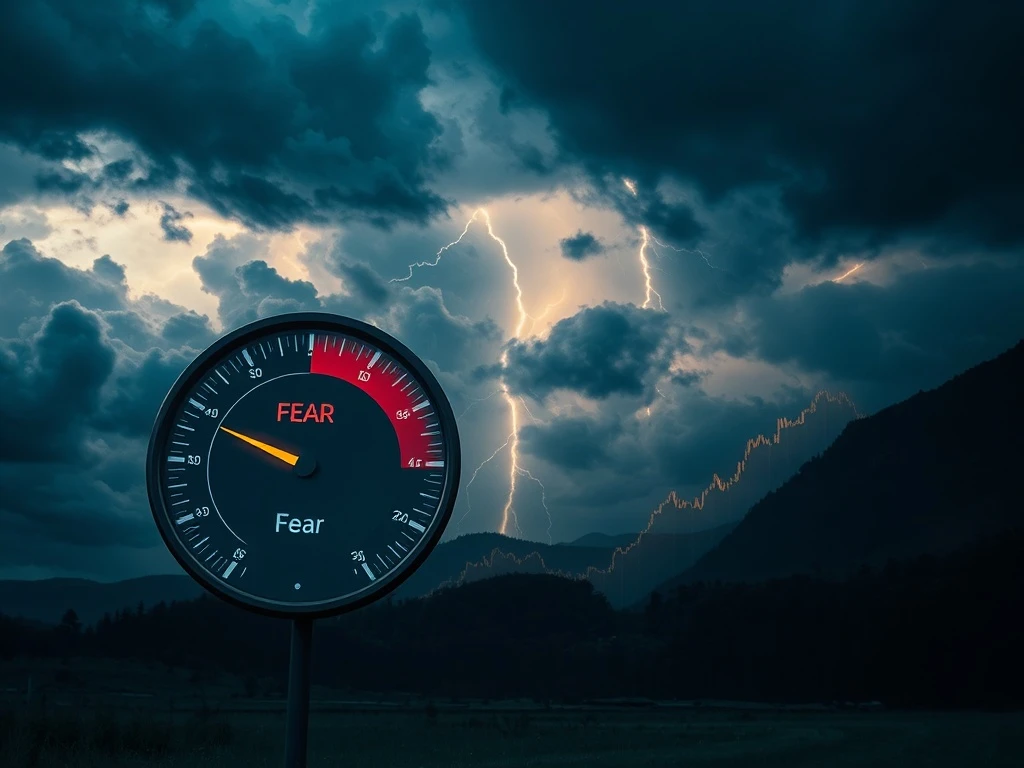
A significant chill swept through digital asset markets today as the widely-watched Crypto Fear & Greed Index dropped five points to 44, decisively crossing from neutral territory into the fear zone. This pivotal shift, reported by data provider Alternative.me, serves as a crucial barometer for the psychological state of cryptocurrency investors worldwide. Consequently, market analysts are now scrutinizing the underlying data for clues about future price action and potential buying opportunities.
Crypto Fear & Greed Index Signals a Critical Sentiment Shift
The Crypto Fear & Greed Index operates on a simple yet powerful scale from 0 to 100. A reading of 0 signifies Extreme Fear, while 100 indicates Extreme Greed. The drop to 44 marks a clear transition. Previously, the index hovered in the neutral range between 45 and 55. This movement below the threshold suggests a tangible increase in investor anxiety. The index’s calculation relies on a sophisticated, multi-factor model designed to quantify emotion, a notoriously difficult metric to capture.
Specifically, the model aggregates data from six core sources. Market data contributes heavily, with volatility and market volume/sentiment each accounting for 25% of the score. Social and survey data provide further insight, making up 15% each through social media mentions and market surveys. Finally, dominance and trends round out the model, with Bitcoin’s market cap dominance and Google Trends data each contributing 10%. This composite approach aims to filter out noise and identify the true emotional undercurrent of the market.
The Anatomy of the Index: More Than Just a Number
Understanding the drop requires examining its components. Increased volatility often precipitates a lower score, as sharp price swings unsettle investors. Similarly, a decline in trading volume can indicate waning confidence and participation. The social media component scans platforms like Twitter and Reddit for the volume and tone of cryptocurrency discussions. A surge in negative or fearful keywords directly impacts the score. Surveys provide a direct pulse check from retail and institutional players.
Bitcoin’s dominance, the percentage of the total crypto market cap it represents, is a key risk-on/risk-off indicator. A rising dominance often occurs during fearful periods as capital flees smaller altcoins for the perceived safety of Bitcoin. Finally, Google search volume for terms like “Bitcoin crash” or “crypto bear market” offers a clear window into mainstream concern. A spike in these searches typically correlates with a falling index.
Contextualizing the Fear: Recent Market Triggers and Historical Parallels
The shift to fear did not occur in a vacuum. Several recent events likely contributed to the deteriorating sentiment. For instance, regulatory announcements from major economies can instantly dampen mood. Additionally, macroeconomic factors like interest rate decisions and inflation reports heavily influence risk assets, including cryptocurrencies. Furthermore, large, unexplained movements of coins from dormant wallets to exchanges—often interpreted as potential sell pressure—can spark anxiety.
Historically, readings in the “Fear” zone (0-49) have presented mixed outcomes. While they can precede further declines, they are also frequently viewed as potential contrarian indicators. Legendary investor Warren Buffett’s adage, “Be fearful when others are greedy, and greedy when others are fearful,” is often cited in crypto circles during such periods. The table below shows notable historical index levels and subsequent market movements.
| Index Level | Sentiment Zone | Historical Period Example | Approximate 30-Day BTC Return |
|---|---|---|---|
| 10-20 | Extreme Fear | March 2020 (COVID Crash) | +30% |
| 40-50 | Fear | June 2022 (Post-Luna Collapse) | -15% |
| 50-60 | Neutral | Q3 2023 (Range-Bound Market) | +5% |
| 80-90 | Extreme Greed | November 2021 (All-Time High) | -20% |
This historical context is vital. It demonstrates that fear, while uncomfortable, is a normal part of market cycles. The current reading of 44 sits in the middle of the fear range, suggesting concern but not yet the panic associated with single-digit readings.
Expert Analysis on the Current Sentiment Shift
Market strategists emphasize the importance of combining sentiment data with on-chain and fundamental analysis. “The Fear & Greed Index is an excellent temperature check,” notes a veteran crypto fund manager, “but it should not be used in isolation. We cross-reference it with metrics like exchange net flows, miner activity, and long-term holder behavior to gauge whether the fear is justified or overblown.” This multi-layered approach helps distinguish between short-term panic and a sustained bearish trend.
Another analyst points to the composition of the fear. “Is the fear driven by Bitcoin’s performance, or is it concentrated in the altcoin market?” they ask. Currently, a combination of factors seems at play. Bitcoin’s price action remains a primary driver, but concerns about specific altcoin projects or sector-wide issues (like DeFi security) also contribute to the overall score. The index reflects the market’s collective psyche, which is inherently complex.
The Impact on Trading Strategies and Market Structure
The move into fear typically triggers specific behavioral changes. Retail investors may pause recurring buys or sell at a loss. Conversely, institutional and sophisticated traders often view these periods as accumulation phases, setting limit orders at lower price levels. This dynamic can create a tug-of-war that leads to heightened volatility and range-bound trading until a new catalyst emerges.
Market structure often changes during fear phases. Liquidity can become fragmented, and spreads may widen on exchanges. Derivatives markets see shifts, with funding rates potentially turning negative and open interest declining as traders reduce leveraged positions. These technical factors, born from sentiment, then feed back into the index’s volatility metric, creating a feedback loop.
Conclusion
The Crypto Fear & Greed Index’s decline to 44 provides a clear, quantifiable signal that investor sentiment has turned fearful. This shift results from a confluence of factors measured by the index’s robust methodology, including volatility, social media tone, and search trends. While fear can signal further downside risk, historical data also shows such periods often precede significant buying opportunities for patient investors. Ultimately, the index serves as a crucial tool for understanding market psychology, reminding participants that prices are driven not just by code and economics, but by human emotion. Monitoring the Crypto Fear & Greed Index, alongside fundamental and on-chain data, remains essential for navigating the volatile cryptocurrency landscape.
FAQs
Q1: What does a Crypto Fear & Greed Index score of 44 mean?
A score of 44 falls into the “Fear” zone (0-49). It indicates that current market data and sentiment metrics collectively show investors are becoming anxious or pessimistic, which often coincides with price declines or increased volatility.
Q2: Who creates the Crypto Fear & Greed Index and how is it calculated?
The index is provided by Alternative.me. It is calculated using six factors: volatility (25%), market volume/momentum (25%), social media (15%), surveys (15%), Bitcoin dominance (10%), and Google Trends data (10%).
Q3: Is a low Fear & Greed Index a good time to buy cryptocurrency?
Historically, periods of extreme fear have sometimes marked market bottoms, presenting potential long-term buying opportunities. However, it is not a timing tool. Experts recommend using it alongside other fundamental and technical analysis, not as a sole investment signal.
Q4: How often does the Crypto Fear & Greed Index update?
The index updates daily, providing a near real-time snapshot of market sentiment based on the previous 24 hours of data from its various sources.
Q5: What is the difference between ‘Fear’ and ‘Extreme Fear’ on the index?
The index categorizes scores from 0-24 as “Extreme Fear” and 25-49 as “Fear.” Extreme Fear suggests panic-selling and maximum pessimism, often seen during major crashes. Fear indicates significant concern and negative sentiment but not necessarily the peak of panic.
Related News
- Crypto Futures Liquidations Unleash $440M Storm as Bitcoin Longs Bear Brutal Brunt
- XRP Plummets: Devastating Support Break Triggers Major Sell-Off Amid Crypto Market Carnage
- Crypto Market Structure Framework: Ripple’s Hopeful Outlook as Senate Considers Landmark Legislation