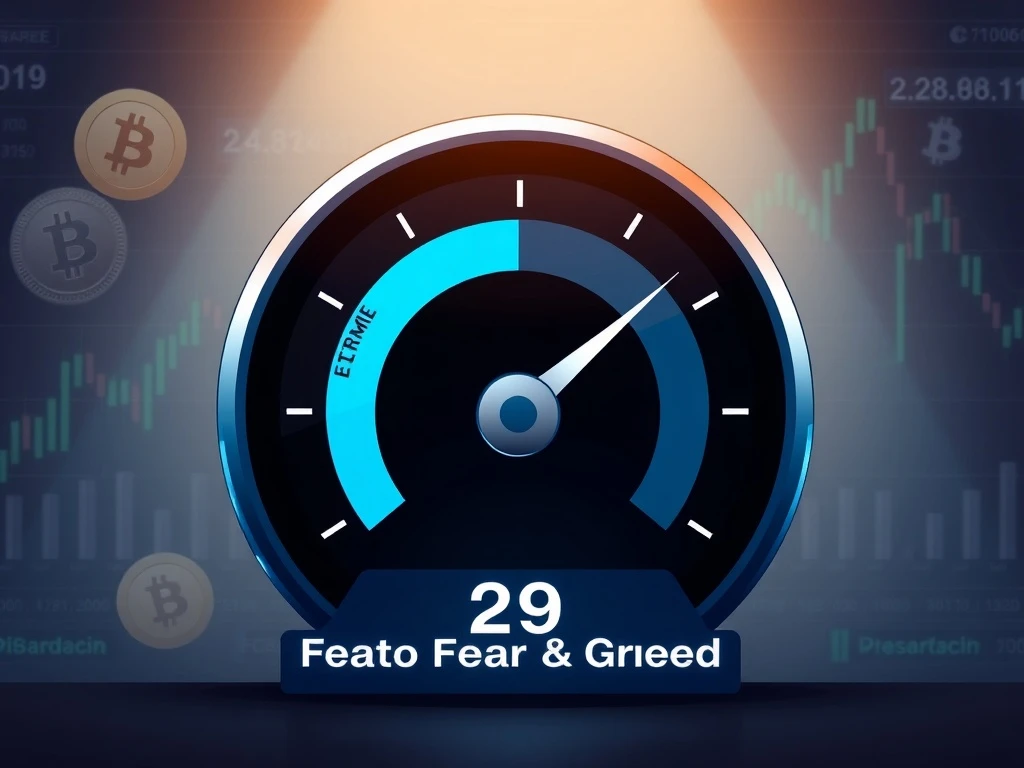
Global cryptocurrency markets witnessed a pivotal psychological shift this week as the widely monitored Crypto Fear & Greed Index climbed nine points to a reading of 29, decisively moving out of the ‘Extreme Fear’ zone for the first time in months. This crucial movement in the market sentiment indicator, reported by Alternative on April 10, 2025, provides a data-driven glimpse into evolving investor psychology following a prolonged period of market uncertainty. The index’s ascent from 20 to 29 represents more than a numerical change; it signals a potential inflection point in trader behavior and risk appetite across digital asset markets.
The Crypto Fear & Greed Index Exits Extreme Fear
Analysts and institutional investors closely track the Crypto Fear & Greed Index as a barometer for market emotion. The index operates on a scale from 0 to 100, where 0 signifies ‘Extreme Fear’ and 100 indicates ‘Extreme Greed.’ A reading of 29 firmly places the market in the ‘Fear’ category, but the nine-point jump from the previous day is the most significant single-day gain observed in the first quarter of 2025. This movement suggests a measurable reduction in panic selling and a tentative return of cautious optimism. Historically, sustained exits from ‘Extreme Fear’ have preceded periods of price consolidation and, in some cases, the early stages of recovery rallies, making this shift a key development for portfolio strategists.
Market data from leading exchanges corroborates the sentiment shift. For instance, aggregate spot trading volume across major platforms increased by approximately 15% in the 24 hours preceding the index’s publication. Furthermore, the volatility of major assets like Bitcoin (BTC) and Ethereum (ETH), a key component of the index’s calculation, showed a noticeable contraction. This combination of higher volume and lower volatility often indicates a transition from reactive, emotion-driven trading to more deliberate, value-based accumulation.
Deconstructing the Index: How Market Sentiment is Calculated
The Crypto Fear & Greed Index is not a simple survey; it is a composite metric derived from multiple real-time data sources. Understanding its components is essential for interpreting its movements accurately. The index’s calculation assigns specific weights to six primary factors, creating a holistic view of market psychology.
- Volatility (25%): This measures the magnitude and frequency of price swings. High volatility typically correlates with fear, while low volatility suggests stability or complacency. The recent decline in volatility contributed positively to the index’s rise.
- Market Volume (25%): This assesses the momentum and strength of market movements. Rising volume on upward price moves is a sign of greed, while high volume on downtrends indicates fear. The recent volume trends suggest a balance is being restored.
- Social Media Sentiment (15%): Algorithms analyze the tone and volume of discussions on platforms like Twitter and Reddit. A surge in positive mentions can lift the index.
- Surveys (15%): Periodic polls of the retail and professional investor community provide direct insight into prevailing moods.
- Bitcoin Dominance (10%): This metric tracks Bitcoin’s share of the total cryptocurrency market capitalization. A rising dominance often signals a ‘flight to safety’ during fearful periods, as investors retreat to the most established asset.
- Google Trends (10%): Search volume for terms like ‘Bitcoin crash’ or ‘crypto bull market’ offers a window into mainstream public interest and concern.
The equal weighting of volatility and volume (25% each) underscores their importance as foundational market health indicators. The improvement in these two areas was likely the primary driver behind the index’s significant jump to 29.
Historical Context and Expert Analysis of Sentiment Shifts
To appreciate the significance of moving from ‘Extreme Fear’ to ‘Fear,’ one must examine historical patterns. For example, during the market trough in late 2022, the index spent consecutive weeks in ‘Extreme Fear’ (often below 20), which coincided with the capitulation phase of the bear market. Conversely, the index hovered in ‘Greed’ and ‘Extreme Greed’ territories above 75 during the market peaks of late 2021. The current reading of 29, while still indicating fear, aligns with levels seen at the beginning of past recovery cycles.
Financial behavioral analysts note that markets often bottom when sentiment is most pessimistic. The exit from ‘Extreme Fear’ can therefore be interpreted as the first sign that the peak of pessimism may have passed. However, experts consistently warn that the index is a contrarian indicator at its extremes. Prolonged ‘Extreme Greed’ can signal an overbought market ripe for a correction, while protracted ‘Extreme Fear’ can indicate a potential buying opportunity for long-term investors. The current shift suggests the market is moving away from an extreme, potentially reducing the contrarian ‘buy’ signal and entering a phase where fundamentals may reassert their influence on prices.
Broader Market Impacts and Trader Psychology in 2025
The rise of the Crypto Fear & Greed Index to 29 occurs within a specific 2025 market context. Regulatory clarity in several major jurisdictions has improved, institutional adoption through spot Bitcoin ETFs has matured, and blockchain infrastructure has continued to develop independently of price action. These fundamental improvements create a backdrop where positive sentiment can find stronger footing than in previous cycles. The sentiment shift may influence derivative markets, where funding rates and open interest often correlate with fear and greed readings. A move out of ‘Extreme Fear’ could lead to a normalization of funding rates, making leveraged positions less costly and potentially encouraging more market participation.
Furthermore, on-chain data from analytics firms like Glassnode and CryptoQuant provides a parallel narrative. Metrics such as Exchange Net Flow (the movement of assets to and from exchanges), the Spent Output Profit Ratio (SOPR), and the proportion of illiquid supply all offer complementary views on holder behavior. Preliminary analysis of these datasets for early April 2025 shows a decrease in coins moving to exchanges (reducing sell-side pressure) and an increase in coins being moved at a profit, aligning with the improved sentiment captured by the Fear & Greed Index. This convergence of on-chain and sentiment data strengthens the case for a meaningful change in market dynamics.
Conclusion
The Crypto Fear & Greed Index’s rise to 29 marks a definitive exit from the ‘Extreme Fear’ zone, offering a quantifiable signal of changing investor psychology. This shift, driven by improvements in market volatility, trading volume, and social sentiment, provides crucial context for the current state of cryptocurrency markets in 2025. While the index remains firmly in ‘Fear’ territory, its upward trajectory suggests a reduction in panic and a move toward a more balanced, albeit cautious, market environment. Investors and analysts will monitor whether this improvement consolidates into a sustained trend or proves temporary, but the break above the extreme fear threshold itself is a noteworthy event for market structure and participant behavior.
FAQs
Q1: What does a Crypto Fear & Greed Index reading of 29 mean?
A reading of 29 places the market in the ‘Fear’ category. It indicates that while negative sentiment and caution still dominate, the extreme panic and pessimism associated with the ‘Extreme Fear’ zone (0-24) have subsided.
Q2: How often is the Crypto Fear & Greed Index updated?
The index is updated daily, typically once per 24-hour period, using the most recent available data for its six component metrics.
Q3: Is the Fear & Greed Index a reliable trading indicator?
The index is best used as a supplementary tool for understanding market psychology, not a standalone trading signal. It is most informative at its extremes (below 25 or above 75) as a potential contrarian indicator.
Q4: What is the difference between ‘Fear’ and ‘Extreme Fear’ on the index?
‘Extreme Fear’ (0-24) suggests widespread panic, potential capitulation selling, and high levels of negative sentiment. ‘Fear’ (25-49) indicates prevailing caution and risk aversion, but without the same intensity of panic-driven behavior.
Q5: Can the index predict future cryptocurrency prices?
No single indicator can reliably predict future prices. The Fear & Greed Index reflects current sentiment, which is just one factor among many—including fundamentals, macroeconomics, and regulation—that influence asset prices over time.
Related News
- Robert Kiyosaki Gold Prediction: Bold $27,000 Forecast Follows $5,000 Breakout
- PENDLE Token Mystery: Team-Linked Address Sparks Concern with $3.5M Binance Deposit
- Ethereum Whale’s Astounding $248M Gemini Deposit After 9-Year Dormancy Unlocks 32x Profit