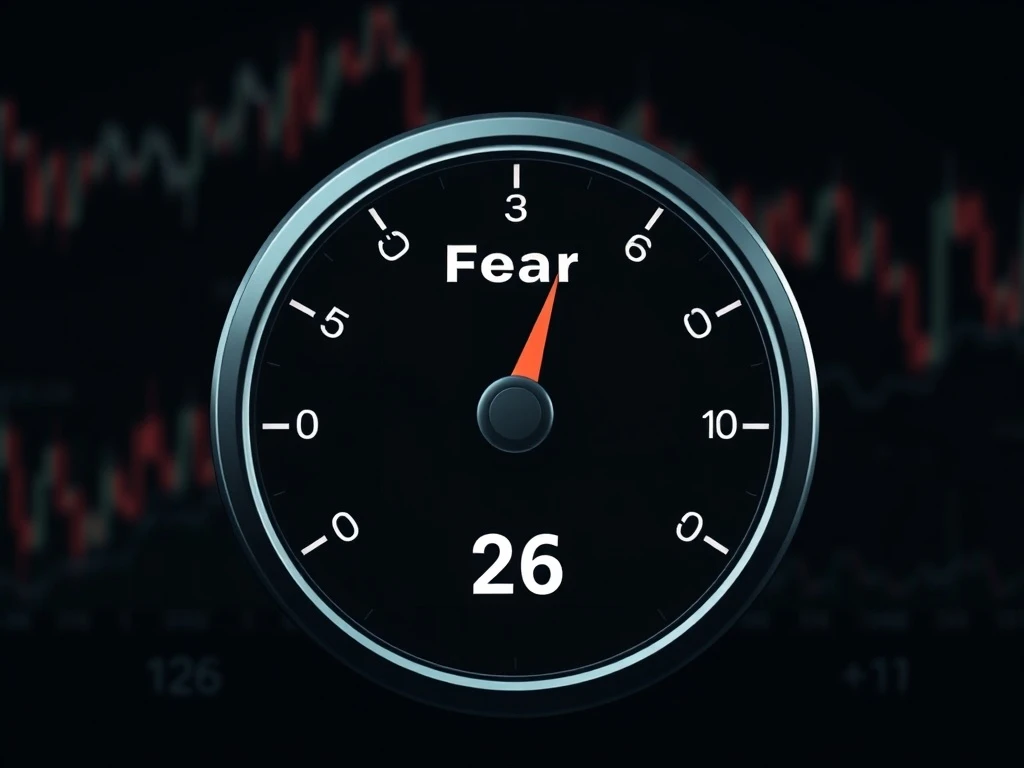
The cryptocurrency market often moves with significant emotional swings. Understanding these shifts is crucial for investors. Recently, the Crypto Fear & Greed Index dropped to 26. This score places the market firmly in the ‘Fear’ category. This shift indicates a prevailing cautious mood among participants. Consequently, many investors are wondering about the immediate implications. Such a low reading suggests widespread apprehension across the digital asset landscape. Therefore, analyzing this metric provides valuable insights into current market psychology.
Understanding the Crypto Fear & Greed Index
The Crypto Fear & Greed Index is a unique tool. It helps gauge overall crypto market sentiment. Data provider Alternative compiles this index daily. It uses a scale from 0 to 100. A score of 0 signifies ‘Extreme Fear.’ Conversely, a score of 100 represents ‘Extreme Greed.’ The index blends several key market factors. This provides a comprehensive view of investor emotions. Currently, a score of 26 reflects a significant level of apprehension. This level of fear often precedes important market shifts. Thus, paying attention to this index is essential for informed decision-making.
The index incorporates six distinct factors. Each factor contributes differently to the final score. These components include:
- Volatility (25%): This measures current price fluctuations. It compares them to average values. High volatility often signals a fearful market.
- Market Volume (25%): Trading volume provides liquidity data. Low volume during price drops can suggest fear. High volume during rallies may indicate greed.
- Social Media Mentions (15%): This analyzes keywords and sentiment. It scans various social media platforms. Negative sentiment online contributes to fear.
- Surveys (15%): Polling investors directly offers a direct sentiment snapshot. This component offers a qualitative measure.
- Bitcoin Dominance (10%): Bitcoin’s share of the total crypto market cap is vital. Increasing dominance often suggests fear. Investors typically move to safer assets like Bitcoin during uncertainty.
- Google Search Trends (10%): Search queries for terms like ‘Bitcoin price manipulation’ or ‘crypto crash’ reveal fear. Conversely, searches for ‘how to buy crypto’ might signal greed.
Each component offers a unique perspective. Together, they form a robust indicator. This holistic approach captures the complex nature of market psychology. Therefore, the index provides a more balanced view than single metrics. Ultimately, it aims to prevent emotional investment choices.
Decoding Current Crypto Market Sentiment
A reading of 26 indicates sustained crypto market sentiment in the ‘Fear’ zone. This is a three-point drop from yesterday. Such a decline reinforces the existing apprehension. When the index registers ‘Fear,’ investors typically become very cautious. They might sell assets to avoid further losses. This behavior can create a downward spiral. However, seasoned investors often view these periods differently. They remember the adage: ‘Be fearful when others are greedy, and greedy when others are fearful.’ This sentiment suggests potential buying opportunities. Consequently, understanding the underlying reasons for this fear becomes paramount. It helps differentiate between temporary dips and more significant downturns. Therefore, a deeper analysis of market drivers is always recommended.
Several factors likely contribute to this pervasive fear. Macroeconomic uncertainties play a significant role. Global inflation concerns continue to impact markets. Interest rate hikes by central banks also weigh heavily. Regulatory crackdowns in various regions add to the pressure. Furthermore, specific crypto-related news can amplify fear. For instance, major hacks or project failures erode confidence. These events combine to create a climate of apprehension. Investors react to these external pressures. Their collective response then manifests in the index. Thus, the index serves as a barometer for these combined forces. Monitoring these external factors helps contextualize the index’s reading. It offers a more complete picture of the market’s current state. This allows for more informed strategic decisions.
The Impact of Bitcoin Sentiment on the Broader Market
Bitcoin sentiment plays a crucial role in the wider cryptocurrency ecosystem. Bitcoin remains the largest cryptocurrency by market capitalization. Its price movements often dictate the direction of altcoins. When Bitcoin experiences significant price drops, altcoins typically follow. This is due to its dominant position. The Fear & Greed Index dedicates 10% of its calculation to Bitcoin dominance. An increase in Bitcoin dominance during a market downturn often signals fear. Investors move capital from riskier altcoins into Bitcoin. They perceive Bitcoin as a relatively safer store of value. This flight to quality reflects a defensive posture. It indicates a lack of confidence in smaller, more volatile assets. Consequently, a strong negative sentiment surrounding Bitcoin can drag the entire market down. Therefore, monitoring Bitcoin’s health is paramount for overall market understanding.
Historical data often supports this observation. Periods of extreme fear in Bitcoin have coincided with broader market corrections. Conversely, strong positive Bitcoin sentiment can lift the entire market. This interconnectedness highlights Bitcoin’s foundational role. Its performance is often seen as a bellwether for the industry. Traders and investors closely watch Bitcoin’s price action. They also monitor news and developments related to it. Any significant negative news about Bitcoin can quickly translate into increased market fear. This effect cascades through other cryptocurrencies. Therefore, the current low index reading likely reflects a challenging period for Bitcoin. It suggests that even the market leader is facing strong headwinds. Understanding this dynamic is key to navigating the current climate. It allows for better anticipation of market trends.
Navigating Periods of Intense Market Fear
Periods of intense market fear can be challenging for investors. Emotional responses often lead to poor decisions. Many investors panic sell during downturns. This behavior can lock in losses. However, these times also present opportunities. Savvy investors often prepare for such scenarios. They develop strategies to mitigate risks. One common approach is dollar-cost averaging (DCA). This involves investing a fixed amount regularly. It averages out the purchase price over time. DCA helps reduce the impact of volatility. It removes the need to time the market perfectly. Consequently, investors can accumulate assets at lower prices during fearful periods. This strategy requires discipline and a long-term perspective. It helps to avoid impulsive decisions driven by fear. Therefore, a structured investment plan is vital.
Another crucial strategy involves thorough research. During market fear, many projects become undervalued. Identifying strong projects with solid fundamentals is key. Investors should focus on:
- Utility: Does the project solve a real problem?
- Team: Is the development team experienced and reputable?
- Community: Does it have an active and engaged community?
- Roadmap: Is there a clear and achievable development plan?
Analyzing these aspects helps separate viable projects from speculative ones. Furthermore, maintaining a diversified portfolio is essential. Spreading investments across different assets reduces overall risk. This includes both crypto and traditional assets. Ultimately, a well-thought-out strategy helps investors navigate market fear more effectively. It turns potential threats into opportunities for growth. Remaining calm and rational is always the best approach. It helps to avoid the pitfalls of emotional trading.
Historical Context of Cryptocurrency Sentiment Swings
The current low cryptocurrency sentiment is not unprecedented. The crypto market is inherently volatile. It has experienced numerous cycles of fear and greed. Understanding these historical patterns offers valuable perspective. For example, during the bear market of 2018, the index often hovered in ‘Extreme Fear.’ Similarly, the market saw significant fear in mid-2021 and throughout 2022. These periods were characterized by sharp price corrections. They also featured widespread investor capitulation. However, these downturns were often followed by periods of recovery. The market eventually rebounded. This cyclical nature is a hallmark of crypto. It reflects the industry’s rapid growth and evolving landscape. Therefore, viewing the current fear through a historical lens can be reassuring. It suggests that market corrections are a normal part of the cycle.
Conversely, periods of ‘Extreme Greed’ have also occurred. These often coincide with parabolic price rallies. During these times, the index can reach 80 or 90. Investors become overly optimistic. They might take on excessive risk. Such periods typically precede market corrections. The market tends to overcorrect in both directions. It swings from extreme optimism to extreme pessimism. This inherent volatility makes sentiment analysis crucial. The Fear & Greed Index provides a quantitative measure of these emotional swings. It helps investors identify potential turning points. Thus, recognizing these patterns allows for more strategic positioning. It helps avoid buying at market tops and selling at market bottoms. Learning from past cycles empowers better future decisions. It reinforces the importance of long-term vision over short-term fluctuations.
Beyond the Index: Other Sentiment Indicators
While the Crypto Fear & Greed Index is a powerful tool, other indicators also reflect cryptocurrency sentiment. Combining multiple data points provides a more robust analysis. For instance, funding rates on perpetual futures markets offer insights. Positive funding rates suggest bullish sentiment. Traders are willing to pay to keep long positions open. Negative funding rates indicate bearish sentiment. Traders pay to maintain short positions. Similarly, open interest in futures contracts can reveal market positioning. High open interest during a price decline might signal impending liquidations. This can further exacerbate fear. Therefore, these derivatives market metrics offer real-time sentiment data. They complement the broader view provided by the index. Integrating these indicators provides a more nuanced understanding. It helps to confirm or challenge the index’s reading.
On-chain metrics also provide valuable sentiment insights. Stablecoin inflows to exchanges can indicate buying pressure. Investors might be preparing to deploy capital. Conversely, large outflows could signal profit-taking or a move to self-custody. Exchange balances of Bitcoin and Ethereum also matter. Declining balances suggest investors are holding their assets. This indicates a long-term bullish outlook. Rising balances suggest potential selling pressure. Whales, or large holders, also influence sentiment. Tracking their movements can reveal significant shifts. Their accumulation or distribution patterns often precede major price changes. Ultimately, a holistic approach to sentiment analysis is best. Combining the Fear & Greed Index with these additional indicators creates a comprehensive picture. It allows investors to make more informed and strategic decisions. This multi-faceted analysis reduces reliance on single data points.
Strategies for Managing Risk During Market Fear
Effectively managing risk is paramount during periods of heightened market fear. Protecting capital becomes the top priority. One fundamental strategy involves setting clear stop-loss orders. These automatically sell an asset if its price drops to a predetermined level. This limits potential losses. However, flash crashes can sometimes trigger stop losses prematurely. Therefore, careful placement is crucial. Another approach is to reduce position sizes. Investing smaller amounts in volatile assets lowers exposure. This reduces the impact of adverse price movements. Diversification across different asset classes also spreads risk. It prevents over-reliance on a single asset or sector. Therefore, a balanced portfolio is often more resilient. It can better withstand market downturns. Implementing these risk management techniques helps safeguard investments.
Furthermore, maintaining a cash reserve is a wise strategy. This ‘dry powder’ allows investors to capitalize on buying opportunities. When prices drop significantly during market fear, having available capital is advantageous. It enables purchases at potentially discounted rates. This aligns with the ‘buy low’ principle. Regularly reviewing and rebalancing your portfolio is also important. This ensures your asset allocation remains consistent with your risk tolerance. Over time, certain assets may grow or shrink disproportionately. Rebalancing brings the portfolio back to its target allocation. Ultimately, a proactive approach to risk management is essential. It helps investors navigate the inherent volatility of the crypto market. It also fosters long-term financial health. Sound risk management is a cornerstone of successful investing. It prevents emotional decisions during turbulent times.
The Future of Cryptocurrency Sentiment
The current low cryptocurrency sentiment may persist for some time. However, market cycles are a fundamental aspect of finance. Periods of fear often pave the way for future growth. The crypto market continues to mature. Institutional adoption is growing. Regulatory frameworks are slowly developing. These factors could lead to more stable market conditions over time. Yet, volatility will likely remain a characteristic. Innovation in blockchain technology continues at a rapid pace. New use cases emerge constantly. This underlying technological progress drives long-term value. Therefore, while short-term sentiment may be fearful, the long-term outlook remains dynamic. Investors should focus on the fundamentals. They should also monitor broader economic trends. These elements will shape future market sentiment. Consequently, a balanced perspective is vital for navigating the evolving crypto landscape. It helps to differentiate between temporary fluctuations and fundamental shifts.
The interplay between fear and greed is a constant in financial markets. The Crypto Fear & Greed Index provides a valuable lens. It helps us understand where we stand in this emotional cycle. A score of 26 signals a challenging period. It calls for caution and strategic thinking. However, it also reminds us of potential opportunities. Historically, periods of extreme fear have often preceded significant recoveries. Therefore, remaining informed and disciplined is key. Investors who understand market psychology are better equipped. They can make rational decisions even when emotions run high. Ultimately, the crypto market rewards patience and a well-researched approach. It is crucial to remember that market sentiment is just one piece of the puzzle. It should always be considered alongside fundamental analysis. This comprehensive approach leads to more robust investment strategies.
Conclusion: Navigating the Fearful Crypto Market
The drop in the Crypto Fear & Greed Index to 26 clearly indicates a prevailing sense of market fear. This metric, encompassing volatility, volume, social media, surveys, Bitcoin dominance, and Google trends, offers a critical snapshot of current crypto market sentiment. While such low readings can be unsettling, they are a normal part of the volatile cryptocurrency cycle. Understanding the nuances of Bitcoin sentiment and its impact on the broader market is crucial. Investors should leverage this data to inform their strategies, focusing on disciplined approaches like dollar-cost averaging, thorough research, and robust risk management. Historically, periods of intense fear have often preceded market recoveries, suggesting that current low cryptocurrency sentiment might present long-term opportunities for well-prepared individuals. Maintaining a neutral, analytical perspective is paramount during these times.
Frequently Asked Questions (FAQs)
Q1: What does a Crypto Fear & Greed Index score of 26 mean?
A score of 26 on the Crypto Fear & Greed Index signifies ‘Fear.’ This indicates a prevailing cautious or apprehensive sentiment among cryptocurrency investors. It suggests many participants are selling or holding back from buying due to concerns about market stability.
Q2: How is the Crypto Fear & Greed Index calculated?
The index is calculated based on six factors: market volatility (25%), market volume (25%), social media mentions (15%), surveys (15%), Bitcoin’s market dominance (10%), and Google search trends (10%). Each factor contributes to a final score from 0 (Extreme Fear) to 100 (Extreme Greed).
Q3: Should investors buy when the Crypto Fear & Greed Index is in ‘Fear’ territory?
Periods of ‘Fear’ can present potential buying opportunities for long-term investors, aligning with the adage to be ‘greedy when others are fearful.’ However, this strategy carries risks. Investors should conduct thorough research, use dollar-cost averaging, and manage their risk carefully rather than acting solely on the index reading.
Q4: How does Bitcoin sentiment influence the overall crypto market?
Bitcoin, as the largest cryptocurrency, significantly influences the broader market. Its price movements and sentiment often dictate the direction of altcoins. When Bitcoin sentiment is fearful, investors tend to move capital out of altcoins, increasing Bitcoin’s dominance and often leading to wider market downturns.
Q5: What other indicators should investors consider alongside the Crypto Fear & Greed Index?
Investors should consider other metrics like funding rates on perpetual futures, open interest, and on-chain data (e.g., stablecoin inflows/outflows, exchange balances). Combining these indicators provides a more comprehensive view of market sentiment and potential trends.
Q6: Is a low Crypto Fear & Greed Index always a sign of a market bottom?
While historical data suggests that extreme fear often precedes market recoveries, a low index score is not a definitive signal of a market bottom. Markets can remain fearful for extended periods. It is one indicator among many and should be used as part of a broader analytical framework, not as a standalone predictor.
Related News
- Crypto Market Structure Framework: Ripple’s Hopeful Outlook as Senate Considers Landmark Legislation
- Crypto Money Laundering: Shocking $107.5M South Korean Plastic Surgery Scheme Exposed
- Aster Buyback Program Expands Dramatically, Allocating Up to 40% of Daily Fees to Token Value Enhancement