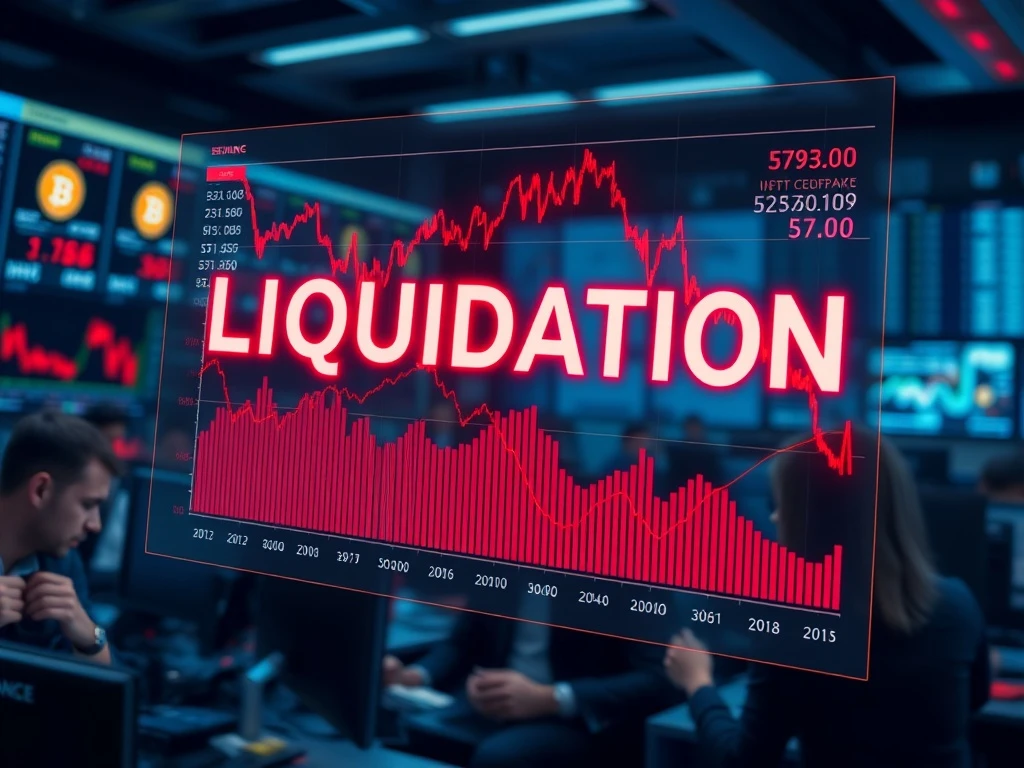
A sudden and severe wave of selling pressure has triggered a staggering $350 million worth of cryptocurrency futures liquidations within a single hour, according to real-time data from major derivatives exchanges on March 21, 2025. This intense activity underscores the extreme volatility and high-leverage risks prevalent in the digital asset markets, with total liquidations soaring past $1.05 billion over the preceding 24-hour period. Market analysts are now scrutinizing the catalysts behind this rapid deleveraging event and its potential implications for trader sentiment and short-term price direction.
Crypto Futures Liquidated in Historic Hourly Cascade
Data aggregation platforms tracking derivatives markets recorded a concentrated burst of forced position closures. These liquidations occur automatically when a trader’s margin balance falls below the maintenance requirement for their leveraged position. Consequently, exchanges sell the collateral to prevent further losses. The $350 million figure represents one of the most significant hourly liquidation clusters witnessed in recent months. Notably, a substantial majority of these liquidations, approximately 65%, were long positions. This indicates traders betting on price increases were caught off-guard by a sharp downward move. The scale of this event immediately reverberated across social trading forums and institutional chat rooms, highlighting the fragile nature of highly leveraged market structures.
Contextualizing the $1.05 Billion 24-Hour Liquidation Event
To fully grasp the severity of the hourly move, one must examine the broader 24-hour context. The cumulative $1.05 billion in liquidations points to a sustained period of market stress, not merely an isolated flash crash. Historical data from previous market cycles shows that liquidation clusters of this magnitude often coincide with major trend reversals or the climax of a volatile correction phase. For comparison, during the market downturn of June 2024, the largest single-hour liquidation event totaled approximately $280 million. Therefore, the current $350 million hourly wipeout signals an escalation in market volatility and leverage usage. This data is compiled from top-tier exchanges like Binance, Bybit, OKX, and Huobi, which collectively command over 80% of the global crypto derivatives volume.
The Mechanics and Market Impact of Mass Liquidations
Futures liquidations create a self-reinforcing feedback loop that can exacerbate price movements. When a large long position is liquidated, the exchange executes a market sell order. This selling pressure can push the price down further, potentially triggering the liquidation of other leveraged long positions at nearby price levels—a phenomenon known as a “liquidation cascade.” Conversely, mass short liquidations can fuel rapid price rallies. The recent event has significantly impacted estimated leverage ratios across exchanges, a key metric watched by risk managers. Furthermore, the funding rates for perpetual swap contracts, which had been positive, likely flipped negative during the sell-off, penalizing remaining long holders and incentivizing short positions.
Analyzing the Catalysts Behind the Sharp Sell-Off
While the liquidation data is a clear effect, identifying the proximate cause requires examining concurrent market events. Several potential triggers align with the timing of the sell-off. First, a larger-than-expected macroeconomic data release, such as inflation figures or central bank policy statements, can instantly reshape risk appetite across all asset classes, including crypto. Second, major movements in the spot market, potentially driven by a large over-the-counter (OTC) sell order or issues at a specific institution, can spill over into derivatives. Third, technical breakdowns below key support levels, watched by algorithmic and retail traders alike, can trigger automated sell orders. Finally, unexpected news regarding regulatory actions in a major jurisdiction can spark panic. Analysts are cross-referencing news timelines with the exact minute-by-minute price and liquidation data to pinpoint the primary catalyst.
Key metrics observed during the event included:
- Long/Short Ratio: A sharp drop, indicating a swift unwind of bullish bets.
- Open Interest: A notable decline, showing total capital committed to futures contracts decreased as positions were closed.
- Volatility Index: A dramatic spike, confirming extreme market fear and uncertainty.
Risk Management Lessons from High-Leverage Trading
Events like the $350 million liquidation hour serve as a stark reminder of the perils of excessive leverage. Professional traders emphasize several core principles to mitigate such risks. Using stop-loss orders at strategic levels, rather than relying solely on exchange liquidation engines, is considered fundamental. Moreover, maintaining conservative leverage multiples, especially in uncertain market conditions, can prevent margin calls during normal volatility. Diversifying across asset types and not over-allocating capital to a single leveraged position is another critical strategy. Finally, continuously monitoring overall market leverage and funding rates can provide early warning signs of overcrowded trades prone to sudden unwinds. Educational resources from exchanges now heavily focus on these concepts in response to past liquidation events.
Historical Precedents and Market Cycle Analysis
The cryptocurrency market has a documented history of violent liquidation events that often mark local tops, bottoms, or acceleration points in trends. For instance, the bull market peak in November 2021 was accompanied by multi-billion dollar liquidation days. Similarly, the collapse of the LUNA ecosystem in May 2022 triggered cascades that erased tens of billions in open interest. Analysts study these events to identify patterns in market structure sentiment. Currently, the ratio of liquidated volume to total market capitalization is a closely watched metric. While the absolute dollar value of $350 million is high, its relative impact compared to the total crypto market cap is less than similar events in 2022, suggesting a larger, more mature market that may be more resilient to single-point failures.
Conclusion
The liquidation of $350 million in crypto futures within one hour, contributing to a 24-hour total exceeding $1.05 billion, represents a significant volatility event that has reset leverage across the market. This episode highlights the inherent risks of derivative trading and the powerful feedback loops that liquidations can create. While the immediate cause is under investigation, the effect is clear: a rapid deleveraging that has forced a reevaluation of risk for many market participants. As the market digests this move, attention will turn to whether this represents a healthy clearing of overleveraged positions or the beginning of a broader corrective phase. Monitoring subsequent price action, changes in open interest, and trader sentiment will be crucial for understanding the longer-term implications of this substantial crypto futures liquidation event.
FAQs
Q1: What does “futures liquidated” mean in cryptocurrency?
A1: It means a trader’s leveraged futures position was forcibly closed by the exchange because their collateral (margin) fell below the required level to maintain the trade. The exchange sells the position to prevent further losses, often at a loss to the trader.
Q2: Why did $350 million in liquidations happen so quickly?
A2: Rapid price movements, especially downward moves against leveraged long positions, can trigger a cascade. As one large position is liquidated, its market sell order pushes the price down, triggering more liquidations at successively lower prices in a short timeframe.
Q3: Are futures liquidations bad for the overall crypto market?
A3: They can increase short-term volatility and cause sharp price swings. However, they can also be seen as “resetting” excessive leverage in the system, which some analysts believe is necessary for healthier long-term price discovery, though painful in the moment.
Q4: How can traders protect themselves from being liquidated?
A4: Key strategies include using lower leverage multiples, setting prudent stop-loss orders manually, maintaining adequate margin buffer above exchange requirements, and avoiding over-concentration in a single, highly leveraged trade.
Q5: Where does the data for futures liquidations come from?
A5: The data is aggregated from public APIs and on-chain settlement information provided by major cryptocurrency derivatives exchanges like Binance, Bybit, and OKX. Independent analytics platforms like Coinglass and Bybt compile and display this data in real-time.
Related News
- Bitcoin Whale’s Stunning Daily Accumulation: Bitfinex Address Buys 450 BTC Matching Entire Mining Output
- CFTC Crypto Oversight Faces Alarming Capacity Crisis as Staff Cuts Collide with Expanding Mandate
- CFTC’s ‘Future-Proof’ Initiative Sparks Unprecedented Bullish Momentum for Digital Assets