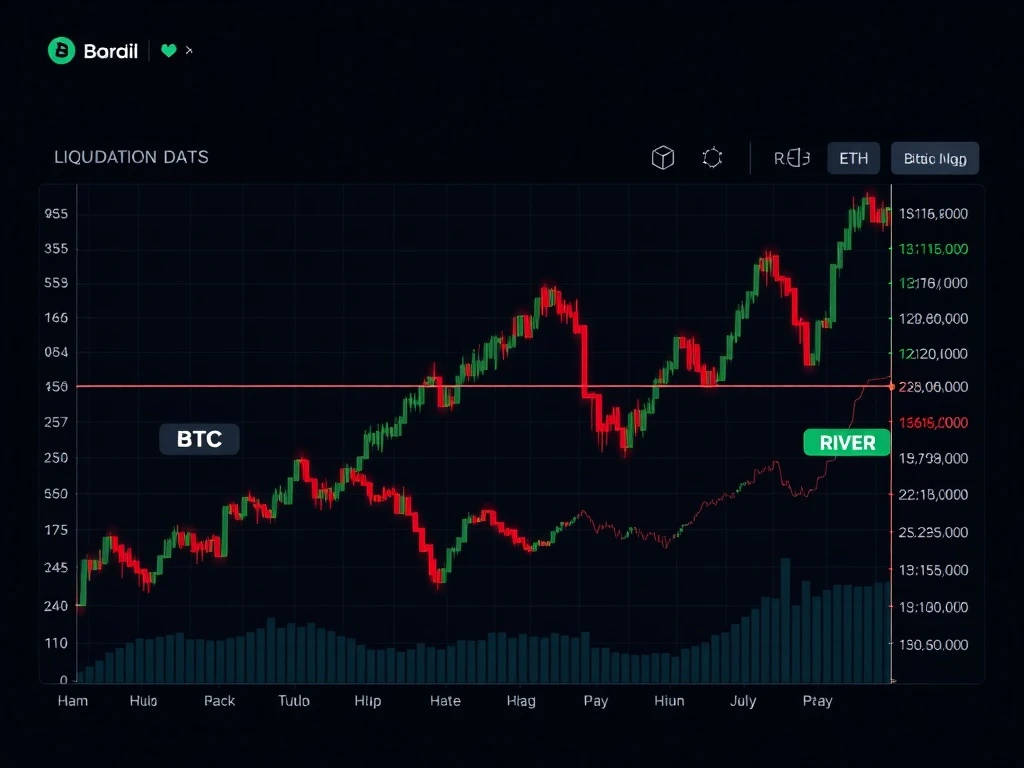
Global cryptocurrency markets witnessed significant forced position closures over the past 24 hours, with total perpetual futures liquidations surpassing $69 million. This substantial liquidation event, primarily impacting long positions on major assets like Bitcoin (BTC) and Ethereum (ETH), serves as a critical reminder of the inherent risks within leveraged derivatives trading. Consequently, traders and analysts are scrutinizing the underlying market mechanics and broader sentiment shifts driving this volatility.
Decoding the $69.69M Crypto Perpetual Futures Liquidations Event
The cryptocurrency derivatives landscape experienced a pronounced shakeout. According to aggregated data from major exchanges, total liquidations across perpetual futures contracts reached approximately $69.69 million. Perpetual futures, unlike traditional futures, lack an expiry date. They utilize a funding rate mechanism to tether their price to the underlying spot market. Traders employ significant leverage in these instruments, amplifying both potential gains and losses. When a position’s maintenance margin is breached due to adverse price movement, exchanges automatically close it—a process known as liquidation. This recent wave of liquidations provides a clear snapshot of prevailing market forces and trader positioning.
Specifically, the data reveals a stark divergence in trader sentiment across different assets. Bitcoin, the market leader, accounted for the lion’s share of the activity. Meanwhile, Ethereum followed a similar pattern, though with slightly different proportions. Interestingly, some altcoins like RIVER presented a contrasting picture, where short sellers faced the brunt of the forced closures. This dichotomy highlights the nuanced and often asset-specific nature of market movements within the crypto ecosystem.
Bitcoin and Ethereum Lead Long Position Unwind
Bitcoin perpetual futures saw $41.59 million in liquidations, representing the single largest contributor to the day’s total. A dominant 89.52% of these liquidations were long positions. This overwhelming skew indicates that a sharp price decline triggered most of the forced selling. Traders who had bet on Bitcoin’s price rising with leveraged positions found their collateral liquidated as the market moved against them. Such a high concentration of long liquidations often acts as a contrarian indicator, potentially signaling a localized capitulation event that can precede a price stabilization or reversal.
Similarly, Ethereum recorded $18.95 million in liquidated contracts. Within this figure, long positions constituted 73.11%. While still a majority, this percentage is notably lower than Bitcoin’s, suggesting a marginally more balanced—though still bearish—pressure on ETH derivatives. The correlation between BTC and ETH liquidation events is common, as Ethereum often moves in sympathy with Bitcoin’s broader market trends. However, the variance in the long/short ratio can reflect differing fundamental narratives or technical levels specific to each asset’s trading charts.
| Asset | Total Liquidations | Long Liquidations | Short Liquidations | Dominant Side |
|---|---|---|---|---|
| Bitcoin (BTC) | $41.59M | 89.52% | 10.48% | Long |
| Ethereum (ETH) | $18.95M | 73.11% | 26.89% | Long |
| RIVER | $9.15M | 43.09% | 56.91% | Short |
The Mechanics and Market Impact of Forced Liquidations
Liquidation events are not merely a record of trader losses; they actively influence market dynamics. The process creates a self-reinforcing cycle: as prices fall and leveraged long positions get liquidated, the exchange’s automatic sell orders hit the order book. This selling pressure can drive the price down further, potentially triggering additional liquidations at lower price points—a phenomenon known as a “liquidation cascade” or “long squeeze.” Conversely, a wave of short liquidations can fuel a rapid price rally. Therefore, monitoring liquidation levels is a crucial part of risk management for both institutional and retail participants. Major analytics platforms now track aggregate liquidation heatmaps, identifying potential price levels where a high concentration of leveraged positions may become vulnerable.
RIVER Defies Trend with Short-Led Liquidations
In a notable contrast to the top two cryptocurrencies, the asset identified as RIVER experienced $9.15 million in liquidations with a majority of 56.91% coming from short positions. This indicates that RIVER’s price action likely moved upward sharply, catching leveraged short sellers—those betting on a price decline—off guard. Such a scenario is often called a “short squeeze.” When an asset with a high level of short interest begins to rise, short sellers are forced to buy back the asset to close their positions, which further accelerates the upward price move and triggers more liquidations.
This divergence underscores a key principle: market sentiment is not monolithic. While broad market fear may trigger long liquidations in Bitcoin and Ethereum, individual altcoins can experience isolated rallies due to project-specific news, exchange listings, or coordinated community action. Analysts must therefore examine liquidation data on an asset-by-asset basis to gain a complete picture of derivative market stress. The RIVER example serves as a warning against overgeneralization from flagship asset data alone.
Historical Context and Risk Management Imperatives
The recent $69.69 million liquidation event, while significant, pales in comparison to historical extremes. For instance, during the market turmoil of May 2021 and June 2022, single-day liquidation volumes regularly exceeded $2 billion. These episodes provided harsh lessons on the dangers of excessive leverage. In response, many leading exchanges have proactively implemented risk-reduction features. These include:
- Isolated Margin Mode: Limits potential loss to the funds allocated to a specific position.
- Multi-Tier Maintenance Margin: Increases the margin requirement for larger positions, reducing systemic risk.
- Auto-Deleveraging (ADL) Protection: Some platforms use insurance funds to cover losses before liquidating other traders’ positions.
Despite these safeguards, the fundamental risk remains. Traders must understand that leverage is a double-edged sword. Professional trading desks consistently emphasize position sizing and the use of stop-loss orders over relying solely on exchange liquidation engines. Furthermore, the volatility inherent to crypto assets means that price swings capable of wiping out highly leveraged positions can occur within minutes, often outside of traditional market hours.
Expert Perspective on Derivatives Market Health
Market analysts often view liquidation clusters as a measure of market froth and leverage saturation. A high volume of long liquidations, as seen with BTC and ETH, can indicate that bullish sentiment had become overextended. Subsequently, the market performed a necessary correction by flushing out overleveraged positions. This process can create healthier foundations for future price movements by removing weak hands. However, sustained high liquidation volumes can also signal underlying market weakness or panic. Therefore, context from spot market volumes, macroeconomic factors, and on-chain data is essential for accurate interpretation. The current event, absent of a multi-billion dollar cascade, suggests a routine market correction rather than a structural breakdown.
Conclusion
The analysis of the past 24 hours of crypto perpetual futures liquidations reveals a market correcting excess leverage, particularly on the long side for Bitcoin and Ethereum. The total of $69.69 million, while notable, represents a controlled recalibration within the volatile derivatives sphere. The contrasting data from RIVER further illustrates the complex and segmented nature of cryptocurrency markets. Ultimately, these events reinforce the critical importance of prudent risk management, appropriate leverage use, and continuous education for all participants in the digital asset ecosystem. As the market evolves, understanding the flow and impact of liquidation events remains a vital skill for navigating the future of crypto trading.
FAQs
Q1: What are perpetual futures in cryptocurrency?
A1: Perpetual futures are derivative contracts that allow traders to speculate on an asset’s future price without an expiration date. They use a funding rate mechanism to periodically exchange payments between long and short holders, keeping the contract price aligned with the underlying spot market price.
Q2: What causes a liquidation in crypto futures trading?
A2: A liquidation occurs when a trader’s position loses enough value that their remaining collateral (margin) falls below the exchange’s required maintenance level. The exchange then automatically closes the position to prevent further losses, often resulting in the total loss of the trader’s initial margin.
Q3: Why were most Bitcoin liquidations long positions?
A3: The data indicates Bitcoin’s price dropped significantly. Traders using leverage to bet on a price increase (long positions) saw their equity decline. When the loss reached their maintenance margin threshold, their positions were forcibly closed, creating a cascade of sell orders.
Q4: How can traders avoid being liquidated?
A4: Traders can mitigate liquidation risk by using lower leverage, employing isolated margin mode to limit loss to specific capital, setting prudent stop-loss orders, continuously monitoring positions, and maintaining a healthy margin balance above exchange requirements.
Q5: Do large liquidation events like this signal a market bottom or top?
A5: While not a perfect indicator, a large cluster of long liquidations can sometimes signal a local capitulation, where excessive optimism is purged from the market. This can precede a short-term price bounce. However, it should not be used in isolation; broader technical and fundamental analysis is required for accurate market timing.
Related News
- Binance Delisting Shakeup: Strategic Removal of BID, DMC, ZRC, TANSSI Perpetual Futures Contracts
- Strategic Shift: Canada’s Calculated Economic Pivot Toward China Signals New Global Alignment
- Coinbase Listing Roadmap Expands with Strategic SKR and FIGHT Token Additions