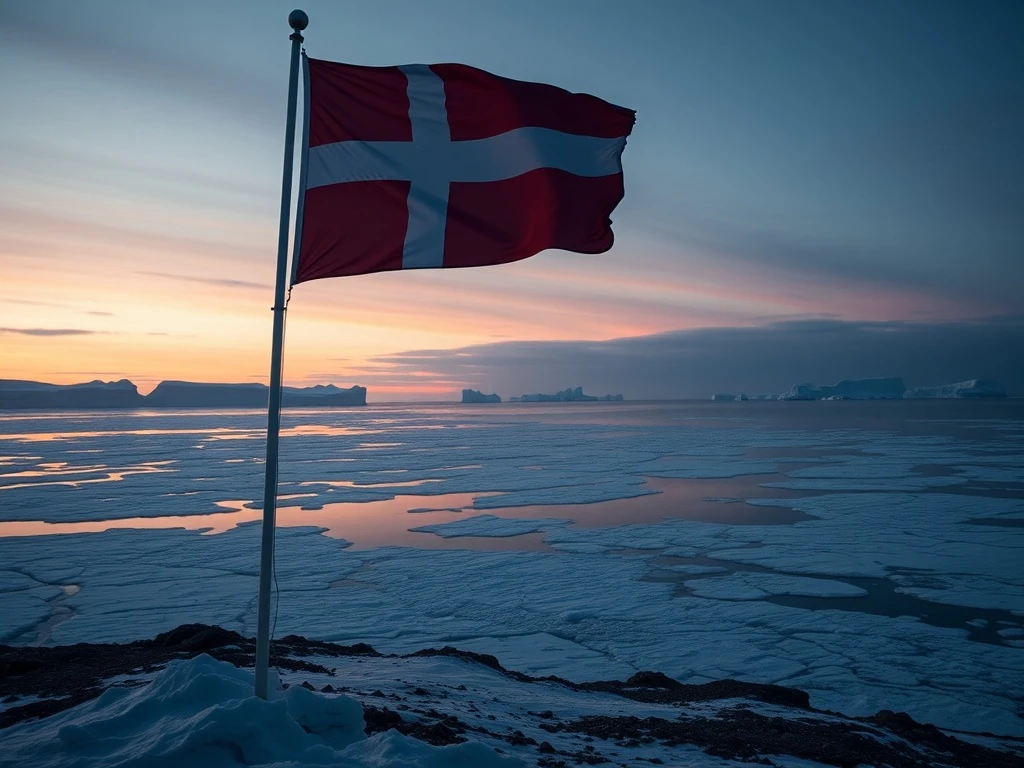
COPENHAGEN, Denmark – In a definitive diplomatic move, Danish Foreign Minister Lars Løkke Rasmussen has formally rejected a request from U.S. President Donald Trump to initiate negotiations for the acquisition of Greenland. This stunning rejection, reported by Walter Bloomberg, directly counters President Trump’s public statements at the World Economic Forum in Davos, Switzerland, where he framed the potential purchase as a strategic necessity. Consequently, this development marks a significant moment in Arctic geopolitics and transatlantic relations.
Greenland Acquisition Proposal Meets Firm Danish Rejection
The core of this geopolitical event centers on a rejected proposal. President Trump, during the annual Davos meeting, asserted that the United States uniquely possesses the capability to protect and develop Greenland. He framed this not as an act of expansion but as a beneficial arrangement for both Europe and the U.S. Furthermore, he explicitly stated his administration was pursuing negotiations and would not resort to force. However, Foreign Minister Rasmussen’s swift rejection underscores a fundamental principle: Greenland is not for sale. This position is rooted in Denmark’s constitutional responsibility for Greenland’s foreign and security policy, despite the island’s extensive self-rule. The Danish response highlights the complex sovereignty arrangements that define the Kingdom of Denmark.
Historical Context and Strategic Arctic Calculations
This is not the first time the United States has expressed interest in Greenland. In 1946, President Harry S. Truman offered Denmark $100 million in gold for the territory, an offer that was similarly rejected. Historically, the U.S. strategic interest has focused on Greenland’s geographic position. For instance, Thule Air Base, America’s northernmost military installation, has been a critical asset for missile warning and space surveillance since the Cold War. Today, melting Arctic ice is opening new shipping routes and access to vast natural resources, including:
- Rare earth elements: Crucial for modern electronics and green technology.
- Hydrocarbon reserves: Significant untapped oil and gas potential.
- Strategic waterways: The emerging Northern Sea Route.
Therefore, the U.S. interest is part of a broader, intensifying competition for influence in the Arctic involving Russia, China, Canada, and Nordic states.
Expert Analysis on Sovereignty and Diplomacy
Geopolitical analysts emphasize that Denmark’s rejection was inevitable. “The notion of selling a sovereign territory and its people in the 21st century is anachronistic,” stated Dr. Anja Dalgaard-Nielsen, a senior fellow at the Danish Institute for International Studies. “This episode, however, reveals a deeper tension between great-power realpolitik and the norms of modern international law and self-determination.” The government of Greenland, which controls mineral rights and domestic policy, has also consistently opposed any discussion of a sale, viewing it as a direct challenge to its ongoing path toward greater independence. The table below outlines key stakeholder positions:
| Stakeholder | Primary Position | Key Concern |
|---|---|---|
| Government of Denmark | Absolute rejection of sale | Upholding national sovereignty and constitutional duty |
| Government of Greenland | Opposition to transfer of sovereignty | Self-determination and control over resources |
| United States Administration | Strategic acquisition for development | Geopolitical positioning and resource security |
| Arctic Council Members | Monitoring for stability implications | Maintaining cooperative regional governance |
Immediate Impacts and Long-Term Ramifications
The immediate impact is a diplomatic chill. The rejection is a rare public rebuke between NATO allies. It may temporarily strain defense and intelligence cooperation, particularly regarding Thule Air Base. In the long term, this event will likely accelerate two key trends. First, Greenland will pursue deeper economic and political ties with other partners, potentially including the European Union and Asian investors, to diversify away from reliance on Denmark and the U.S. Second, the U.S. may increase pressure through alternative means, such as expanding investment in Greenlandic mining projects or enhancing its military and scientific presence on the island under existing agreements. Ultimately, the episode signals that the era of territorial transactions is over, replaced by a complex game of economic influence and strategic partnership in the High North.
Conclusion
The Danish rejection of the Greenland acquisition proposal is a landmark event with profound implications. It reinforces the primacy of sovereignty and self-determination in contemporary international relations. Moreover, it exposes the growing strategic friction in the Arctic as climate change reshapes the geopolitical landscape. While the proposal for a Greenland acquisition has been firmly closed, the underlying competition for influence in the region is only intensifying, setting the stage for continued diplomatic and economic maneuvering among global powers.
FAQs
Q1: Has the US tried to buy Greenland before?
A1: Yes. In 1946, President Harry S. Truman’s administration offered Denmark $100 million for Greenland. Denmark rejected that offer, just as it has rejected the recent proposal.
Q2: Does Greenland want to be part of the United States?
A2: No. The government of Greenland and its population have consistently expressed a desire for greater independence from Denmark, not a transfer of sovereignty to another power.
Q3: Why is Greenland strategically important?
A3: Greenland’s importance stems from its location in the Arctic, which controls emerging shipping routes, its vast untapped mineral resources (including rare earth elements), and the presence of Thule Air Base, a key U.S. military installation.
Q4: Who makes decisions about Greenland’s future?
A4: Greenland has self-rule over most domestic affairs, including resource management. Denmark retains control over foreign policy, security, and defense. Any change to sovereignty would require consent from both governments and likely a referendum in Greenland.
Q5: What is the status of Thule Air Base after this rejection?
A5: Thule Air Base operates under a 1951 defense agreement between Denmark and the U.S. The rejection of the purchase proposal does not directly affect this agreement, but it may influence future negotiations regarding the base’s role and scope.
Related News
- Bitcoin Plummets: $490M ETF Exodus Erases 2026 Gains, Tests Critical $80K Support
- Federal Reserve Independence: Governor Lisa Cook’s Crucial Pledge to Defend Central Bank Autonomy
- Bitcoin Price Prediction: Compass Point’s Crucial Warning Against Premature Dip-Buying Until $98K Breakout