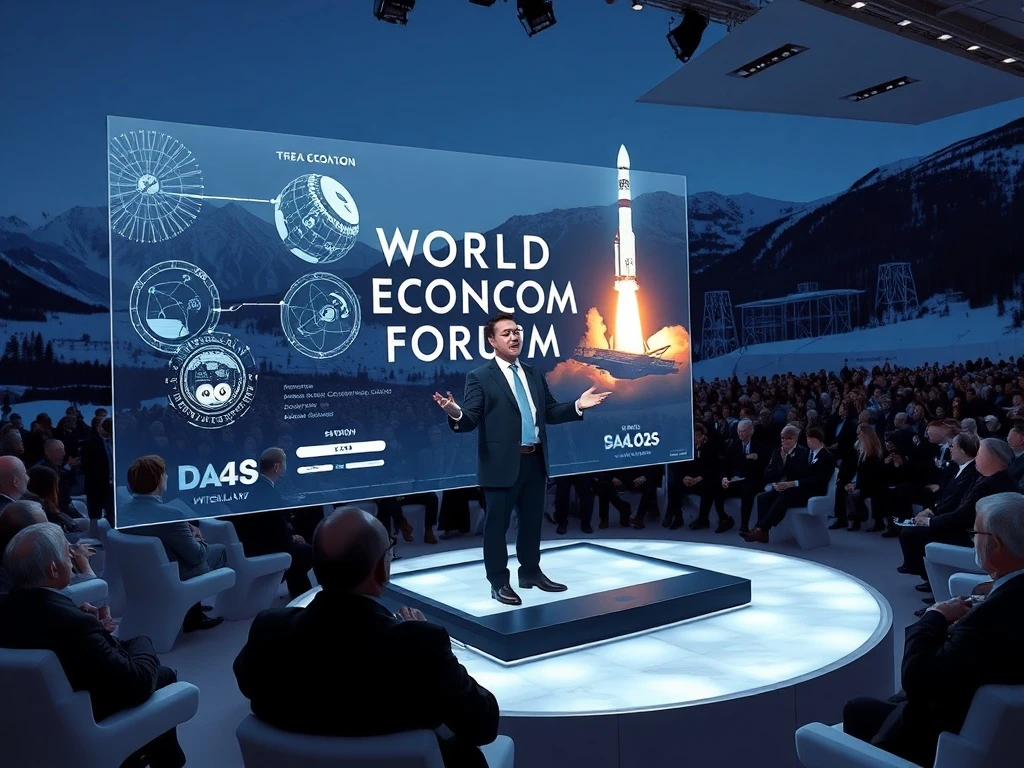
DAVOS, SWITZERLAND – JANUARY 22, 2025: In a keynote address that captivated global leaders, Elon Musk outlined a stunning vision for the next decade. The Tesla and SpaceX CEO asserted that converging technologies in artificial intelligence, advanced robotics, and space exploration will fundamentally redefine the structure of the global economy. His presentation at the World Economic Forum’s annual meeting provided a concrete, albeit disruptive, roadmap for economic evolution.
Elon Musk Davos 2025: The Core Thesis on Economic Redefinition
Elon Musk framed his argument around a simple, powerful premise. He stated that current economic models remain largely terrestrial and labor-intensive. Consequently, they fail to account for three imminent technological leaps. First, artificial intelligence will achieve general problem-solving capabilities within years. Second, humanoid robots will enter mass production, performing tasks across industries. Third, rapidly reusable spaceflight will make orbital and lunar industrialization economically viable. Musk emphasized these are not separate trends. Instead, they form a synergistic triad that will dismantle and rebuild global value chains.
The Historical Context and Musk’s Track Record
Analysts often contextualize Musk’s predictions against his execution history. For instance, he revolutionized the automotive sector with electric vehicles. Similarly, he reduced space launch costs by a factor of ten with reusable rockets. Therefore, his forecasts at forums like Davos carry significant weight. The World Economic Forum itself has long tracked these technologies on its Global Risks Report. However, Musk’s integration of them into a single economic narrative marked a departure from typical sector-specific discussions. His speech provided specific timelines, suggesting tangible inflection points for policymakers and investors.
The AI Imperative: From Assistant to Economic Architect
Musk dedicated substantial time to the role of artificial intelligence. He described a near-term future where AI transcends its current role as a tool. It will become a primary economic agent. “We are moving from an economy of human labor augmented by machines,” he stated, “to an economy of machine intelligence directed by human goals.” This shift carries profound implications. For example, AI could optimize global logistics in real-time, manage complex supply chains, and drive unprecedented gains in productivity. However, it also necessitates a complete rethinking of labor, education, and social safety nets.
Key economic impacts of advanced AI include:
- Productivity Supercycle: AI could accelerate the rate of scientific discovery and technological iteration, leading to faster GDP growth.
- Labor Market Transformation: While displacing certain cognitive tasks, AI may create new roles in oversight, ethics, and human-AI collaboration.
- Geopolitical Rebalancing: Nations leading in AI development could capture disproportionate economic value, altering global power dynamics.
The Rise of Humanoid Robotics and Physical Automation
Complementing AI, Musk highlighted the imminent arrival of versatile humanoid robots. Tesla’s own Optimus project aims to create robots for manufacturing, logistics, and even domestic tasks. Musk argued that this represents the final frontier of automation. Historically, automation affected structured environments like factories. Next-generation robots, powered by the same AI, will operate in unstructured human spaces. This development could address labor shortages in aging societies. Conversely, it may disrupt service industries employing hundreds of millions globally.
A comparison of automation waves illustrates the scale of change:
| Wave | Era | Primary Domain | Economic Impact |
|---|---|---|---|
| First | 18th-19th Century | Mechanical Production | Industrial Revolution |
| Second | 20th Century | Assembly Lines | Mass Consumer Society |
| Third | Late 20th Century | Computers & IT | Information Economy |
| Fourth (Current) | 21st Century | AI & Smart Robotics | Autonomous Economy |
Space as the Next Economic Frontier
Perhaps the most visionary segment addressed the space economy. Musk reiterated his goal of making humanity a multi-planetary species. He then detailed the near-term economic benefits. Affordable access to space enables satellite mega-constellations for global internet. It also facilitates space manufacturing, using microgravity to produce superior alloys and pharmaceuticals. Furthermore, he discussed the potential for asteroid mining, which could provide rare metals without terrestrial environmental cost. “Earth’s economy is currently a closed system,” Musk noted. “Space offers infinite resources and energy. Integrating it breaks the old constraints of growth.”
Expert Analysis and Counterpoints
Economic historians and futurists provided immediate reactions. Dr. Anya Sharma, a senior fellow at the Peterson Institute, acknowledged the technological trajectory. However, she stressed the governance challenge. “Technology defines what is possible,” she said. “But policy defines what is permissible and equitable. The 2025 Davos discussion must pivot from ‘can we’ to ‘how should we.'” Other experts pointed to necessary investments in retraining and infrastructure. They argued that without proactive policy, Musk’s vision could exacerbate inequality. The consensus was that his timeline might be aggressive, but the direction was undeniable.
Conclusion
Elon Musk’s Davos 2025 address presented a coherent, technology-driven forecast for the global economy. The intertwined advancements in artificial intelligence, robotics, and space technology promise a era of unprecedented abundance and complexity. While the path forward demands careful navigation of social and ethical dilemmas, the potential for solving grand challenges is immense. The central question for global leaders is no longer if these technologies will reshape the economy, but how to steer that transformation toward inclusive and sustainable outcomes. The Elon Musk Davos 2025 vision serves as a crucial catalyst for this essential global dialogue.
FAQs
Q1: What were the main technologies Elon Musk highlighted at Davos 2025?
Elon Musk focused on the convergence of three key technologies: advanced Artificial Intelligence (AI) with general problem-solving capabilities, mass-produced humanoid robotics for physical tasks, and cost-effective, reusable spaceflight enabling orbital industrialization.
Q2: How does Musk believe AI will specifically change the economy?
He posits AI will evolve from a productivity tool to a primary economic agent. This could drive a “productivity supercycle,” optimize global systems in real-time, and force a fundamental restructuring of labor markets and value creation.
Q3: What is the significance of humanoid robots in this economic vision?
Humanoid robots represent the extension of automation into unstructured human environments. They could solve labor shortages but also disrupt vast service sectors, requiring new social and economic policies to manage the transition.
Q4: Why is space considered a new economic frontier?
Space offers access to near-infinite resources, energy (via solar power satellites), and unique manufacturing conditions. Musk argues that integrating space into Earth’s economic model breaks traditional constraints on growth and resource availability.
Q5: What are the major challenges or risks associated with this technological transformation?
Key challenges include potential mass job displacement, increased inequality if benefits are not widely shared, geopolitical tensions over technological dominance, and the ethical governance of powerful AI and autonomous systems. Proactive international policy is considered essential.
Related News
- Bitcoin Price Consolidates Near $90K Amid Market Volatility as Cooling PCE Inflation Fuels Remarkable Risk-On Sentiment
- Optimism OP Buyback Proposal Sparks Crucial Governance Vote on Superchain Revenue Allocation
- South Korea’s KOSPI Achieves Stunning Historic High Amid Global Financial Uncertainty