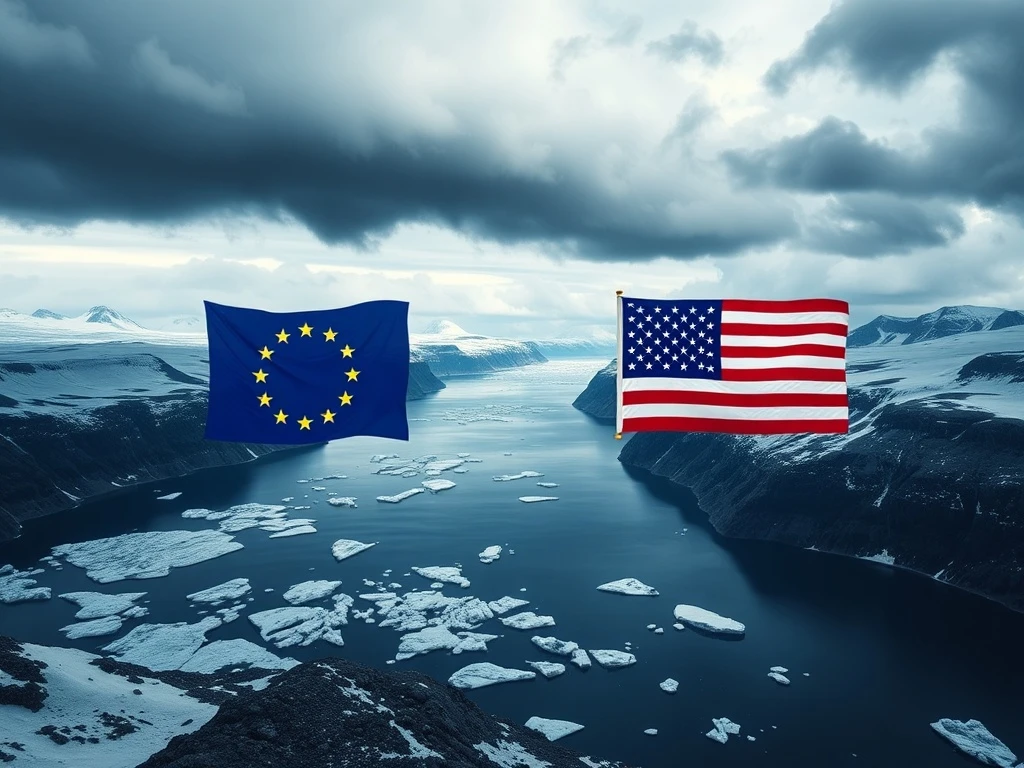
BRUSSELS, BELGIUM — March 15, 2025 — The European Union has prepared unprecedented $108 billion retaliatory measures against the United States, escalating a simmering diplomatic conflict over Greenland’s strategic resources and sovereignty. This development marks the most significant transatlantic trade confrontation in decades, potentially reshaping global economic alliances and Arctic geopolitics. The EU retaliatory measures specifically target key American export sectors, responding to what European officials describe as “unilateral resource claims” in Greenlandic territories.
EU Retaliatory Measures Target Core US Economic Interests
The European Commission formally approved the comprehensive package yesterday. Consequently, these measures will impose tariffs on $108 billion worth of American goods. The targeted sectors include agricultural products, automotive components, and digital services. Additionally, the package restricts technology transfers and imposes investment screening requirements. European trade officials emphasize these actions respond directly to recent US legislation. Specifically, the “Arctic Resource Security Act” passed by Congress last month triggered this response.
Furthermore, the EU retaliatory measures incorporate strategic timing elements. They will phase in over six months unless negotiations produce a settlement. This approach provides diplomatic breathing room while demonstrating European resolve. The European Parliament must still ratify the measures, though analysts predict strong support. Meanwhile, transatlantic business groups express deep concern about escalating costs and supply chain disruptions.
Greenland Dispute Origins and Strategic Implications
The Greenland dispute centers on competing interpretations of resource rights and environmental jurisdiction. The United States maintains a strategic airbase at Thule in northern Greenland. Recently, American companies secured exploratory licenses for rare earth minerals without Greenlandic parliamentary approval. These actions violated the 2009 Self-Government Act, according to Danish and EU legal analyses. Greenland, while autonomous, remains part of the Kingdom of Denmark, an EU member through special arrangements.
Moreover, climate change has intensified Arctic competition. Melting ice opens new shipping routes and resource access. The United States, Russia, China, and European nations all seek influence in the region. Greenland possesses approximately 25% of global rare earth element deposits. These minerals are essential for electric vehicles, wind turbines, and defense technologies. Consequently, control over these resources carries significant economic and security implications.
Historical Context and Legal Frameworks
The dispute traces back to World War II-era agreements. The United States established military presence in Greenland during the war. The 1951 Defense Agreement between Denmark and the US governs the Thule Air Base. However, recent interpretations diverge significantly. American officials argue expanded resource rights accompany security commitments. Conversely, European legal experts cite the United Nations Convention on the Law of the Sea (UNCLOS). The United States never ratified this convention, creating fundamental legal disagreements.
Additionally, Greenland’s political evolution complicates matters. The territory gained increased autonomy in 2009. It now controls mineral resources under its soil. The Greenlandic government explicitly opposed the American licensing actions. It requested EU support through Denmark, triggering the current confrontation. This situation illustrates growing tensions between great power interests and local autonomy movements.
Economic Impacts and Global Trade Consequences
The $108 billion EU retaliatory measures will immediately affect several industries. Agricultural exports from American Midwest states face 35% tariffs. Automotive components encounter 25% duties. Digital service taxes will target major US technology firms. European economists project these measures could reduce US GDP growth by 0.3% annually if fully implemented. Conversely, European consumers may face higher prices for affected goods. Global supply chains already strained by recent disruptions will experience additional pressure.
Furthermore, financial markets reacted negatively to the announcement. The euro and dollar both weakened against other major currencies. Defense and mining stocks showed particular volatility. Commodity prices for rare earth elements spiked 12% on supply concerns. International trade organizations monitor the situation closely. The World Trade Organization may eventually adjudicate the dispute, though that process requires years.
| Sector | Tariff Rate | Annual Trade Value |
|---|---|---|
| Agricultural Products | 35% | $42 billion |
| Automotive Components | 25% | $38 billion |
| Digital Services | Digital Tax | $28 billion |
Diplomatic Reactions and International Responses
The United States Department of State issued a strong condemnation yesterday. Officials called the EU retaliatory measures “disproportionate and damaging to alliance solidarity.” They emphasized America’s security contributions to Europe over decades. However, European diplomats reference President Dwight Eisenhower’s 1953 assurance. He pledged the US would never “act unilaterally in Greenland’s affairs without Danish consent.” This historical reference frames the current disagreement as a breach of trust.
Meanwhile, other global powers carefully position themselves. China expressed support for “respecting territorial sovereignty and international law.” Russia increased Arctic military exercises, though officially remained neutral. NATO faces internal strain as two key members confront each other economically. The alliance’s Secretary-General urged diplomatic resolution, emphasizing shared security interests. Nevertheless, the situation tests transatlantic cooperation mechanisms established since World War II.
Expert Analysis and Strategic Forecasts
Dr. Elin Jørgensen, Arctic policy expert at the University of Copenhagen, provides critical context. “This dispute represents more than trade numbers,” she explains. “It reflects fundamental shifts in global power dynamics. The Arctic has become a strategic frontier. Climate change accelerates accessibility while great power competition intensifies.” She notes Greenland’s population of 56,000 faces disproportionate pressure from external powers. Their self-determination aspirations complicate traditional diplomacy.
Additionally, trade analysts highlight precedent concerns. Professor Markus Schmidt at the Berlin School of Economics comments, “If the EU successfully implements these measures, other nations may adopt similar approaches for territorial disputes. This could fragment the global trading system further.” He references recent tensions in the South China Sea and Eastern Europe. The Greenland dispute may establish patterns for resource conflicts in emerging strategic regions.
Potential Resolution Pathways and Negotiation Prospects
Several diplomatic channels remain open despite the escalating rhetoric. The EU-US Trade and Technology Council will convene an emergency session next week. Greenlandic representatives will participate for the first time, signaling their central role. Potential compromise frameworks include:
- Joint development agreements: Shared resource extraction with revenue splitting
- Environmental oversight committees: Multilateral monitoring of Arctic operations
- Security guarantees: Enhanced NATO role in Greenlandic protection
- Investment frameworks: Structured participation for Greenlandic sovereign wealth funds
However, significant obstacles persist. The United States Congress shows little willingness to revise recent legislation. European Parliament elections this year increase political pressures. Greenland’s government faces domestic demands for resource control. These competing interests complicate negotiation dynamics. International mediators from Norway and Canada have offered facilitation services, though both nations have Arctic interests themselves.
Conclusion
The $108 billion EU retaliatory measures over the Greenland dispute represent a pivotal moment in transatlantic relations. This confrontation extends beyond trade balances to fundamental questions of sovereignty, resource rights, and international law. The EU retaliatory measures demonstrate European willingness to challenge American unilateral actions in strategic regions. As climate change reshapes the Arctic’s geopolitical significance, such conflicts may become more frequent. Ultimately, resolution requires balancing great power interests with local autonomy and environmental protection. The coming months will test diplomatic creativity and alliance resilience in an increasingly multipolar world.
FAQs
Q1: What triggered the EU’s $108 billion retaliatory measures against the US?
The immediate trigger was US legislation granting American companies resource exploration rights in Greenland without proper consultation with Greenlandic or Danish authorities, which the EU views as violating Greenland’s self-government agreement and international norms.
Q2: How will the EU retaliatory measures affect ordinary consumers?
European consumers may see price increases for certain American agricultural products and vehicles, while American farmers and manufacturers will face reduced access to the European market, potentially affecting employment in targeted sectors.
Q3: What makes Greenland strategically important in this dispute?
Greenland contains approximately 25% of global rare earth element deposits essential for green technologies and defense systems, while melting Arctic ice opens new shipping routes, making control over the territory increasingly valuable.
Q4: Are there historical precedents for this type of EU-US conflict?
While trade disputes have occurred previously, this confrontation is unprecedented in combining territorial sovereignty issues, strategic resource competition, and historical alliance tensions, making it uniquely complex.
Q5: What are the potential global consequences if this dispute escalates further?
Further escalation could fragment Western alliances, disrupt global supply chains for critical minerals, encourage similar territorial resource claims worldwide, and potentially weaken international institutions designed to mediate such conflicts.
Related News
- Spot Bitcoin ETF and Spot Ethereum ETF Log Stunning $1.9 Billion Weekly Inflow, Marking Critical Institutional Pivot
- Alien Life Financial Crisis: Former Bank of England Analyst Issues Urgent Warning for Global Markets
- Coinone RIVER Listing: Strategic Expansion Brings New Digital Asset to South Korean Market