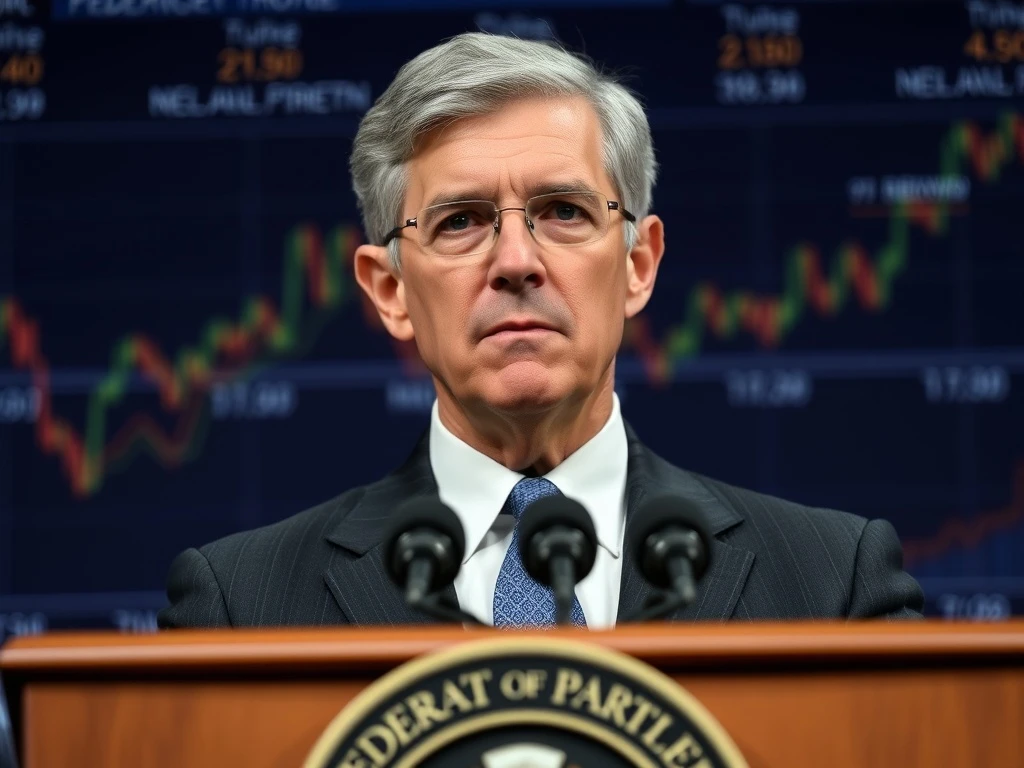
The financial world recently witnessed a significant moment as the **Federal Reserve** made a pivotal decision regarding interest rates. This move carries profound implications for traditional markets and the burgeoning cryptocurrency space. The Federal Reserve, the central banking system of the United States, ultimately enacted a 25 basis point (bp) interest rate cut. However, this consensus was not universal. A notable voice emerged, arguing for a more aggressive stance. Newly appointed Governor Steve Miran, a key figure in the central bank’s leadership, advocated for a 50 basis point reduction. This divergence highlights ongoing debates within the Fed regarding the optimal path for monetary policy. Investors, therefore, watch these developments closely, understanding their potential influence on asset valuations, including digital currencies.
Federal Reserve Decisions and Their Weight
The **Federal Reserve** holds immense power over the nation’s economy. Its decisions directly influence borrowing costs, inflation, and employment levels. The Federal Open Market Committee (FOMC), comprising governors and regional Fed presidents, sets the target federal funds rate. This rate, in turn, impacts consumer loans, mortgages, and business investments. Therefore, any change sends ripples through global financial systems. A basis point is simply one-hundredth of a percentage point. Thus, a 25 bp cut means a 0.25% reduction, while a 50 bp cut signifies a 0.50% reduction.
The recent meeting saw the FOMC deliberate on the future of interest rates. The committee members analyze various economic indicators before reaching a conclusion. Their primary goals include:
- Maintaining maximum employment.
- Ensuring stable prices (controlling inflation).
- Moderating long-term interest rates.
These objectives often require a delicate balancing act. Consequently, different committee members may interpret the same data differently, leading to varied policy recommendations. The Fed’s transparency regarding these discussions offers valuable insight into its thinking.
Steve Miran’s Argument for a Deeper Interest Rate Cut
Governor **Steve Miran** presented a compelling case for a more substantial **interest rate cut**. His argument centered on the perceived need for a more robust stimulus to the economy. Miran likely emphasized certain data points or future projections that suggested a larger reduction was necessary to prevent a slowdown or to accelerate growth. His perspective offers a glimpse into the diverse opinions shaping monetary policy.
Sources close to the deliberations indicate Miran’s rationale included:
- Concerns about global economic deceleration impacting U.S. growth.
- The desire to proactively counter any potential deflationary pressures.
- A belief that current inflation levels allowed for greater policy flexibility.
A 50 basis point cut would represent a more aggressive easing of monetary policy. Historically, such significant cuts are reserved for periods of pronounced economic weakness or crisis. Miran’s advocacy, therefore, signaled a stronger apprehension about the economic trajectory than that of the majority. His position highlights the complexity of economic forecasting and policy formulation. It also underscores the importance of individual perspectives within the collective decision-making body.
The Fed’s Chosen Path: A 25 Basis Point Reduction
Despite Miran’s powerful argument, the majority of the FOMC ultimately opted for a 25 basis point **interest rate cut**. This decision reflects a more cautious approach. The committee likely balanced concerns about economic growth with the need to maintain some policy headroom. A smaller cut allows the Fed to monitor incoming data and adjust future policy as needed. This gradual approach is a hallmark of many central bank strategies.
The Fed’s official statement often provides clues regarding its collective reasoning. Key factors supporting the 25 bp cut likely included:
- Resilient labor market data.
- Inflation remaining near the target, but with some persistent elements.
- Desire to avoid appearing overly reactive to short-term fluctuations.
This measured reduction indicates the Fed’s confidence in the underlying strength of the economy, even while acknowledging areas of concern. It aims to provide a moderate boost without overheating the economy or signaling undue alarm. Consequently, markets often interpret such a move as a ‘mid-cycle adjustment’ rather than an emergency measure. This nuanced decision-making process is crucial for long-term stability.
Understanding the Broader Economic Outlook
The **economic outlook** is a critical determinant for Federal Reserve actions. When the economy shows signs of slowing, an **interest rate cut** can stimulate activity. Lower rates make borrowing cheaper for businesses and consumers. This encourages investment, spending, and job creation. Conversely, if inflation becomes a concern, the Fed might raise rates to cool down the economy. The current environment presents a mix of signals.
Recent economic data points include:
- **Inflation:** While showing signs of moderating, certain sectors still experience price pressures.
- **Employment:** The labor market remains relatively robust, though some indicators suggest a softening.
- **Consumer Spending:** Holds steady, but rising debt levels are a concern for some analysts.
- **Global Growth:** International headwinds, such as geopolitical tensions and slower growth in major economies, could impact the U.S.
These complex factors feed into the Fed’s models and forecasts. The divergent views, like Miran’s, highlight the inherent uncertainty in predicting economic trajectories. Policymakers must weigh the risks of doing too much against the risks of doing too little. Therefore, the Fed’s decisions are rarely simple, reflecting a constant evaluation of incoming information and potential future scenarios.
The Critical Crypto Market Impact of Rate Decisions
Federal Reserve interest rate decisions have a significant **crypto market impact**. Cryptocurrencies, often considered riskier assets, tend to perform differently in varying monetary policy environments. When interest rates are low, the cost of borrowing decreases. This can encourage investors to seek higher returns in assets perceived as more volatile, like Bitcoin and Ethereum. Conversely, higher interest rates make safer investments, such as bonds, more attractive, potentially drawing capital away from crypto.
Specifically, an **interest rate cut** generally signals:
- **Increased Liquidity:** More money flows into the financial system.
- **Reduced Opportunity Cost:** Holding cash or low-yield assets becomes less appealing.
- **Risk-On Sentiment:** Investors become more willing to take on risk for higher potential returns.
These conditions can create a more favorable environment for digital assets. Furthermore, the narrative of cryptocurrencies as a hedge against inflation or traditional financial instability can gain traction during periods of economic uncertainty, which sometimes accompanies rate adjustments. Therefore, Miran’s call for a larger cut, if adopted, could have signaled an even stronger bullish impulse for crypto. The 25 bp cut, while less aggressive, still contributes to a supportive backdrop for digital asset valuations. Understanding this relationship is vital for any crypto investor.
Looking Ahead: Future Federal Reserve Actions and Miran’s Influence
The recent **interest rate cut** is unlikely to be the final word from the **Federal Reserve**. Future decisions will depend heavily on evolving economic data. Inflation trends, employment figures, and global economic developments will all play crucial roles. Governor Steve Miran’s dissenting vote, while not swaying the immediate outcome, signals a significant voice within the FOMC. His arguments for more aggressive action could gain traction if economic conditions deteriorate further.
The market will closely watch for:
- Any shifts in the Fed’s forward guidance.
- Statements from individual governors, including Miran.
- Key economic reports, such as CPI and employment data.
The influence of a governor like Miran can shape future policy debates. His willingness to argue for a stronger intervention demonstrates a particular philosophy toward economic management. This perspective could become more prominent if the economy faces new challenges. Ultimately, the Fed’s ongoing vigilance and adaptability remain paramount in navigating an ever-changing global financial landscape. For crypto enthusiasts, these signals from the Federal Reserve remain a crucial indicator for market sentiment and potential price movements.
The Federal Reserve’s recent decision, alongside Governor Steve Miran’s dissenting view, underscores the complex dynamics of monetary policy. While the Fed opted for a measured 25 basis point interest rate cut, Miran’s call for a 50 basis point reduction highlights diverse perspectives on the economic outlook. These decisions profoundly influence not only traditional markets but also the volatile cryptocurrency ecosystem. As the economic landscape continues to evolve, understanding the Federal Reserve’s actions and internal debates remains essential for investors navigating both conventional and digital asset classes.
Frequently Asked Questions (FAQs)
Q1: What is a basis point (bp)?
A basis point (bp) is a common unit of measure in finance, equal to one-hundredth of a percentage point. For example, a 25 bp interest rate cut means the rate decreased by 0.25%.
Q2: Why did Governor Steve Miran argue for a 50 bp interest rate cut?
Governor Miran likely argued for a larger cut due to concerns about a potential economic slowdown, a desire to stimulate growth more aggressively, or a belief that current inflation levels allowed for greater policy flexibility.
Q3: How does a Federal Reserve interest rate cut impact the economy?
An interest rate cut generally makes borrowing cheaper for businesses and consumers. This encourages spending, investment, and job creation, aiming to stimulate economic growth. It can also weaken the currency, making exports cheaper.
Q4: What is the crypto market impact of a Federal Reserve interest rate cut?
A Federal Reserve interest rate cut often positively impacts the crypto market. Lower rates make traditional safe investments less attractive, prompting investors to seek higher returns in riskier assets like cryptocurrencies. This can lead to increased liquidity and a ‘risk-on’ sentiment.
Q5: What factors does the Federal Reserve consider when deciding on interest rates?
The Federal Reserve considers various factors, including inflation rates, employment data, GDP growth, consumer spending, global economic conditions, and financial market stability. Its primary goals are maximum employment and price stability.
Related News
- Tokenized Gold Skyrockets: BTCC Exchange Reports Stunning 809% Surge as Gold Prices Shatter Records
- Bitcoin Price Prediction: Tiger Research’s Bold $185.5K Q1 Target Reveals Critical Market Dynamics
- BTC Perpetual Futures Long/Short Ratio Reveals Cautious Market Sentiment Across Major Exchanges