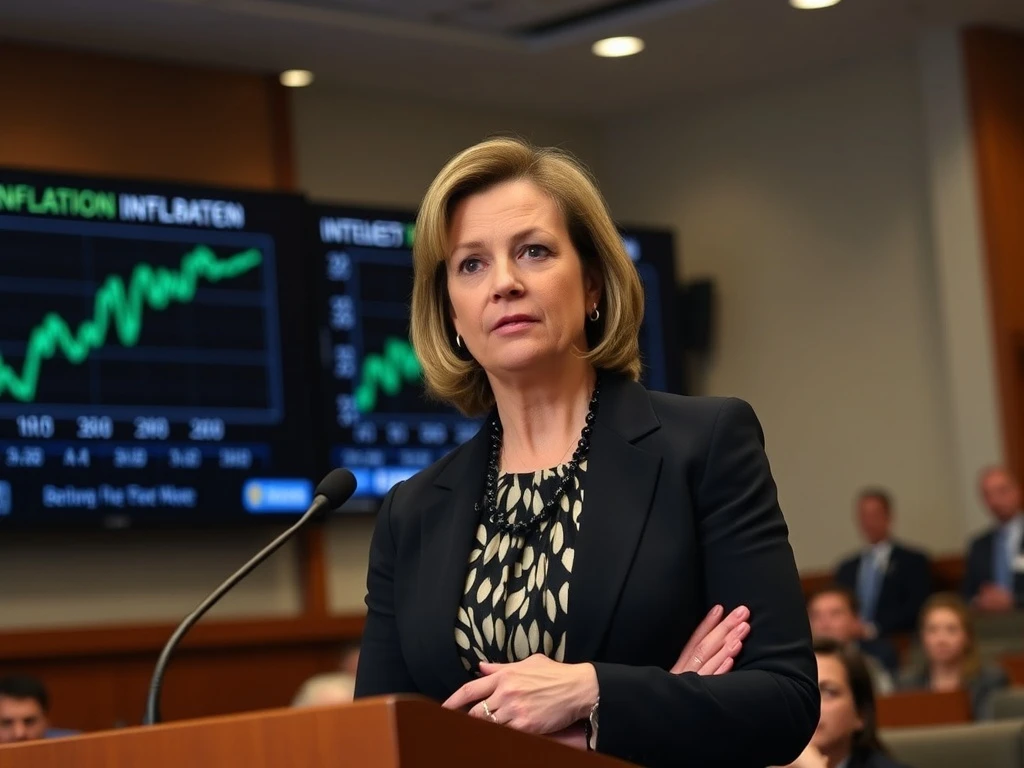
Investors in the cryptocurrency market often monitor macroeconomic signals closely. After all, decisions made by central banks, particularly the **Federal Reserve**, significantly influence broader market liquidity and risk appetite. Therefore, recent comments from Beth Hammack, President of the Federal Reserve Bank of Cleveland, carry considerable weight. She has indicated that further interest rate reductions are far from guaranteed, challenging market expectations for easier monetary policy.
Cleveland Fed’s Stance on Future **Interest Rate Cuts**
Beth Hammack recently delivered a clear message regarding the future trajectory of monetary policy. She stated that additional **interest rate cuts** are “not obvious” under current conditions. This assessment directly addresses ongoing speculation about when the Federal Reserve might begin to ease its tight monetary stance. Many analysts and market participants have anticipated multiple rate reductions later this year. However, Hammack’s remarks suggest a more cautious and data-dependent approach.
Her statement underscores a prevailing sentiment among some Fed officials. They believe that while inflation has moderated from its peak, it remains stubbornly above the central bank’s 2% target. Consequently, the Fed must maintain a restrictive policy for longer than some might hope. This prolonged period of higher rates aims to firmly anchor inflation expectations and ensure price stability. Moreover, this perspective highlights the challenges facing policymakers as they navigate complex economic signals.
The Lingering **Inflation Outlook** and Its Implications
A primary driver behind Hammack’s cautious outlook is the persistent **inflation outlook**. She projected that inflation is likely to remain elevated through 2026. Bringing it back to the Fed’s 2% target will realistically take another two to three years. This timeline extends beyond many market forecasts, suggesting a longer period of economic adjustment. Several factors contribute to this prolonged inflation forecast. Firstly, a robust labor market continues to exert upward pressure on wages. Secondly, global supply chain dynamics, although improved, still present potential bottlenecks. Furthermore, geopolitical events introduce uncertainties that can impact commodity prices.
Understanding the nuances of the inflation outlook is crucial for investors. For instance, persistent services inflation, often tied to wage growth, proves particularly challenging to address. Goods inflation has largely cooled, yet services costs remain elevated. This distinction is vital for the Federal Reserve. They must carefully assess which components of inflation are most sticky. Therefore, a comprehensive understanding of these underlying inflationary pressures informs Hammack’s cautious stance on rate cuts. The path to 2% is complex and multi-faceted.
Understanding **Beth Hammack**’s Economic Perspective
As the newly appointed President of the Federal Reserve Bank of Cleveland, **Beth Hammack** brings a wealth of experience to her role. Her background in financial markets, particularly from Goldman Sachs, provides a unique perspective on economic policy. She understands the intricate connections between monetary policy decisions and their real-world impact on businesses and consumers. Her statements, therefore, are not merely academic pronouncements. They reflect a deep understanding of market mechanisms and economic forces. This expertise lends significant credibility to her current assessments.
Hammack’s role involves contributing to the Federal Open Market Committee (FOMC) discussions. The FOMC sets the nation’s monetary policy. Her voice, alongside other regional Fed presidents and governors, helps shape the consensus view. Therefore, her explicit warning about the unlikelihood of immediate rate cuts signals a potentially more hawkish tilt within the Committee. Investors typically scrutinize such statements for clues about future policy direction. Her experience allows her to identify subtle shifts in economic data. Consequently, her insights are invaluable for anticipating market movements.
Implications for the **Federal Reserve**’s Broader Strategy
Hammack’s comments clearly indicate a cautious approach for the **Federal Reserve**. The central bank’s dual mandate includes achieving maximum employment and maintaining price stability. Currently, the focus heavily remains on price stability. This implies that the Fed prioritizes bringing inflation down to its target, even if it means maintaining higher interest rates for an extended period. The risk of cutting rates too soon and reigniting inflationary pressures weighs heavily on policymakers. Consequently, the Fed will likely continue to emphasize data dependency.
Policymakers will closely monitor a range of economic indicators. These include consumer price index (CPI) data, personal consumption expenditures (PCE) inflation, employment reports, and wage growth figures. Any sustained evidence of disinflation would be necessary before considering rate adjustments. However, without clear and consistent data supporting a rapid return to the 2% target, the current restrictive stance will likely persist. This strategy aims to avoid the mistakes of previous eras, where premature easing led to resurgent inflation. Therefore, patience and vigilance define the Federal Reserve’s current approach.
Broader **Economic Forecast** and Market Reactions
The **economic forecast** outlined by Beth Hammack suggests a challenging period ahead for various sectors. For instance, higher interest rates impact borrowing costs for businesses and consumers. This can slow investment, dampen consumer spending, and affect overall economic growth. Businesses might delay expansion plans. Consumers could face higher mortgage rates and credit card interest. Consequently, these effects ripple through the economy, influencing everything from housing markets to corporate earnings. The cryptocurrency market, often sensitive to liquidity conditions, also reacts significantly to such forecasts. Tighter monetary policy typically reduces the availability of risk capital, potentially leading to downward pressure on digital asset prices.
Market participants often react to these signals by adjusting their portfolios. Some investors may shift towards less risky assets, such as government bonds, during periods of prolonged economic uncertainty. Others might reassess their exposure to growth-oriented sectors and speculative assets. Therefore, Hammack’s extended timeline for inflation and rate stability could lead to a repricing of assets across the board. The market’s initial optimism for early rate cuts appears to be tempering. This shift reflects a more realistic assessment of the economic landscape. Ultimately, the Fed’s communication plays a critical role in shaping market expectations and investor behavior.
In conclusion, Beth Hammack’s statements from the Cleveland Fed provide a crucial insight into the **Federal Reserve**’s current thinking. The path to lower inflation and subsequent **interest rate cuts** is not as straightforward as many might hope. Her **inflation outlook**, extending through 2026, signals a longer period of tight monetary policy. This perspective, rooted in her extensive experience, underscores the challenges faced by policymakers. Investors and market watchers, including those in the crypto space, must pay close attention to these signals. The **economic forecast** suggests a continued period of vigilance. Therefore, adaptability and a deep understanding of macroeconomic trends will remain essential for navigating the evolving financial landscape.
Frequently Asked Questions (FAQs)
1. What did Beth Hammack say about future interest rate cuts?
Beth Hammack, President of the Federal Reserve Bank of Cleveland, stated that further **interest rate cuts** are “not obvious” given the current inflation outlook. She emphasized that inflation is likely to remain high through 2026.
2. Why does the Federal Reserve maintain a 2% inflation target?
The **Federal Reserve** aims for a 2% inflation target to ensure price stability. This level is considered optimal for fostering sustainable economic growth and preventing deflation, which can harm the economy.
3. How long does Hammack expect inflation to remain high?
Hammack expects inflation to remain elevated through 2026. She believes it will take two to three more years to bring it back down to the **Federal Reserve**’s 2% target.
4. How do the Fed’s interest rate decisions affect the cryptocurrency market?
The **Federal Reserve**’s **interest rate cuts** or hikes significantly impact market liquidity and investor risk appetite. Higher rates generally make riskier assets like cryptocurrencies less attractive, while lower rates can stimulate investment in them.
5. What factors contribute to the current **inflation outlook**?
The current **inflation outlook** is influenced by several factors. These include a strong labor market, wage growth, global supply chain dynamics, and geopolitical events that can affect commodity prices and overall economic stability.
6. What is the significance of Beth Hammack’s role at the Cleveland Fed?
As President of the Federal Reserve Bank of Cleveland, Beth Hammack contributes to the Federal Open Market Committee (FOMC) discussions. Her statements provide valuable insights into the **Federal Reserve**’s monetary policy strategy and **economic forecast**.
Related News
- Steak ‘n Shake Boldly Expands Bitcoin Treasury to $10M, Doubling Down on Digital Reserve Strategy
- Trump’s Shocking Tariff Threat Over Greenland Annexation Opposition Sends Global Shockwaves
- Privacy Coins Revolution: The Critical Shift from Anonymity to Selective Disclosure