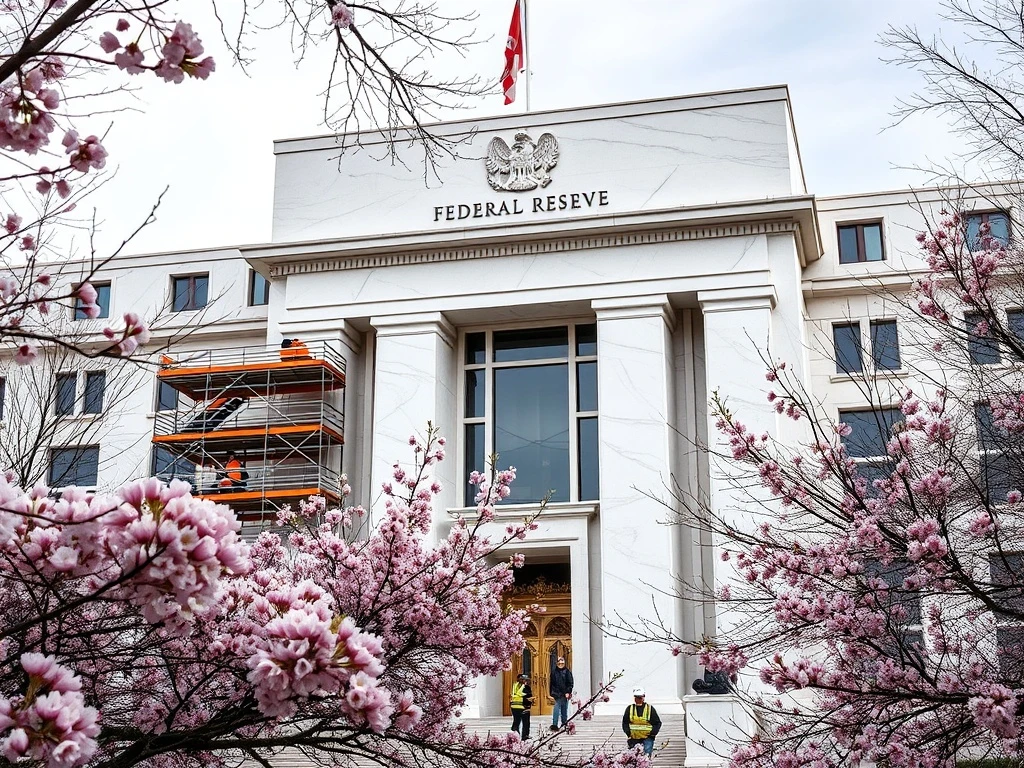
WASHINGTON, D.C. – March 2025: The Federal Reserve’s announcement of a $2.5 billion renovation for its Washington headquarters has ignited intense debate about government spending priorities during uncertain economic times. This massive infrastructure project, while framed as essential modernization, raises fundamental questions about fiscal responsibility and institutional transparency at America’s central bank.
Federal Reserve Renovation: Breaking Down the $2.5 Billion Price Tag
The Federal Reserve Board approved the comprehensive renovation of the Marriner S. Eccles Building in late 2024. Consequently, the project will address critical infrastructure needs that have accumulated over decades. The building, completed in 1937, requires substantial mechanical, electrical, and plumbing upgrades. Additionally, security enhancements must meet contemporary standards for a critical financial institution.
Specifically, the renovation includes seismic retrofitting for earthquake safety. It also involves complete asbestos abatement throughout the historic structure. Modernization of the building’s technology infrastructure represents another significant cost component. The Federal Reserve emphasizes that delaying these essential repairs would ultimately prove more expensive.
However, critics immediately questioned the staggering $2.5 billion figure. Comparatively, recent major federal building projects have cost substantially less. For instance, the renovation of the U.S. Capitol’s West Front completed in 2022 at approximately $750 million. Similarly, the ongoing modernization of the Pentagon’s office spaces involves significantly lower per-square-foot costs.
| Building | Cost | Completion Year | Square Footage |
|---|---|---|---|
| Federal Reserve Eccles Building | $2.5 billion | Estimated 2030 | 1.2 million |
| U.S. Capitol West Front | $753 million | 2022 | 850,000 |
| Department of Justice HQ | $1.1 billion | 2024 | 1.8 million |
| FBI Headquarters (planned) | $3.5 billion | Estimated 2032 | 2.4 million |
Historical Context and Building Condition Assessment
The Marriner S. Eccles Building has served as the Federal Reserve’s headquarters for nearly nine decades. Originally constructed during the Great Depression, the building’s design reflected both austerity and institutional permanence. Over time, however, numerous infrastructure systems have reached or exceeded their expected lifespans.
Multiple engineering assessments conducted between 2018 and 2023 revealed several critical issues:
- Electrical Systems: Original wiring incapable of supporting modern technology loads
- Plumbing Infrastructure: Lead-containing pipes requiring complete replacement
- HVAC Systems: Inefficient climate control affecting both energy costs and preservation of historical documents
- Structural Elements: Concrete and steel components showing advanced deterioration
- Security Vulnerabilities: Inadequate protection against contemporary physical and cyber threats
Furthermore, the building must accommodate approximately 2,000 employees who conduct the nation’s monetary policy. Their work requires secure, technologically advanced facilities that can operate continuously during financial crises. The Federal Reserve argues that these operational requirements justify significant investment.
Expert Perspectives on the Renovation Costs
Architectural and engineering professionals offer mixed assessments of the project’s scope and cost. John Richardson, a principal at Federal Infrastructure Consultants with 25 years of government project experience, explains the challenges: “Historic preservation combined with modern security and technology requirements creates exponential cost complexities. Additionally, working in an occupied building that must maintain continuous operations adds substantial logistical expenses.”
Conversely, Sarah Chen, director of the Government Accountability Project, raises concerns: “While some renovation is undoubtedly necessary, the $2.5 billion figure demands extraordinary justification. Taxpayers deserve transparent breakdowns showing how each dollar will be spent. Moreover, we need comparative analysis demonstrating this represents the most cost-effective approach.”
The Federal Reserve has released preliminary cost allocations showing approximately 40% for core infrastructure, 30% for security enhancements, 20% for technology modernization, and 10% for historic preservation compliance. However, detailed line-item budgets remain classified for security reasons, according to official statements.
Economic Context and Timing Considerations
The renovation announcement coincides with ongoing debates about federal spending and monetary policy. The Federal Reserve has recently maintained elevated interest rates to combat inflation. Simultaneously, the federal government continues to operate with substantial budget deficits. This economic backdrop amplifies scrutiny of major capital expenditures.
Proponents argue that delaying necessary maintenance represents false economy. Michael Torres, an economist specializing in public infrastructure, notes: “Deferred maintenance on critical facilities inevitably leads to higher costs later. The Federal Reserve building houses essential financial infrastructure. Its operational continuity directly affects economic stability.”
Nevertheless, critics question whether less expensive alternatives were adequately explored. Could partial renovation or phased implementation reduce immediate costs? Would constructing a new facility elsewhere in the Washington area provide better long-term value? These questions remain largely unanswered in publicly available documentation.
Comparative Analysis with Private Sector Renovations
Private sector headquarters renovations for major financial institutions provide relevant comparisons. JPMorgan Chase’s recent Manhattan headquarters renovation cost approximately $3 billion for 2.5 million square feet. Goldman Sachs’ headquarters construction in New York totaled about $2.1 billion for 2 million square feet.
These private sector projects, however, typically include luxurious amenities not present in government buildings. They also face different regulatory and preservation requirements. The Federal Reserve project must comply with numerous federal regulations including the Historic Preservation Act and Security Standards for Federal Buildings.
Additionally, government procurement processes often increase costs compared to private sector approaches. Competitive bidding requirements, wage standards, and documentation mandates add layers of complexity and expense. These factors partially explain the significant price tag, according to procurement specialists.
Security Imperatives and Technological Requirements
The Federal Reserve’s unique role necessitates exceptional security measures. As the institution responsible for monetary policy and financial stability, it represents a potential target for both physical and cyber attacks. Modern security requirements have evolved dramatically since the building’s original construction.
Contemporary security infrastructure includes:
- Blast-resistant construction materials and design features
- Advanced surveillance and access control systems
- Secure communications infrastructure resistant to interception
- Protected emergency operations centers
- Redundant power and data systems ensuring continuous operation
Technological modernization represents another critical component. The Federal Reserve’s operations increasingly depend on sophisticated data analysis and secure communications. Modern trading floors, secure meeting spaces, and advanced computing infrastructure require substantial physical plant upgrades.
Furthermore, the building must accommodate evolving work patterns including hybrid arrangements. Flexible workspace design, enhanced ventilation systems, and improved technological connectivity all contribute to the project’s scope and cost.
Transparency and Oversight Mechanisms
Public scrutiny has focused particularly on oversight and accountability measures. The Federal Reserve operates with substantial independence in its monetary policy decisions. However, its administrative expenditures typically receive congressional oversight through appropriations processes.
Interestingly, the renovation funding comes from the Federal Reserve’s own earnings rather than congressional appropriations. The central bank generates substantial revenue from its financial operations. These funds, after covering operational expenses and dividend payments to member banks, flow to the U.S. Treasury. The renovation will utilize a portion of these retained earnings.
This funding mechanism raises complex questions about accountability. While reducing direct taxpayer burden, it also limits traditional congressional oversight. The Government Accountability Office has announced plans to review the project’s planning and implementation. Additionally, the Federal Reserve’s Office of Inspector General will monitor expenditures throughout the multi-year project.
Historical Preservation Challenges and Solutions
The Eccles Building holds historical significance as an example of Depression-era architecture and as the operational center of American monetary policy for generations. Renovation must balance modernization with preservation of historically significant elements.
Key preservation considerations include:
- Maintaining the building’s distinctive marble exterior and architectural details
- Preserving historically significant interior spaces including the Board Room
- Protecting artwork and historical documents housed within the building
- Complying with Secretary of the Interior Standards for historic preservation
Preservation requirements often increase renovation costs compared to new construction or less constrained renovations. Specialized materials, artisan labor, and meticulous documentation all contribute to project expenses. However, they also ensure conservation of historically valuable assets for future generations.
Conclusion
The Federal Reserve’s $2.5 billion renovation project represents a complex intersection of infrastructure needs, security requirements, historical preservation, and fiscal responsibility. While substantial modernization is undoubtedly necessary for an 88-year-old building housing critical financial infrastructure, the extraordinary cost demands exceptional justification and transparency. Ongoing oversight from multiple government accountability entities will determine whether this massive expenditure represents prudent investment or institutional excess. The project’s implementation over the coming years will ultimately validate or undermine the Federal Reserve’s assertions of necessity regarding this controversial renovation.
FAQs
Q1: Why does the Federal Reserve building need renovation?
The Marriner S. Eccles Building, completed in 1937, requires extensive updates to electrical, plumbing, HVAC, and security systems. Multiple engineering assessments identified critical infrastructure at or beyond expected lifespans, necessitating comprehensive modernization.
Q2: Where is the $2.5 billion renovation funding coming from?
The Federal Reserve will fund the renovation through its own earnings rather than congressional appropriations. These funds come from the central bank’s financial operations after covering expenses and required payments to the U.S. Treasury.
Q3: How does this renovation cost compare to other federal building projects?
The $2.5 billion price tag exceeds recent renovations of comparable federal buildings. However, the Federal Reserve’s unique security requirements and the building’s historical preservation needs contribute to higher costs than standard government office renovations.
Q4: What oversight exists for this massive expenditure?
The Government Accountability Office plans to review the project, and the Federal Reserve’s Office of Inspector General will monitor implementation. However, because funding comes from Federal Reserve earnings rather than appropriations, traditional congressional oversight is limited.
Q5: Will the renovation disrupt Federal Reserve operations?
The renovation plan includes phased implementation designed to maintain continuous operations. Critical functions including monetary policy decisions and financial market operations will continue throughout the multi-year project with appropriate contingency arrangements.
Related News
- CLARITY Act Timelines Intensify as Senate Committees Coordinate, Creating Critical Turning Point for US Crypto Markets
- Altcoin Season Index Surges to 30, Hinting at Potential Crypto Market Shift
- Crypto Fear & Greed Index Reveals Crucial Shift to Neutral at 48, Signaling Market Calm