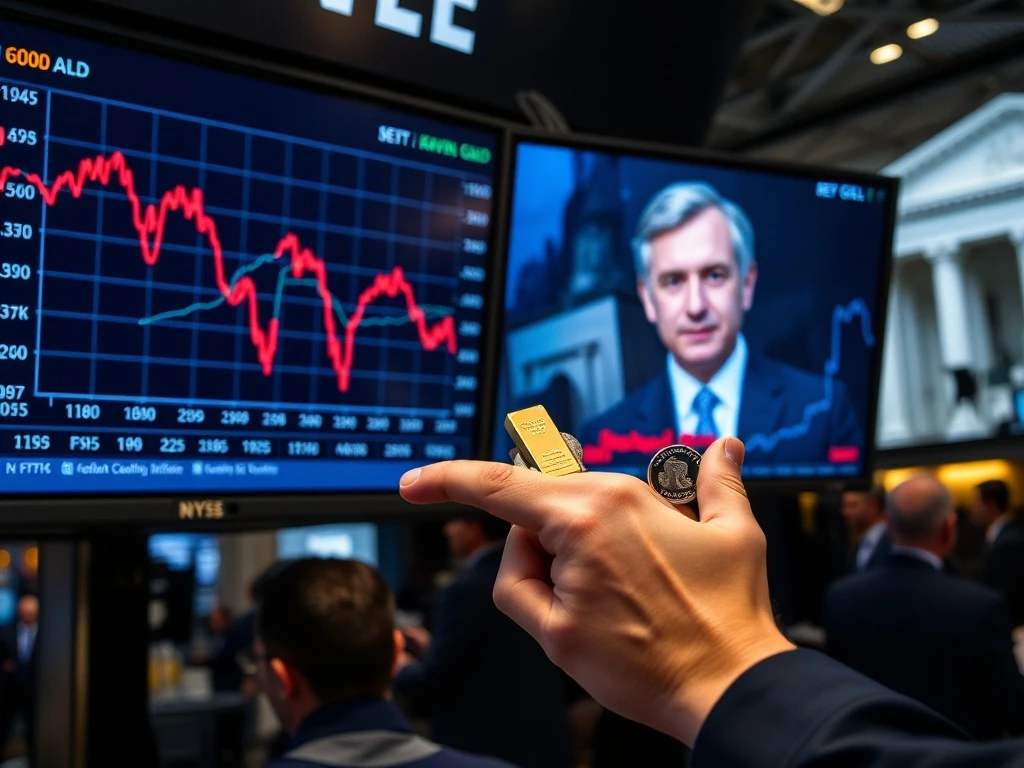
Global financial markets witnessed another significant downturn in precious metals this week as gold prices fell to $1,850 per ounce and silver dropped to $22.30, marking the third consecutive week of declines amid what analysts now term the “Warsh Effect.” This sustained downward pressure reflects broader market adjustments to shifting monetary policy expectations and their profound implications for traditional safe-haven assets. Market participants globally are reassessing their positions in response to these developments, creating unprecedented volatility in commodities markets.
Gold and Silver Prices Experience Sustained Pressure
Precious metals markets continue facing substantial headwinds throughout early 2025. Gold has declined approximately 8% from its January peak, while silver has experienced an even more dramatic 12% correction. These movements represent the most significant coordinated downturn since the 2022 rate hike cycle began. Market analysts attribute this trend to multiple converging factors, primarily centered around monetary policy expectations and their impact on opportunity costs for holding non-yielding assets.
Several key developments have contributed to this market environment. First, rising real interest rates have diminished gold’s appeal as an inflation hedge. Second, dollar strength has created additional pressure on dollar-denominated commodities. Third, reduced geopolitical tensions have temporarily decreased safe-haven demand. Finally, improved economic indicators in major economies have shifted investor preferences toward risk assets.
Understanding the Warsh Effect on Financial Markets
The term “Warsh Effect” refers to the market impact of monetary policy perspectives associated with former Federal Reserve Governor Kevin Warsh and similarly-minded policymakers. This approach emphasizes several distinctive principles that differ from previous monetary frameworks. These principles include prioritizing inflation control over employment metrics, advocating for earlier and more aggressive policy responses to economic signals, and maintaining greater independence from political pressures.
Market participants have interpreted recent Federal Reserve communications through this analytical lens. Consequently, expectations have shifted toward potentially more restrictive monetary policies than previously anticipated. This reassessment has profound implications across asset classes, particularly affecting interest-rate-sensitive investments and traditional inflation hedges like precious metals.
Historical Context and Policy Evolution
Kevin Warsh served as a Federal Reserve Governor from 2006 to 2011, during which he developed a reputation for hawkish monetary views. His policy framework emphasizes several key principles that have gained renewed relevance in current economic conditions. First, he advocates for forward-looking policy adjustments rather than reactive measures. Second, he stresses the importance of financial stability considerations in monetary decisions. Third, he emphasizes clear communication to prevent market disruptions.
The current market interpretation of the Warsh Effect extends beyond any single individual’s views. Instead, it represents a broader shift in market expectations toward monetary policy frameworks that prioritize inflation control and financial stability. This paradigm shift has accelerated throughout 2024 and early 2025 as inflation has proven more persistent than many central banks initially anticipated.
Monetary Policy’s Direct Impact on Precious Metals
Monetary policy decisions create multiple transmission mechanisms affecting precious metals prices. Understanding these relationships helps explain current market movements. The primary channel involves interest rate expectations and their effect on opportunity costs. Higher interest rates increase the attractiveness of yield-bearing assets relative to non-yielding gold and silver.
Additionally, monetary policy influences currency valuations, particularly the U.S. dollar. Stronger dollar conditions typically pressure dollar-denominated commodities like gold and silver. Furthermore, policy expectations affect inflation projections, which historically supported precious metals as inflation hedges. However, credible anti-inflation policies can reduce this supportive dynamic.
Key factors currently influencing precious metals include:
- Real interest rate expectations and their trajectory
- Central bank balance sheet policies and quantitative tightening
- Forward guidance from major central banks
- Currency market dynamics and dollar strength
- Inflation expectations across different time horizons
Comparative Analysis: Gold vs. Silver Market Dynamics
While both gold and silver face similar macroeconomic pressures, their market structures and demand drivers create important distinctions. Gold maintains stronger safe-haven characteristics and central bank demand, while silver exhibits greater industrial sensitivity and volatility. These differences explain why silver has declined more sharply during the current downturn.
| Metric | Gold | Silver |
|---|---|---|
| Price Decline | 8.2% | 12.4% |
| Volatility Index | 18.5 | 26.3 |
| Trading Volume Change | +15% | +28% |
| ETF Outflows | $2.1B | $1.4B |
| Future Contracts Open Interest | -7% | -12% |
Industrial Demand Considerations
Silver’s substantial industrial applications create additional market dynamics beyond monetary factors. Approximately 50% of silver demand originates from industrial uses, including electronics, solar panels, and medical applications. Consequently, silver prices respond to both monetary policy developments and industrial demand projections. Current economic uncertainty has tempered industrial demand expectations, contributing to silver’s underperformance relative to gold.
Global Market Reactions and Regional Variations
Market responses to the Warsh Effect have varied significantly across different regions and market structures. Asian markets, particularly China and India, have demonstrated relatively stronger physical demand despite price declines. European investors have shown greater sensitivity to interest rate differentials and currency effects. Meanwhile, North American institutional investors have led the selling pressure through ETF outflows and futures market positioning.
Central bank behavior has also exhibited regional variations. Emerging market central banks continue accumulating gold reserves as diversification strategy, though at a moderated pace. Developed market central banks have maintained more stable reserve positions. These divergent behaviors create complex cross-currents in global precious metals markets, preventing uniform price movements across all trading venues and time zones.
Expert Perspectives on Market Trajectory
Financial analysts and precious metals experts offer varied interpretations of current market conditions. Most agree that monetary policy expectations represent the dominant driver, but opinions diverge regarding duration and magnitude of current trends. Some analysts anticipate further declines if central banks maintain hawkish postures, while others see current levels as attractive entry points for long-term investors.
Several prominent market observers have published detailed analyses of the situation. For instance, commodity strategists at major investment banks have revised their price targets downward while maintaining constructive long-term outlooks. Meanwhile, mining industry executives emphasize fundamental supply constraints that could support prices despite monetary headwinds. Academic researchers highlight historical patterns where precious metals eventually decouple from monetary policy cycles.
Historical Precedents and Market Psychology
Current market conditions bear similarities to several historical periods, though important distinctions exist. The 2013 taper tantrum created comparable dynamics, with gold declining approximately 25% over six months. The 1999-2001 period also featured precious metals weakness amid dollar strength and technology sector enthusiasm. However, current conditions differ due to elevated geopolitical tensions and unprecedented central bank balance sheets.
Market psychology plays a crucial role in precious metals pricing. Sentiment indicators currently show extreme pessimism, which historically precedes market reversals. However, timing such reversals remains challenging amid strong fundamental headwinds. Contrarian investors monitor these sentiment extremes while respecting prevailing market trends and macroeconomic conditions.
Investment Implications and Portfolio Considerations
The current market environment presents both challenges and opportunities for different investor categories. Long-term strategic investors may view price declines as accumulation opportunities, while tactical traders focus on momentum and technical levels. Portfolio managers must reassess allocation targets and risk parameters in light of changing correlation patterns between precious metals and other asset classes.
Key considerations for market participants include:
- Rebalancing frequency and threshold adjustments
- Physical versus paper exposure management
- Geographic diversification of holdings
- Storage and custody arrangements for physical metals
- Tax implications of portfolio adjustments
Conclusion
Gold and silver prices continue facing significant pressure as markets digest the implications of the Warsh Effect and evolving monetary policy expectations. This environment reflects broader adjustments in global financial markets as central banks navigate complex economic conditions. While current trends present challenges for precious metals investors, they also create potential opportunities for those with longer time horizons and appropriate risk management frameworks. Market participants should monitor monetary policy developments closely while maintaining diversified portfolios aligned with their specific investment objectives and risk tolerances.
FAQs
Q1: What exactly is the “Warsh Effect” influencing gold and silver prices?
The Warsh Effect refers to market impacts resulting from monetary policy perspectives associated with former Federal Reserve Governor Kevin Warsh. This framework emphasizes aggressive inflation control, forward-looking policy adjustments, and financial stability considerations, leading markets to anticipate potentially more restrictive monetary policies than previously expected.
Q2: How long might gold and silver prices continue declining?
Duration depends on multiple factors including central bank policy decisions, inflation trajectory, and economic growth patterns. Historical precedents suggest such adjustments typically last several months, though precise timing remains uncertain. Most analysts anticipate volatility continuing throughout 2025 as markets adjust to new policy paradigms.
Q3: Are there differences between how gold and silver react to monetary policy?
Yes, significant differences exist. Gold responds more directly to interest rates and currency movements as a monetary metal, while silver exhibits greater sensitivity to industrial demand and economic growth expectations. Consequently, silver often demonstrates higher volatility during monetary policy transitions.
Q4: Should investors consider buying gold and silver during price declines?
Investment decisions depend on individual objectives, time horizons, and risk tolerance. Some long-term investors view price declines as accumulation opportunities, while others await clearer policy signals. Diversification principles suggest maintaining some precious metals exposure, though appropriate allocation levels vary by investor circumstances.
Q5: What indicators should investors monitor regarding precious metals markets?
Key indicators include real interest rates, dollar index movements, central bank communications, inflation expectations data, ETF flow patterns, futures market positioning, and physical market premiums. Additionally, broader economic indicators and geopolitical developments provide important context for precious metals price movements.
Related News
- Bitcoin Soars: BTC Price Surges Above $78,000 Mark in Stunning Rally
- Stablecoin Interest Showdown: White House Convenes Critical Meeting with Crypto and Banking Leaders
- XRP Plunges: Digital Asset Crashes to $1.52 Amidst Frightening Middle East Escalation