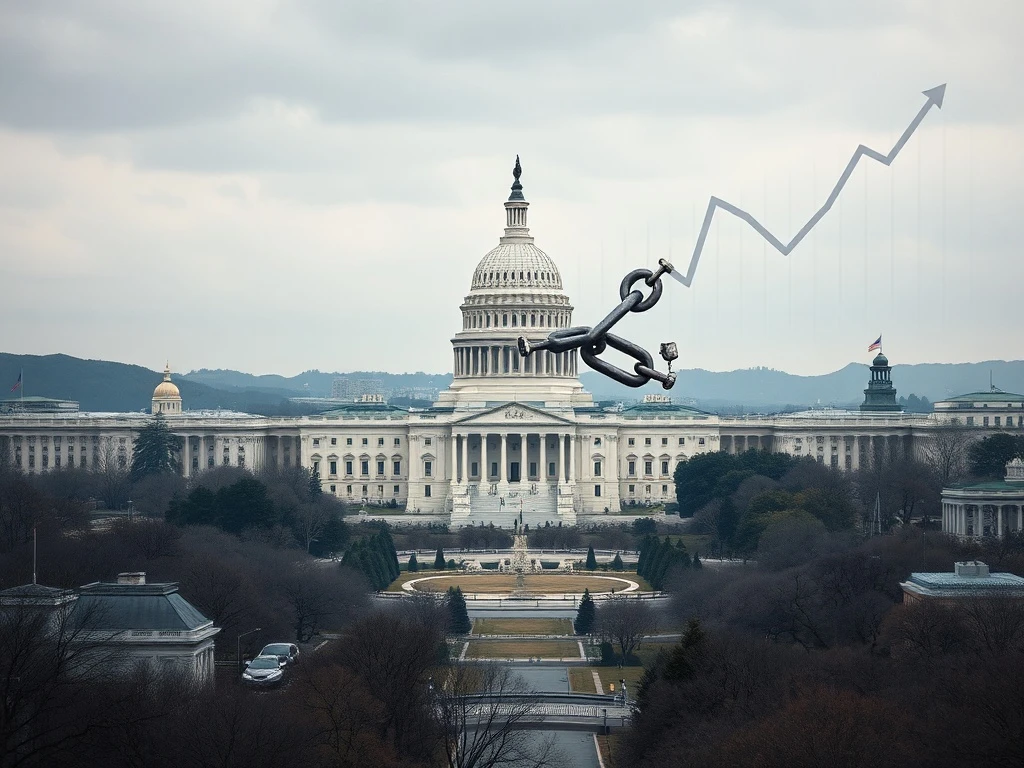
The U.S. government faces another prolonged shutdown. This political stalemate often casts a shadow over financial markets. Cryptocurrency investors, therefore, closely monitor such events for potential impacts on crypto market stability. The recent failure of a Republican stopgap bill ensures the shutdown will continue, raising questions about broader economic health.
Understanding the Government Shutdown Impact
The U.S. government shutdown continues. A Republican-proposed stopgap bill recently failed in the Senate. This failure extends the funding lapse. Consequently, many non-essential federal operations remain suspended. This ongoing government shutdown impact raises concerns across economic sectors. Essential services, however, generally continue. Agencies like the Department of Defense and border protection remain operational. Non-essential personnel are furloughed without pay. This situation creates significant uncertainty for federal workers. The lack of federal services also affects various industries indirectly.
The Failed Federal Spending Bill
Republicans introduced a temporary spending measure. This federal spending bill aimed to fund the government for a short period. It included specific policy provisions. These provisions addressed issues like border security. Democrats, however, opposed these measures. They viewed them as partisan. The bill required 60 votes to pass the Senate. It failed to secure enough support. Many senators voted against it. The outcome was predictable given the current political climate. This impasse highlights deep divisions in Congress. Both parties maintain firm stances on fiscal priorities.
Navigating US Political Deadlock
The current situation reflects a persistent US political deadlock. Disagreements over budget priorities drive this gridlock. Both major parties hold firm positions. Republicans often push for spending cuts. Democrats advocate for various social programs. Compromise proves difficult. Historically, shutdowns occur when Congress cannot agree on appropriations bills. These standoffs can last for days or even weeks. Each side blames the other for the impasse. Public trust in government often erodes during these periods. This political instability can influence investor confidence. Furthermore, global partners observe these domestic struggles.
Economic Repercussions and Economic Policy Uncertainty
A prolonged shutdown carries economic risks. It can reduce GDP growth. Consumer confidence may decline. Federal contracts face delays. Small businesses reliant on government work suffer. Economic policy uncertainty grows during these times. Businesses delay investment decisions. This hesitation can slow overall economic activity. Credit rating agencies also monitor these events. A downgrade could increase borrowing costs for the U.S. government. Moreover, the global financial community observes these developments closely. They assess the reliability of U.S. fiscal management. This scrutiny adds pressure to resolve the situation.
Implications for Crypto Market Stability
Traditional markets often react to political instability. The crypto market stability can also face indirect pressure. Some investors view cryptocurrencies as a hedge against traditional financial system risks. During times of economic uncertainty, capital might flow into assets like Bitcoin. Conversely, a broad risk-off sentiment could see investors divest from all volatile assets, including crypto. Therefore, the market’s reaction is not always uniform. Traders carefully assess the specific economic context. The shutdown’s duration plays a crucial role in this assessment.
- Increased Volatility: Markets often become more volatile.
- Investor Sentiment Shift: Some investors might seek safety in digital assets.
- Dollar Fluctuations: A weaker dollar could boost crypto, or vice versa.
- Regulatory Delays: Government agencies involved in crypto regulation might experience operational slowdowns.
The direct impact on daily crypto operations is usually minimal. However, the indirect effects through macroeconomics are significant. Market participants carefully watch for shifts in sentiment. They also monitor global economic indicators. Any major economic disruption can ripple through digital asset markets.
Investor Sentiment and Future Outlook
Investor sentiment remains crucial. News of the extended shutdown creates apprehension. Many market participants prefer stability. They seek clear policy directions. The ongoing government shutdown impact complicates this. Future legislative efforts face an uphill battle. Another vote on a different spending bill is expected. However, the path to resolution remains unclear. Analysts predict continued market vigilance. They advise investors to stay informed. Ultimately, a resolution requires bipartisan cooperation. This cooperation is currently lacking. The duration of the shutdown will determine its full economic fallout. Both traditional and crypto investors will continue to monitor developments closely.
Conclusion:
The failure of the Republican stopgap bill prolongs the U.S. government shutdown. This situation underscores deep political divisions. It also introduces significant economic policy uncertainty. While direct impacts on cryptocurrency operations are limited, the broader economic environment influences crypto market stability. Investors should monitor both political developments and their wider economic repercussions. Navigating this period requires careful consideration of market dynamics and potential shifts in investor behavior.
Frequently Asked Questions (FAQs)
Q1: What caused the current U.S. government shutdown?
A1: The shutdown occurred because Congress failed to pass new appropriations bills or a temporary spending measure before the previous funding expired. Disagreements over budget priorities and specific policy riders in proposed bills led to the impasse.
Q2: How does a government shutdown typically affect the U.S. economy?
A2: A government shutdown can negatively impact the U.S. economy by reducing GDP growth, decreasing consumer confidence, delaying federal contracts, and furloughing non-essential federal workers. This creates economic uncertainty and can slow overall economic activity.
Q3: Is the cryptocurrency market directly impacted by a U.S. government shutdown?
A3: The direct impact on daily cryptocurrency operations is usually minimal. However, indirect effects through broader economic uncertainty, shifts in investor sentiment, and potential fluctuations in the U.S. dollar can influence crypto market stability. Regulatory agencies might also experience operational slowdowns.
Q4: What is a “stopgap bill,” and why did it fail in the Senate?
A4: A stopgap bill, also known as a continuing resolution, is a temporary spending measure designed to fund the government for a short period while a longer-term budget is negotiated. The Republican-proposed bill failed in the Senate because it included policy provisions that Democrats opposed, preventing it from securing the necessary 60 votes to pass.
Q5: What are the potential long-term consequences if the government shutdown continues?
A5: A prolonged shutdown could lead to more significant economic slowdowns, further erosion of public trust, potential downgrades of the U.S. credit rating, and increased economic policy uncertainty. It also delays critical government functions and services, affecting many sectors.
Q6: How do investors generally react to such political deadlocks?
A6: Investors typically react to political deadlocks and government shutdowns with caution. They often become more risk-averse, leading to increased market volatility. Some might seek “safe haven” assets, while others might pull back from all speculative investments, including cryptocurrencies, until the political situation stabilizes.
Related News
- Bhutan to Host National Sei Validator: A Strategic Leap Toward Digital Sovereignty
- Bhutan’s Sei Validator Launch: A Strategic Leap for the Nation’s Digital Economy
- BTC Perpetual Futures Long/Short Ratio Reveals Critical Market Sentiment Shift