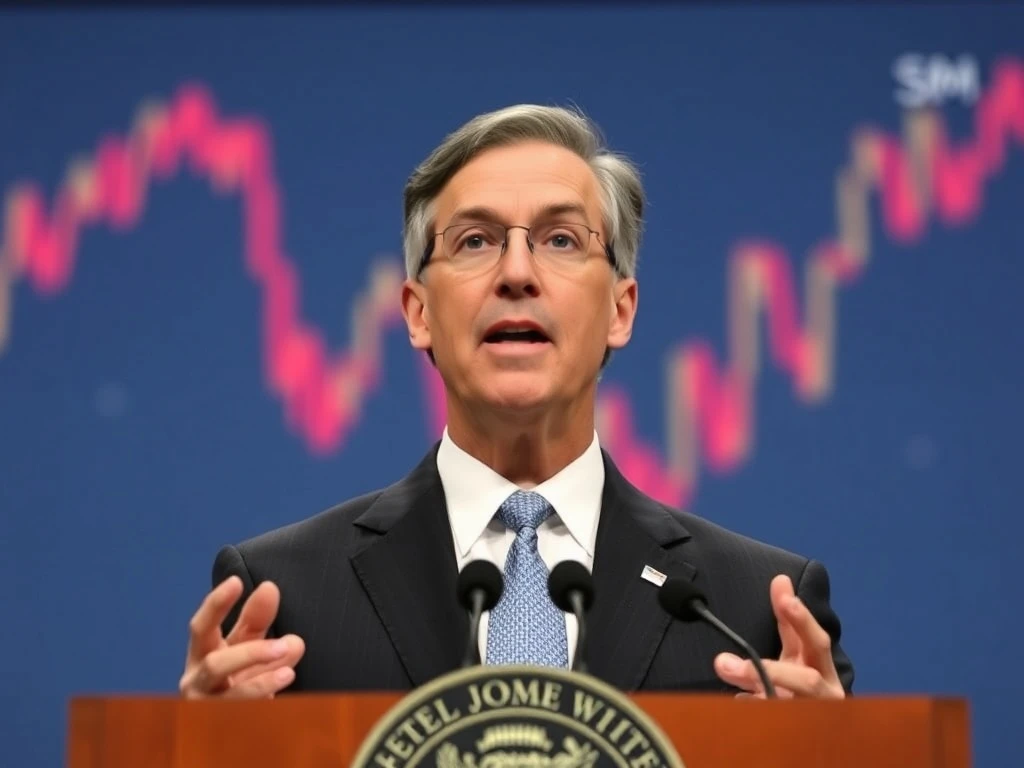
Understanding the forces that shape global markets is crucial for anyone navigating the financial landscape, especially those invested in cryptocurrencies. Recent statements from **Jerome Powell**, the Chair of the Federal Reserve, offer vital insights into the current **economic outlook** and its potential implications. Powell has indicated that any **tariff inflation** impacting prices will likely be temporary, providing a nuanced perspective on market stability.
Jerome Powell’s Stance on Tariff Inflation
Federal Reserve Chair Jerome Powell recently addressed the nation’s economic health. He spoke directly about the impact of tariffs on consumer prices. Powell conveyed that any price pressures from tariffs are expected to be short-lived. This assessment came during his remarks on the broader **economic outlook** in Warwick, Rhode Island. His comments offer a crucial signal to investors and the public.
Furthermore, Powell acknowledged that inflation levels remain slightly elevated. Despite this, he expressed confidence in the **Federal Reserve’s** current position. The central bank recently enacted an **interest rate cut** in September. This move places the Fed in a ‘favorable position,’ according to Powell. This strategic decision aims to support economic growth and manage inflationary pressures effectively. Therefore, market participants closely watch these pronouncements for future guidance.
Understanding the Federal Reserve’s Economic Outlook
The **Federal Reserve** plays a pivotal role in guiding the U.S. economy. Its primary goals include maximizing employment and maintaining price stability. When discussing the **economic outlook**, Powell highlighted several key factors. He emphasized that global trade tensions, specifically tariffs, introduce uncertainty. However, he believes the domestic economy remains resilient. This resilience is a testament to strong consumer spending and a robust job market.
Powell’s assessment of **tariff inflation** as temporary suggests a measured approach. He indicated that the Fed monitors data closely. They will adjust policy as needed. This flexibility is essential for responding to evolving economic conditions. Consequently, businesses and consumers can anticipate a period of careful observation from the central bank. The Fed aims to avoid overreacting to short-term fluctuations. They prefer to focus on long-term stability.
The Impact of the Recent Interest Rate Cut
In September, the **Federal Reserve** implemented an **interest rate cut**. This decision aimed to provide further stimulus to the economy. Lower interest rates typically encourage borrowing and spending. This can boost economic activity. Powell stated that this cut positioned the Fed favorably. It gives them more flexibility to respond to future economic challenges. For instance, if global growth slows, the Fed has room to act.
The **interest rate cut** also impacts various sectors. It can reduce the cost of mortgages and business loans. This stimulates investment and consumption. Moreover, it influences the value of the U.S. dollar. A weaker dollar can make American exports more competitive. These effects collectively contribute to the broader **economic outlook**. They help mitigate potential negative impacts from issues like **tariff inflation**. Thus, the Fed’s proactive stance aims to safeguard economic stability.
Navigating Tariff Inflation and Market Stability
The concept of **tariff inflation** refers to price increases resulting from taxes on imported goods. When tariffs are imposed, import costs rise. These higher costs are often passed on to consumers. However, Powell’s view suggests this effect might not be sustained. He believes the market can absorb these costs over time. Alternatively, businesses may find new supply chains. They might also adjust their pricing strategies.
For investors, especially in the cryptocurrency space, understanding this nuance is critical. While traditional markets react to inflationary pressures, crypto assets can also feel the ripple effects. A stable economic environment, free from persistent **tariff inflation**, generally fosters greater investor confidence. This confidence can positively influence risk assets like cryptocurrencies. Conversely, prolonged economic uncertainty can lead to caution. Therefore, Powell’s ‘temporary’ assessment offers a degree of reassurance. It suggests a potential ceiling on tariff-driven price hikes. This can contribute to overall market stability.
Global Trade and the Economic Outlook
Global trade dynamics significantly influence the **economic outlook**. Tariffs represent a barrier to free trade. They can disrupt supply chains and increase production costs. Powell’s comments reflect a careful analysis of these global forces. He understands that trade disputes create headwinds for economic growth. However, he remains optimistic about the U.S. economy’s ability to adapt.
The **Federal Reserve** continually assesses international developments. These assessments inform their policy decisions. A stable global trade environment supports stronger economic performance. Therefore, the Fed hopes for a resolution to ongoing trade tensions. This would further alleviate concerns about **tariff inflation**. It would also bolster the overall global **economic outlook**. Powell’s leadership emphasizes prudent policy-making in a complex global arena.
In conclusion, Federal Reserve Chair **Jerome Powell’s** recent statements offer a clear perspective on current economic challenges. His view that **tariff inflation** will likely be temporary provides a sense of calm amidst trade tensions. The **Federal Reserve’s** strategic **interest rate cut** in September positions the institution favorably. This allows for flexibility in managing the economy. As we move forward, market participants will continue to monitor the **economic outlook**. Powell’s measured approach underscores a commitment to long-term stability and growth. This outlook is crucial for all financial markets, including the evolving world of cryptocurrencies.
Frequently Asked Questions (FAQs)
Q1: What exactly is tariff inflation?
A1: Tariff inflation occurs when governments impose taxes (tariffs) on imported goods. These taxes increase the cost for importers, who often pass these higher costs on to consumers through elevated prices for goods and services.
Q2: Why does Jerome Powell believe tariff inflation will be temporary?
A2: Powell suggests that the economy can adjust to tariffs over time. Businesses might find alternative suppliers, absorb some costs, or consumers might shift their purchasing habits. This adaptability can prevent tariffs from causing sustained, long-term inflation.
Q3: How does an interest rate cut by the Federal Reserve impact the economy?
A3: An interest rate cut makes borrowing cheaper for consumers and businesses. This encourages spending and investment, which can stimulate economic growth. It also makes the U.S. dollar potentially less attractive, which can boost exports.
Q4: What is the Federal Reserve’s main role in the economy?
A4: The **Federal Reserve** serves as the central bank of the United States. Its primary roles include conducting monetary policy to foster maximum employment and price stability, supervising and regulating banking institutions, and maintaining the stability of the financial system.
Q5: How might Powell’s statements affect cryptocurrency markets?
A5: While not directly linked, a stable and predictable **economic outlook** generally benefits all financial markets, including cryptocurrencies. If **tariff inflation** is temporary, it reduces economic uncertainty. This can encourage investor confidence and potentially increase appetite for risk assets like crypto.
Related News
- Kalshi Prediction Market Faces Devastating Legal Challenge from Connecticut Tribes Over Gaming Law Violations
- Tokenize ETF Shares: F/m Investments’ Bold SEC Request Could Transform Traditional Finance
- Zcash Grant: Winklevoss Twins’ Strategic Investment Boosts Shielded Labs’ Privacy Mission