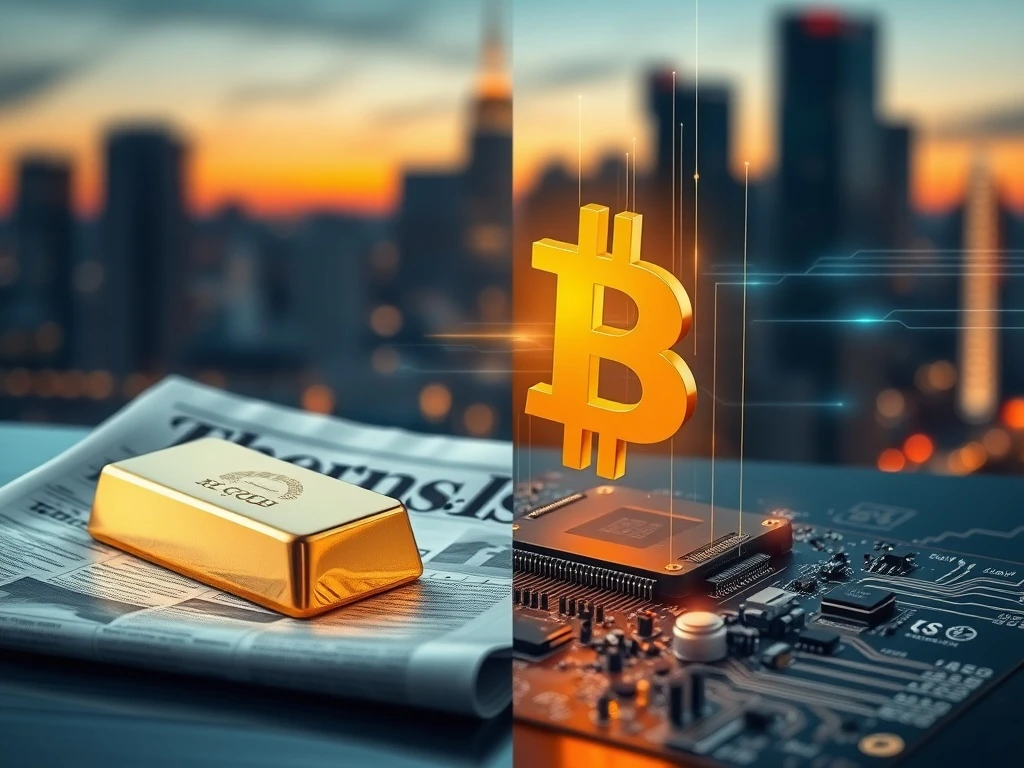
In a significant declaration reshaping modern portfolio theory, renowned financial author Robert Kiyosaki has publicly stated he would select Bitcoin over gold if forced to choose a single investment, a stunning endorsement from a figure long associated with tangible assets. This perspective, shared via social media platform X, arrives during a period of intense global monetary uncertainty and offers a pivotal analysis of digital scarcity versus traditional store-of-value models. The ‘Rich Dad Poor Dad’ author’s comments provide crucial context for investors navigating the 2025 financial landscape, where digital asset integration continues to accelerate. Consequently, his rationale warrants detailed examination for its implications on personal finance strategy.
Bitcoin Investment Thesis: Scarcity as the Ultimate Driver
Robert Kiyosaki’s preference for a Bitcoin investment fundamentally hinges on the cryptocurrency’s immutable scarcity. He explicitly contrasted Bitcoin’s fixed protocol with the dynamics of precious metals. Specifically, Kiyosaki noted that rising gold prices economically incentivize increased mining activity. This activity, in turn, can lead to greater supply entering the market, which may apply downward pressure on prices over the long term—a basic principle of supply and demand. Conversely, Bitcoin’s supply is algorithmically capped at 21 million coins, a limit enforced by its decentralized network consensus. This digital scarcity is absolute and predictable, creating a starkly different economic model from commoditized precious metals.
Furthermore, this fixed supply operates independently of price. Whether Bitcoin’s value rises or falls, no entity can mint new coins beyond the predetermined schedule. This characteristic makes Bitcoin uniquely resistant to inflationary pressures that can devalue traditional currencies and, to a lesser extent, commoditized stores of value. Financial analysts often refer to this property as ‘programmable scarcity,’ a feature impossible to replicate in the physical world. Therefore, Kiyosaki’s analysis spotlights a core technological innovation that redefines asset preservation for the digital age.
Gold Versus Bitcoin: A Historical and Economic Comparison
To fully grasp Kiyosaki’s statement, one must examine the historical roles of gold and Bitcoin. For millennia, societies have utilized gold as a primary store of value and medium of exchange. Its value derives from physical properties, cultural significance, and industrial utility. Central banks still hold vast gold reserves, cementing its status within the traditional financial system. However, gold’s market dynamics are indeed subject to the forces Kiyosaki described. High prices trigger expanded exploration and technological advances in extraction, potentially increasing the above-ground supply over time.
In contrast, Bitcoin represents a nascent, digitally-native asset class. Its value proposition stems from cryptographic security, network decentralization, and its fixed monetary policy. The following table outlines key comparative aspects:
| Attribute | Gold | Bitcoin |
|---|---|---|
| Supply Nature | Ultimately expandable (mineable) | Absolutely finite (21 million cap) |
| Portability & Transfer | Physical, costly to secure/transport | Digital, globally transferable peer-to-peer |
| Verification & Custody | Requires assaying and secure vaults | Verified by public blockchain, self-custody possible |
| Primary Value Driver | Historical precedent, industrial use, jewelry | Network security, monetary policy, adoption as digital gold |
This comparison highlights the paradigm shift Kiyosaki acknowledges. While gold’s value is deeply entrenched, Bitcoin offers a novel combination of attributes previously unavailable. Market data from 2024 showed increasing institutional allocation to Bitcoin, often framed as a hedge against currency debasement, a role traditionally filled by gold. Thus, Kiyosaki’s commentary reflects a broader trend of portfolio diversification into digital assets.
The Critical Nuance of Kiyosaki’s Diversification Advice
Importantly, Robert Kiyosaki did not advocate for abandoning traditional assets. His hypothetical choice of a single investment served to underscore Bitcoin’s unique strength. He immediately followed his statement with pragmatic advice for actual portfolio construction. Kiyosaki explicitly recommended holding a diversified mix of gold, silver, and Bitcoin. This tri-asset strategy aims to balance the stability and historical resilience of precious metals with the asymmetric growth potential and digital scarcity of Bitcoin.
This approach aligns with modern portfolio theory, which emphasizes diversification across uncorrelated or differently correlated assets to reduce overall risk. During different economic climates—such as high inflation, currency crises, or technological adoption surges—these assets may perform differently. For instance, gold may react strongly to geopolitical tension, while Bitcoin may be more sensitive to adoption cycles and liquidity flows. By holding all three, an investor gains exposure to multiple distinct value preservation mechanisms. Kiyosaki’s ultimate message, therefore, is not about exclusion but about recognizing Bitcoin’s ascendant role within a balanced, forward-looking asset allocation framework.
The Broader Context: Monetary Policy and Digital Asset Adoption
Kiyosaki’s views cannot be separated from the current macroeconomic environment. Persistent concerns about government debt levels, expansive monetary policies, and currency inflation have driven many investors, including high-profile figures, to seek alternative stores of value. Kiyosaki has been a long-time critic of fiat currency systems, often promoting tangible assets. His evolving stance to include, and even prioritize, Bitcoin signifies a recognition that the definition of a ‘tangible’ asset is evolving in the digital era.
Moreover, the regulatory landscape for cryptocurrencies has matured significantly by 2025. Clearer frameworks in major economies, the advent of spot Bitcoin Exchange-Traded Funds (ETFs), and integration by traditional financial institutions have provided a more stable foundation for Bitcoin investment. These developments reduce perceived execution risk and enhance Bitcoin’s accessibility for mainstream investors, validating its inclusion in serious financial discourse. Kiyosaki’s statement acts as both a reflection of this progress and a catalyst for further consideration among his vast audience of retail investors.
Conclusion
Robert Kiyosaki’s declaration in favor of a Bitcoin investment, when posed with a singular choice, marks a notable evolution in mainstream financial thought. His analysis correctly centers on the fundamental economic difference between an expandable commodity and a digitally-scarce protocol. However, his simultaneous endorsement of a diversified portfolio containing gold, silver, and Bitcoin provides a nuanced and practical roadmap for investors. This perspective underscores Bitcoin’s maturation from a speculative technological experiment to a legitimate component of wealth preservation strategy, competing with and complementing ancient stores of value. As the global financial system continues its digital transformation, such insights from established financial educators will likely guide millions in re-evaluating their long-term asset allocation.
FAQs
Q1: What was Robert Kiyosaki’s main reason for choosing Bitcoin over gold?
A1: Kiyosaki’s primary reason was Bitcoin’s fixed, capped supply of 21 million coins. He contrasted this with gold, whose supply can increase through mining when prices rise, potentially diluting its value over time.
Q2: Does Robert Kiyosaki recommend selling all gold to buy Bitcoin?
A2: No, he does not. He explicitly advised holding gold, silver, and Bitcoin for proper asset diversification. His hypothetical choice was to illustrate Bitcoin’s unique value proposition, not to suggest abandoning precious metals.
Q3: How does Bitcoin’s scarcity differ from gold’s scarcity?
A3: Bitcoin’s scarcity is absolute and protocol-enforced; only 21 million will ever exist. Gold’s scarcity is relative and physical; while finite on Earth, the total above-ground supply can and does increase through mining efforts, which are economically motivated.
Q4: What is the significance of Kiyosaki making this statement in 2025?
A4: The significance lies in the matured context. By 2025, clearer cryptocurrency regulations, institutional adoption via ETFs, and Bitcoin’s longer performance history provide a more stable foundation for such an endorsement, lending it greater weight than it might have had a decade earlier.
Q5: How should an investor interpret Kiyosaki’s advice for their own portfolio?
A5: Investors should interpret it as an argument for including Bitcoin as a strategic asset class alongside traditional hedges like precious metals. The core takeaway is diversification across different types of scarcity—physical and digital—to hedge against various economic risks. Individual allocation should always align with personal risk tolerance and investment goals.
Related News
- XRPL Diamond Tokenization: Revolutionary $280M Digital Transformation Powers Ripple’s Gulf Infrastructure Expansion
- Cryptocurrency Regulation Crisis: How SEC Evasion Dooms Most Tokens to Failure
- Quantum Computing Bitcoin Security: Coinshares Reveals Why Cryptocurrency Faces No Immediate Crisis