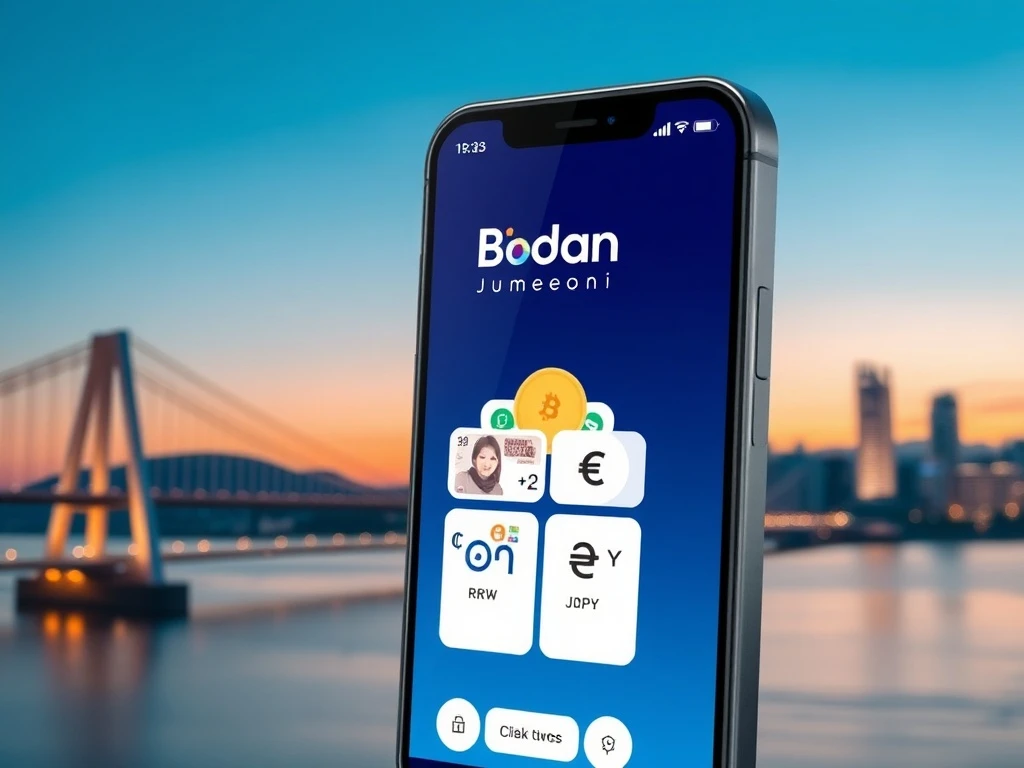
South Korea has taken a groundbreaking step toward integrating traditional finance with digital assets through the launch of the Bidan Jumeoni wallet, a platform designed to enable direct foreign currency exchange for KRW-pegged stablecoins. This development, reported by the Seoul Economic Daily in late 2025, represents a significant milestone in the country’s digital asset infrastructure evolution. The wallet’s pre-launch phase showcases its potential to transform how individuals and businesses interact with both local and international currencies through blockchain technology.
Bidan Jumeoni Wallet: South Korea’s KRW Stablecoin Gateway
The Bidan Jumeoni wallet application emerged from a strategic collaboration between three major entities. Hashed, a prominent blockchain venture studio, partnered with Naver Financial, the financial arm of South Korea’s internet giant, and the Busan Digital Asset Exchange. These organizations signed a tripartite memorandum of understanding in May 2025, committing to develop this innovative digital asset solution. Consequently, the wallet represents a convergence of technological expertise, financial infrastructure, and regulatory alignment.
Currently in its pre-launch demonstration phase, the application provides users with a preview of its core functionalities. The interface reportedly emphasizes user experience while maintaining robust security protocols. Moreover, the wallet’s architecture supports multiple digital assets with a particular focus on stablecoins pegged to the Korean Won. This strategic direction aligns with South Korea’s broader financial digitization initiatives that have accelerated throughout the early 2020s.
Forex-to-Stablecoin Exchange Mechanism
The wallet’s most notable feature enables users to exchange foreign currencies directly for ‘Dongbaekjeon,’ Busan’s local currency issued as a KRW-pegged stablecoin. This mechanism creates a bridge between traditional forex markets and blockchain-based digital assets. Essentially, users can convert currencies like US dollars, euros, or Japanese yen into a digital representation of Korean Won that maintains a 1:1 peg with the fiat currency.
This process involves several technical and regulatory components. First, the system must verify foreign currency deposits through established banking channels. Next, it mints or allocates an equivalent amount of Dongbaekjeon stablecoins to the user’s wallet. The stablecoin’s value remains tied to the Korean Won through reserve mechanisms that the issuing authorities maintain. Importantly, this entire exchange occurs within a regulated framework that South Korean financial authorities oversee.
Infrastructure Development and Regulatory Context
South Korea’s approach to digital assets has evolved significantly since the initial cryptocurrency boom of 2017. The government implemented the Specific Financial Information Act in 2021, establishing licensing requirements for cryptocurrency exchanges. Subsequently, regulatory clarity improved throughout 2023 and 2024, creating an environment conducive to innovative financial products. The Bidan Jumeoni wallet development reflects this maturation, operating within clearly defined legal parameters.
The Busan Digital Asset Exchange plays a crucial role in this ecosystem. As a government-supported initiative, it provides the regulated venue for digital asset trading that underpins the wallet’s functionality. Meanwhile, Naver Financial contributes its extensive experience in digital payment systems and user authentication. Hashed brings blockchain development expertise and connections to the broader cryptocurrency ecosystem. Together, these partners address the technical, financial, and compliance aspects necessary for a successful implementation.
Comparative Analysis: Global Stablecoin Landscape
South Korea’s entry into the national stablecoin space places it among several countries exploring similar initiatives. The table below illustrates how Dongbaekjeon compares to other prominent national stablecoin projects:
| Stablecoin | Country | Pegged Currency | Primary Use Case | Status (2025) |
|---|---|---|---|---|
| Dongbaekjeon | South Korea | Korean Won (KRW) | Local commerce, forex exchange | Pre-launch |
| Digital Euro | European Union | Euro (EUR) | Retail payments | Pilot phase |
| E-CNY | China | Chinese Yuan (CNY) | Domestic payments | Nationwide rollout |
| Project Hamilton | United States | US Dollar (USD) | Wholesale settlements | Research phase |
Unlike many global initiatives focused primarily on domestic payments, the Bidan Jumeoni wallet emphasizes cross-border functionality from its inception. This distinctive approach addresses South Korea’s position as a major trading economy with significant foreign currency flows. Additionally, the wallet integrates with existing local currency systems rather than replacing them, creating a complementary relationship between traditional and digital finance.
Potential Impacts on South Korea’s Financial Ecosystem
The successful implementation of the Bidan Jumeoni wallet could produce several transformative effects. First, it may reduce friction in foreign currency exchanges for both tourists and businesses. Traditional forex transactions often involve multiple intermediaries, fees, and processing delays. Conversely, blockchain-based exchanges can potentially streamline this process while maintaining regulatory compliance.
Second, the wallet could enhance financial inclusion for foreign residents and businesses operating in South Korea. By providing direct access to KRW-pegged digital assets, the system might simplify financial operations for entities without extensive local banking relationships. Furthermore, the transparency inherent in blockchain transactions could improve audit trails and regulatory oversight compared to some traditional systems.
Key potential benefits include:
- Reduced transaction costs for currency conversion
- Faster settlement times compared to traditional banking systems
- Enhanced transparency through blockchain record-keeping
- Improved accessibility to Korean financial markets
- Strengthened local currency through digital adoption
Technical Architecture and Security Considerations
The Bidan Jumeoni wallet reportedly employs a hybrid architecture that balances decentralization with regulatory requirements. While specific technical details remain proprietary during the pre-launch phase, industry analysts suggest the system likely utilizes permissioned blockchain elements. This approach enables transaction validation by authorized nodes while maintaining the immutability and transparency benefits of distributed ledger technology.
Security measures probably include multi-signature wallets, biometric authentication, and cold storage for reserve assets. These precautions address concerns about digital asset theft that have affected earlier cryptocurrency platforms. Additionally, the involvement of established financial institutions like Naver Financial suggests integration with existing financial crime prevention systems, including anti-money laundering (AML) and know-your-customer (KYC) protocols.
Timeline and Implementation Roadmap
The Bidan Jumeoni project follows a deliberate development timeline that reflects its regulatory significance. The initial memorandum of understanding in May 2025 established the partnership framework. Subsequently, the development team conducted technical feasibility studies and regulatory consultations throughout mid-2025. The current pre-launch application demonstration represents the first public phase, allowing for user feedback and system refinement before full deployment.
Looking forward, industry observers anticipate a phased rollout beginning with limited pilot programs. These initial implementations will likely involve selected user groups in Busan, testing both technical performance and regulatory compliance. Assuming successful pilot results, broader availability could follow throughout 2026. This cautious approach mirrors South Korea’s generally methodical stance toward financial innovation, prioritizing stability alongside progress.
Conclusion
The Bidan Jumeoni wallet represents a significant advancement in South Korea’s digital asset infrastructure, particularly for KRW stablecoin exchange. By enabling direct foreign currency conversion to Dongbaekjeon stablecoins, the platform bridges traditional finance and blockchain technology. This development reflects years of regulatory evolution and technical preparation within South Korea’s financial sector. While currently in pre-launch demonstration, the wallet’s potential to streamline forex transactions and expand financial access positions it as a noteworthy innovation in the 2025 digital finance landscape. The collaboration between Hashed, Naver Financial, and the Busan Digital Asset Exchange demonstrates how strategic partnerships can advance national digital currency initiatives within established regulatory frameworks.
FAQs
Q1: What is the Bidan Jumeoni wallet?
The Bidan Jumeoni wallet is a digital asset application developed through a partnership between Hashed, Naver Financial, and the Busan Digital Asset Exchange. It enables users to exchange foreign currencies for KRW-pegged stablecoins, specifically Dongbaekjeon, Busan’s local digital currency.
Q2: How does the forex-to-stablecoin exchange work?
Users deposit foreign currency through connected banking channels, and the system issues an equivalent amount of Dongbaekjeon stablecoins to their wallet. These digital tokens maintain a 1:1 value peg with the Korean Won through reserve mechanisms maintained by the issuing authority.
Q3: When will the wallet be fully available?
The wallet is currently in a pre-launch demonstration phase showcasing its features. Full public availability will likely follow pilot programs and regulatory approvals, with industry observers anticipating potential broader rollout in 2026.
Q4: What makes Dongbaekjeon different from other stablecoins?
Dongbaekjeon is specifically designed as a local currency for Busan, South Korea, issued in digital form as a KRW-pegged stablecoin. Unlike global stablecoins, it focuses on regional commerce and integrates with South Korea’s specific regulatory and financial infrastructure.
Q5: Is this wallet part of South Korea’s central bank digital currency (CBDC) project?
No, the Bidan Jumeoni wallet and Dongbaekjeon stablecoin represent separate initiatives from South Korea’s CBDC research. They are developed by private sector entities in partnership with local government, whereas a potential CBDC would be issued directly by the Bank of Korea.
Q6: What security measures does the wallet employ?
While specific technical details remain proprietary, the wallet likely incorporates multi-signature authentication, biometric verification, cold storage for reserves, and integration with existing financial crime prevention systems to ensure security and regulatory compliance.
Related News
- Bitget TradFi’s Stunning $4B Daily Volume Surge Reveals Crypto Traders’ Massive Global Market Migration
- Ripple’s Strategic XRP Sales: How $109 Billion in Token Distribution Fueled 31,000% Growth
- Cryptocurrency Bull Market Demands Ruthless Elimination of Junk Coins, Analyst Benjamin Cowen Warns