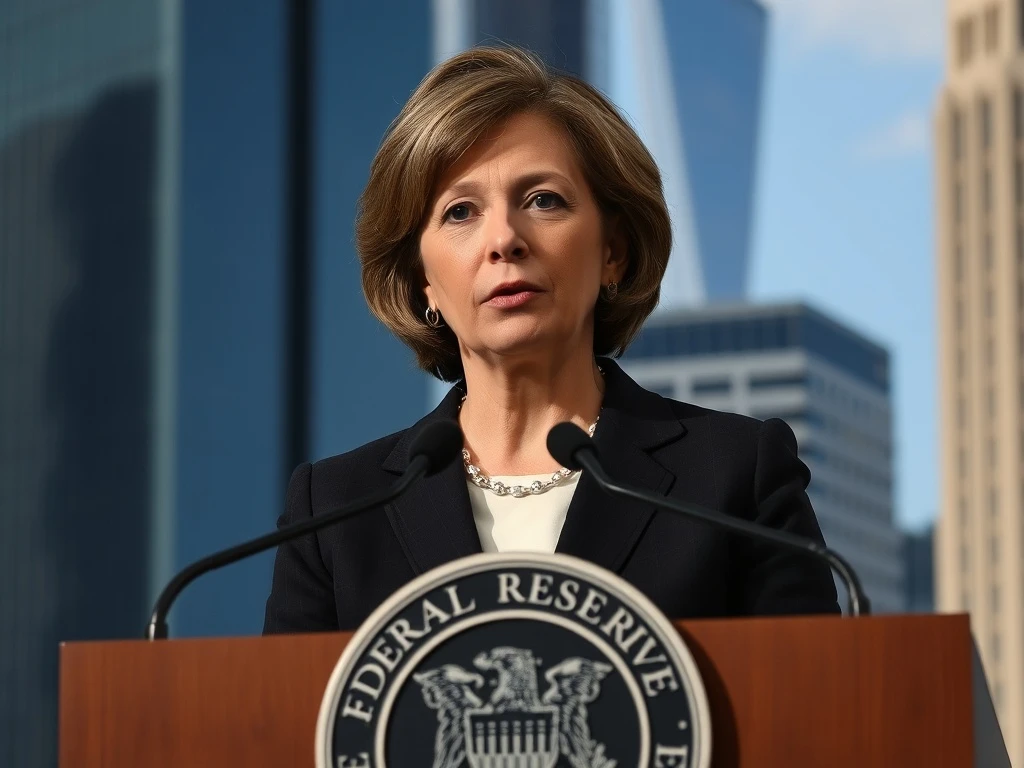
WASHINGTON, D.C. – March 2025: In a significant statement reinforcing a foundational principle of modern economics, Federal Reserve Governor Lisa Cook has publicly pledged to defend the central bank’s independence for the duration of her tenure. This commitment arrives at a critical juncture for global monetary policy, directly impacting financial markets, inflation expectations, and long-term economic stability. Consequently, her declaration underscores the ongoing debate about the appropriate role of central banks in democratic societies, especially following periods of intense political and economic pressure.
Understanding the Federal Reserve’s Crucial Independence
Central bank independence represents a cornerstone of contemporary economic governance. Essentially, it refers to the operational freedom of a monetary authority, like the Federal Reserve, to set policy without direct political interference. This autonomy allows policymakers to make difficult, often unpopular decisions—such as raising interest rates to combat inflation—based on economic data rather than short-term political cycles. Historically, nations with independent central banks demonstrate lower and more stable inflation rates, fostering greater investor confidence and sustainable growth. Therefore, Governor Cook’s pledge defends this established economic doctrine, which has guided U.S. monetary policy for decades.
Governor Cook, a respected economist and former professor, brings substantial academic and policy expertise to her role. Her research on inequality and monetary policy directly informs her perspective on the Fed’s dual mandate of price stability and maximum employment. Moreover, her recent statement aligns with a long tradition of Fed officials, from Paul Volcker to Jerome Powell, who have consistently argued that political independence is non-negotiable for effective policy. For instance, during the high-inflation era of the 1970s and 80s, it was the Fed’s independence that empowered Chairman Volcker to implement the aggressive rate hikes necessary to restore price stability, despite severe political backlash.
The Historical Context of Political Pressure
The Federal Reserve has frequently navigated complex relationships with the executive and legislative branches. Notably, recent administrations have occasionally publicly criticized Fed policy decisions, testing the boundaries of its traditional independence. These episodes highlight a persistent tension: while the Fed is accountable to Congress and operates under a mandate set by law, its day-to-day decisions on interest rates and balance sheet management are designed to be insulated from partisan influence. Governor Cook’s pledge, therefore, serves as a timely reaffirmation of this institutional firewall. It signals to markets and policymakers alike that the Fed’s decision-making framework will remain data-dependent and forward-looking.
Why Central Bank Autonomy Matters for the Economy
The practical impacts of a strong, independent Federal Reserve are profound and far-reaching. Primarily, it anchors inflation expectations. When businesses, consumers, and investors trust that the Fed will act to maintain price stability, they make long-term plans with greater confidence. This stability reduces risk premiums in financial markets, leading to lower borrowing costs for households and companies. Conversely, perceived political influence can trigger market volatility, currency depreciation, and a loss of credibility that is difficult to regain.
- Market Stability: Independent central banks provide predictable policy environments, reducing uncertainty for global investors.
- Inflation Control: Autonomous institutions can implement necessary tightening measures without fear of political reprisal.
- Long-term Planning: Businesses rely on stable monetary policy for capital investment and hiring decisions.
Furthermore, in the current economic landscape of 2025, characterized by rapid technological change and geopolitical shifts, the Fed’s role is more complex than ever. It must balance combating inflation, ensuring financial stability, and navigating the digital transformation of currency, including the potential for a central bank digital currency (CBDC). Each of these tasks requires technical expertise and a long-term view that political cycles often cannot accommodate. Governor Cook’s defense of independence is, in essence, a defense of the technical, apolitical management of the nation’s money supply.
The Legal and Institutional Framework of the Fed
The Federal Reserve’s independence is not absolute but is carefully structured within a system of checks and balances. Governors like Lisa Cook are appointed by the President and confirmed by the Senate for staggered 14-year terms, a design specifically intended to insulate them from political pressure. However, the Fed remains accountable to Congress through regular testimony, reporting requirements, and statutory oversight. This structure creates a balance: operational independence for technical decisions within a framework of democratic accountability for its broad goals.
The table below outlines key aspects of the Federal Reserve’s independent structure:
| Feature | Purpose |
|---|---|
| Staggered 14-year terms for Governors | Prevents any single administration from dominating the Board. |
| Funding from interest on securities, not Congress | Removes appropriations as a tool for political leverage. |
| Dual Mandate (Price Stability & Max Employment) | Provides clear, congressionally-set goals for policy. |
| Regular Congressional Testimony (Humphrey-Hawkins) | Ensures transparency and public accountability. |
Governor Cook’s pledge reinforces the intent behind this design. It is a commitment to uphold the spirit of the Federal Reserve Act, which sought to create a central bank free from the politicization that contributed to earlier financial panics. Her statement also comes as some legislative proposals periodically surface to alter the Fed’s structure or subject its policy decisions to greater political review, making her public stance particularly relevant.
Expert Perspectives on the Current Climate
Economists and former policymakers widely support the principle Cook is defending. For example, former Fed Chair Ben Bernanke has often argued that independence allows the Fed to “take away the punch bowl just as the party gets going,” a metaphor for tightening policy before overheating occurs. Similarly, international bodies like the International Monetary Fund consistently champion central bank independence as a key indicator of institutional quality. In the context of 2025, with global debt levels elevated and new financial technologies emerging, this expert consensus holds that an independent Fed is essential for navigating uncertainty and maintaining the dollar’s global reserve currency status.
Conclusion: A Foundational Pledge for Future Stability
Federal Reserve Governor Lisa Cook’s pledge to defend central bank independence is a significant reaffirmation of a core institutional value. Her commitment, grounded in economic history and expert consensus, serves as a vital signal of stability for financial markets and the broader U.S. economy. Ultimately, maintaining the Federal Reserve’s operational autonomy is not about removing accountability but about ensuring that complex monetary policy decisions are made with technical expertise and a long-term perspective, free from the distorting influence of short-term political pressures. As the economic landscape evolves, this principle remains a bedrock for sustainable growth and price stability.
FAQs
Q1: What does “central bank independence” actually mean?
It means the Federal Reserve’s leadership can set monetary policy—primarily interest rates—based on economic analysis and its congressionally mandated goals, without direct instruction or interference from the President, Congress, or political parties.
Q2: Why is Federal Reserve independence considered so important?
History shows that when politicians directly control money supply and interest rates, they often prioritize short-term stimulus (like before elections) over long-term stability, frequently leading to higher inflation and economic booms-and-busts. Independence helps avoid this cycle.
Q3: Is the Federal Reserve completely free from any government oversight?
No. The Fed is an independent agency within government, not outside it. Congress created the Fed, sets its dual mandate, and holds its leaders accountable through hearings and audits. Its independence is operational, not absolute.
Q4: Who is Lisa Cook and what is her background?
Lisa D. Cook is a member of the Board of Governors of the Federal Reserve System. She is a distinguished economist and former professor of economics and international relations at Michigan State University. Her research has focused on economic growth, innovation, and financial institutions.
Q5: Has the Fed’s independence been challenged recently?
Yes, the Fed’s policy decisions, especially during periods of high inflation or market stress, often attract public criticism from political figures. Governor Cook’s statement is a proactive defense of the institution’s need to make data-driven decisions despite such external pressures.
Related News
- Futures Liquidated: Staggering $144 Million Hourly Wipeout Shakes Crypto Markets
- Strategic Shift: Trump Cancels Feb. 1 Tariffs Citing Pivotal Greenland Agreement Framework
- Bitcoin Shatters $90,000 Barrier: A Historic Surge Analyzed