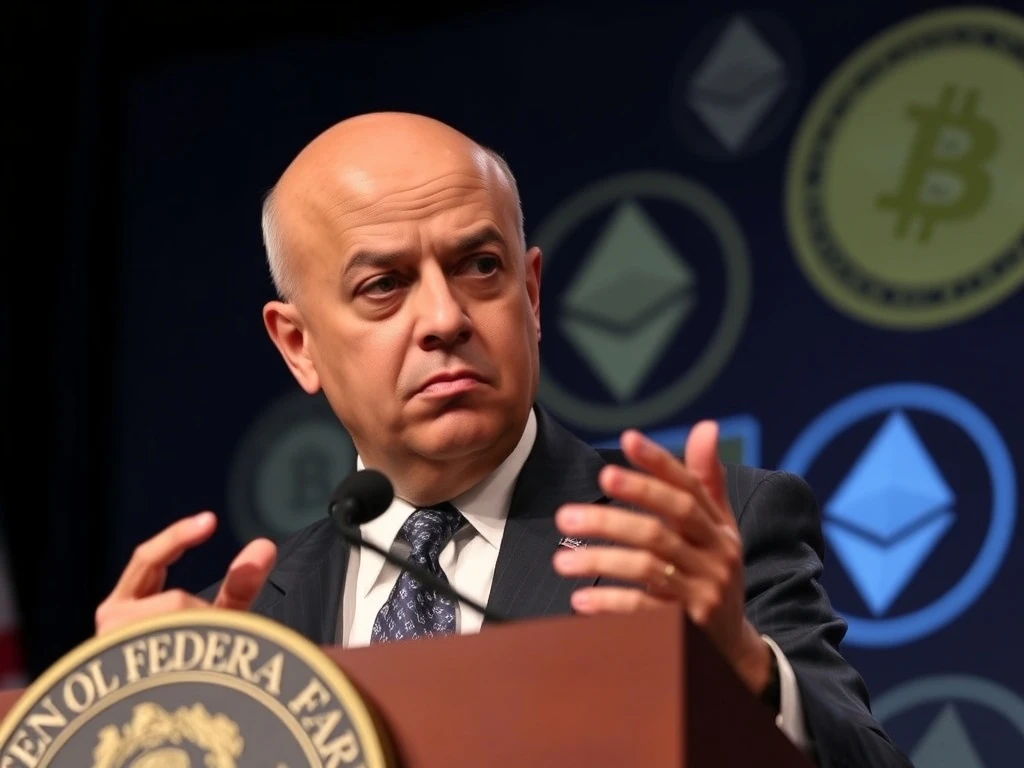
In a significant development for digital asset markets, Minneapolis Federal Reserve President Neel Kashkari has delivered a stark verdict on cryptocurrency’s role in everyday finance, declaring the technology fundamentally useless to consumers. This statement, made during a policy address in Minneapolis, Minnesota, on March 15, 2025, reignites a crucial debate about the practical utility of decentralized digital currencies versus their speculative appeal. Kashkari’s position as a prominent skeptic within the U.S. central banking system lends considerable weight to his critique, potentially influencing regulatory discussions and public perception.
Neel Kashkari’s Core Argument Against Cryptocurrency Utility
President Kashkari’s criticism centers on a fundamental question of value. He argues that traditional financial systems already provide efficient, secure, and regulated services for payments, savings, and credit. Consequently, he sees most consumer-facing cryptocurrency applications as solutions searching for a problem. For instance, he highlights the volatility of major cryptocurrencies like Bitcoin and Ethereum, which makes them poor mediums of exchange or stores of value for daily transactions. Furthermore, Kashkari points to persistent issues with fraud, hacking, and the lack of consumer protections in the crypto ecosystem as critical failures. These problems, he contends, stand in stark contrast to the insured deposits and legal recourse available in the traditional banking sector.
His perspective is not isolated. Several economists and policymakers share concerns about cryptocurrency’s energy consumption and its potential use for illicit activities. However, Kashkari’s voice is particularly influential due to his role in shaping monetary policy. His comments arrive amid a global reassessment of digital asset frameworks. For example, the European Union’s Markets in Crypto-Assets (MiCA) regulation and ongoing U.S. congressional efforts seek to establish clearer rules. Kashkari’s stance suggests a preference for a tightly regulated financial innovation landscape, potentially favoring central bank digital currencies (CBDCs) over permissionless crypto networks.
The Regulatory and Market Context of the Critique
Kashkari’s remarks did not occur in a vacuum. They follow a period of significant market turbulence and regulatory action. The 2022-2023 crypto winter exposed vulnerabilities in major firms like FTX and Celsius, leading to substantial consumer losses. In response, U.S. agencies like the Securities and Exchange Commission (SEC) and the Commodity Futures Trading Commission (CFTC) have intensified enforcement. Kashkari’s comments align with a cautious, evidence-based approach emerging from some regulatory quarters. This approach demands that new financial technologies demonstrably improve upon existing systems in terms of stability, inclusion, and security before gaining widespread adoption.
Examining the Counterarguments for Digital Assets
Proponents of cryptocurrency offer robust counterpoints to Kashkari’s assessment. They argue that utility extends beyond simple consumer payments. Key areas of claimed utility include:
- Financial Inclusion: Providing banking services to unbanked populations via a smartphone.
- Cross-Border Payments: Enabling faster and cheaper international remittances compared to traditional wire services.
- Programmable Money: Facilitating automatic payments and complex financial agreements through smart contracts.
- Inflation Hedge: Serving as a decentralized alternative in countries with unstable national currencies.
Furthermore, advocates distinguish between the technology (blockchain) and specific volatile assets. They note that stablecoins—digital tokens pegged to fiat currencies—attempt to solve the volatility problem Kashkari cites. The growth of decentralized finance (DeFi) for lending and borrowing, while risky, also represents an experiment in disintermediating traditional finance. A balanced analysis requires weighing these potential innovations against the very real risks of scams, complexity, and market manipulation that Kashkari emphasizes.
Historical Perspective on Financial Innovation Skepticism
Skepticism toward new financial technology has historical precedent. Early criticisms of online banking and electronic payments cited security and reliability concerns similar to those leveled at crypto today. Over time, regulation and technological refinement addressed many of those issues. The current debate may follow a similar path. The critical difference, as Kashkari implies, is whether the core innovation justifies the transition cost and risk. The internet revolutionized communication and commerce; the question for crypto is whether it can do the same for money itself, or if it merely adds a speculative, inefficient layer atop existing infrastructure.
The Federal Reserve’s Evolving Stance on Digital Currency
Kashkari’s views exist within a spectrum of opinions at the Federal Reserve. While he represents a skeptical pole, other Fed officials have acknowledged the transformative potential of the underlying technology. The Fed’s own research into a U.S. Central Bank Digital Currency (CBDC) indicates serious engagement with digital money concepts. A CBDC, however, would be a centralized, government-issued digital dollar, fundamentally different from decentralized cryptocurrencies. The table below contrasts key features:
| Feature | Decentralized Cryptocurrency (e.g., Bitcoin) | Potential U.S. CBDC |
|---|---|---|
| Issuer | Decentralized Network | Federal Reserve |
| Backing | Market Demand/Protocol | Full Faith & Credit of U.S. |
| Control | Distributed | Centralized |
| Primary Goal | Decentralized Payment System / Store of Value | Modernize Currency, Maintain Monetary Sovereignty |
| Privacy | Pseudonymous | Likely Designed with Privacy Considerations |
This internal Fed dialogue highlights the nuanced reality: criticism of current crypto assets does not equate to rejection of all digital currency innovation. The debate is about the architecture, governance, and consumer safeguards of future digital money systems.
Potential Impacts on Policy and Consumer Behavior
Statements from senior Fed officials can shape market sentiment and legislative priorities. Kashkari’s blunt assessment may bolster arguments for stricter consumer protection regulations in crypto markets. It could also encourage traditional financial institutions to proceed cautiously with crypto integration. For consumers, such high-profile skepticism serves as a powerful reminder to critically evaluate the risks of any investment, especially in a novel and volatile asset class. It underscores the importance of understanding that cryptocurrencies are not backed by any government or central bank, unlike traditional savings accounts or Treasury bonds.
Ultimately, the market will test Kashkari’s thesis. Consumer utility is not decreed by officials but demonstrated through adoption and use cases that solve real problems. If cryptocurrencies remain primarily speculative assets prone to booms and busts, his critique will gain validity. Conversely, if applications emerge that offer clear, safe, and superior alternatives to existing services for a significant user base, the technology may prove its worth. The coming years will be a crucial proving ground, watched closely by regulators, investors, and innovators alike.
Conclusion
Minneapolis Fed President Neel Kashkari’s declaration that cryptocurrency is useless to consumers frames a pivotal challenge for the digital asset industry. His critique forces a necessary examination of practical utility beyond price speculation. While proponents point to potential benefits in cross-border payments and financial inclusion, significant hurdles around volatility, security, and regulation remain. The path forward likely involves continued innovation, inevitable market consolidation, and increasingly clear regulatory frameworks. Whether cryptocurrency evolves into a mainstream tool for consumers or remains a niche, speculative asset will depend on its ability to reliably solve everyday financial problems better than the systems it seeks to augment or replace. Kashkari’s skepticism provides a critical benchmark for that evaluation.
FAQs
Q1: What exactly did Neel Kashkari say about cryptocurrency?
Neel Kashkari, President of the Minneapolis Federal Reserve, stated that he believes cryptocurrency is “fundamentally useless to consumers.” He argues traditional banking already provides efficient, secure services and that crypto adds little practical value while introducing significant risk.
Q2: Does the entire Federal Reserve share Kashkari’s view on crypto?
No. The Federal Reserve comprises diverse viewpoints. While some officials share Kashkari’s skepticism, others acknowledge blockchain’s potential. The Fed is actively researching a Central Bank Digital Currency (CBDC), showing engagement with digital money concepts, albeit of a centralized nature.
Q3: How do cryptocurrency advocates respond to the “useless” claim?
Advocates argue utility exists in areas like cheaper cross-border remittances, financial inclusion for the unbanked, and programmable money via smart contracts. They distinguish the technology from volatile assets and point to innovations like stablecoins designed for payments.
Q4: Could Kashkari’s comments influence cryptocurrency regulation?
Potentially. As an influential voice in monetary policy, his skepticism could lend support to legislative efforts focused on stringent consumer protection, transparency, and oversight within the crypto industry, aligning with actions already taken by the SEC and CFTC.
Q5: What is the difference between cryptocurrency and a Central Bank Digital Currency (CBDC)?
Cryptocurrencies like Bitcoin are decentralized and not issued by any government. A CBDC would be a digital form of a nation’s fiat currency (like a digital dollar), issued and controlled by the central bank, offering potential benefits of digital technology with sovereign backing.
Related News
- Cryptocurrency Failure Rate Soars: 53.2% of Tokens Launched Since 2021 Have Vanished in Alarming Market Purge
- Bitcoin Price Surges Toward $100,000 Milestone as Geopolitical and Monetary Policy Tensions Create Market Volatility
- Alpaca Series D Funding: The $150M Power Move That Redefines Tokenization Infrastructure