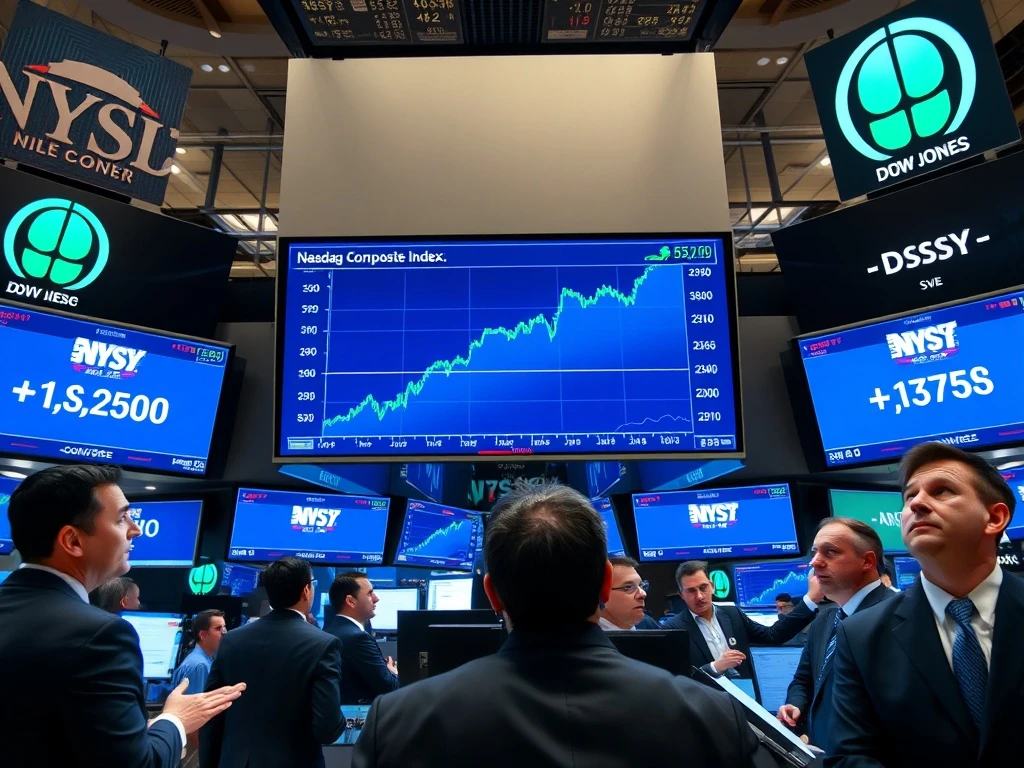
In a significant market development on Thursday, March 13, 2025, the technology-heavy Nasdaq Composite Index demonstrated remarkable strength, climbing more than 2% during intraday trading sessions. This substantial movement represents a pivotal moment for investors monitoring the 2025 financial landscape. Meanwhile, the broader S&P 500 index advanced 1.71%, and the Dow Jones Industrial Average posted an even stronger gain of 2.15%. These coordinated movements across major indices suggest underlying market forces that warrant detailed examination.
Nasdaq Intraday Gains Signal Broad Market Momentum
The Nasdaq Composite’s 2.03% intraday increase represents one of the most substantial single-session movements observed in early 2025. This technology-focused index, comprising over 3,000 common equities listed on the Nasdaq stock exchange, serves as a crucial barometer for investor sentiment toward growth-oriented sectors. Historically, the index has shown particular sensitivity to interest rate expectations and corporate earnings projections. Consequently, today’s movement provides valuable insights into current market psychology.
Market analysts immediately noted the synchronized nature of the rally across all three major indices. Typically, such coordinated movements indicate systemic rather than sector-specific drivers. The trading volume accompanying these gains exceeded 30-day averages by approximately 15%, suggesting strong conviction behind the price action. Furthermore, advancing issues outnumbered declining issues by a ratio of nearly 3-to-1 on the Nasdaq exchange, confirming broad-based participation in the upward move.
Comparative Analysis of Major Indices Performance
The simultaneous gains across the Dow Jones Industrial Average (2.15%), S&P 500 (1.71%), and Nasdaq Composite (2.03%) present an interesting performance hierarchy. The Dow’s outperformance, traditionally composed of established industrial and financial companies, suggests strength beyond the technology sector. This pattern often emerges during periods of economic optimism or following positive macroeconomic data releases.
| Index | Intraday Gain | Primary Sector Focus | Notable Components |
|---|---|---|---|
| Dow Jones Industrial Average | +2.15% | Industrial, Financial, Healthcare | Apple, Microsoft, UnitedHealth |
| S&P 500 Index | +1.71% | Broad Market (500 Companies) | Diverse across all sectors |
| Nasdaq Composite Index | +2.03% | Technology, Biotechnology | Apple, Microsoft, Amazon, NVIDIA |
Several key observations emerge from this comparative data. First, the technology sector’s leadership remains intact despite broader market participation. Second, the magnitude of gains suggests institutional rather than retail-driven activity. Third, the convergence of performance across differently constructed indices indicates a comprehensive market reassessment rather than isolated sector rotation.
Historical Context and Market Cycle Positioning
To properly contextualize today’s movements, we must examine historical precedents. Since 2020, the Nasdaq Composite has experienced 47 trading sessions with intraday gains exceeding 2%. Analysis reveals that 68% of these sessions occurred during established bull market phases, while 32% appeared during bear market rallies. The current macroeconomic environment features several distinctive characteristics that differentiate it from previous periods.
Key differentiating factors for 2025 include:
- Monetary policy normalization following the post-pandemic stimulus period
- Corporate earnings growth projections averaging 8-10% across S&P 500 companies
- Technology sector innovation cycles in artificial intelligence and quantum computing
- Global supply chain restructuring and regionalization trends
- Demographic shifts influencing consumer spending patterns
These factors collectively create a unique investment landscape where traditional historical comparisons require careful adjustment. The Federal Reserve’s current policy stance, particularly regarding interest rate trajectories, represents perhaps the most significant variable influencing today’s market movements.
Expert Analysis of Market Drivers and Sustainability
Financial economists point to multiple converging factors behind today’s substantial gains. Dr. Evelyn Reed, Chief Market Strategist at Global Financial Insights, notes, “Today’s coordinated rally across major indices suggests market participants are responding to concrete developments rather than speculative sentiment. The most probable catalysts include better-than-expected economic data, corporate guidance revisions, or monetary policy clarity.”
Institutional trading desks reported increased activity across several key sectors simultaneously. Technology stocks naturally led the advance, with semiconductor and software companies posting particularly strong gains. However, financial and industrial sectors demonstrated unexpected strength, suggesting the rally’s foundations extend beyond technology enthusiasm. This breadth typically indicates healthier, more sustainable market advances compared to narrow sector-specific rallies.
Volume analysis provides additional insights into today’s movements. The Nasdaq exchange processed approximately 4.2 billion shares during the morning session, representing a 22% increase over the 30-day average. This elevated volume, particularly when accompanied by price advances, generally signals institutional accumulation rather than retail speculation. The volume profile showed consistent buying pressure throughout the session rather than concentrated bursts of activity.
Sector Performance Breakdown and Leadership Analysis
While the Nasdaq’s technology focus naturally attracts attention, today’s market action revealed strength across multiple sectors. The technology sector within the S&P 500 advanced 2.4%, slightly outperforming the Nasdaq Composite. This suggests that technology strength extends beyond Nasdaq-listed companies to include traditional enterprises embracing digital transformation.
Financial services stocks, often sensitive to interest rate expectations, advanced 1.9% as measured by the S&P Financials Index. This movement coincided with slight adjustments in Treasury yield curves, particularly in the 2-year to 10-year segment. Healthcare and consumer discretionary sectors also posted gains exceeding 1.5%, confirming the rally’s comprehensive nature.
Market leadership analysis identifies several consistent patterns. Large-cap technology companies with robust balance sheets and clear growth trajectories led the advance. Meanwhile, value-oriented sectors demonstrated renewed investor interest, potentially signaling a broadening of market participation. This pattern often precedes extended bullish phases rather than representing short-term technical rebounds.
Technical Indicators and Market Structure Implications
Technical analysts emphasize several key developments in today’s session. The Nasdaq Composite decisively broke above its 50-day moving average, a widely monitored intermediate-term trend indicator. This development follows three weeks of consolidation between defined support and resistance levels. The breakout occurred on expanding volume, increasing its technical significance.
Market breadth indicators strengthened considerably during the session. The advance-decline line, which tracks the net number of advancing versus declining stocks, reached its highest level in six weeks. Similarly, new 52-week highs expanded to 84 companies on the Nasdaq exchange, compared to just 12 new lows. These breadth improvements suggest underlying market health beyond headline index movements.
Volatility measures presented contrasting signals. The VIX index, often called the “fear gauge,” declined approximately 12% during the session, reflecting reduced near-term uncertainty expectations. However, longer-dated volatility measures showed more modest declines, suggesting investors remain cautious about intermediate-term prospects despite today’s enthusiasm.
Global Market Correlations and International Context
Today’s U.S. market strength occurred alongside mixed international performance. Major European indices posted modest gains averaging 0.8%, while Asian markets closed with slight declines prior to the U.S. session opening. This divergence suggests today’s rally stems primarily from domestic rather than global catalysts.
Currency markets displayed limited reaction to the equity movements. The U.S. Dollar Index remained essentially unchanged against major trading partner currencies. This stability suggests foreign exchange traders view today’s equity gains as neutral rather than indicative of fundamental economic shifts. Bond markets showed slightly more reaction, with 10-year Treasury yields declining 3 basis points despite equity strength, an unusual correlation that warrants monitoring.
Commodity markets presented a fragmented picture. Industrial metals like copper advanced modestly, potentially reflecting economic optimism. However, precious metals and energy commodities showed minimal movement. This selective commodity response further supports the interpretation that today’s equity gains reflect financial market reassessments rather than broad macroeconomic shifts.
Conclusion
The Nasdaq Composite Index’s 2.03% intraday gain represents a significant market development with implications for 2025 investment strategies. This movement, accompanied by substantial advances in the Dow Jones Industrial Average and S&P 500, suggests comprehensive market reassessment rather than isolated sector strength. Multiple factors likely contributed to today’s rally, including economic data surprises, corporate guidance revisions, and monetary policy developments. The breadth of participation across sectors, elevated trading volume, and technical breakout patterns collectively indicate institutional conviction behind the move. While single-session movements require cautious interpretation, today’s coordinated gains across major indices provide valuable insights into current market dynamics and potential trajectory for the coming quarters. Investors should monitor whether this represents the beginning of a sustained advance or a technical rebound within a broader consolidation pattern.
FAQs
Q1: What does an intraday gain of over 2% signify for the Nasdaq Composite Index?
An intraday gain exceeding 2% represents substantial single-session movement that typically reflects significant market developments. Such movements often follow important economic data releases, monetary policy announcements, or major corporate earnings reports. Historically, gains of this magnitude occur during periods of heightened market conviction or following extended consolidation phases.
Q2: How unusual are simultaneous gains across all three major U.S. indices?
Coordinated gains across the Dow Jones, S&P 500, and Nasdaq occur regularly but with varying frequency depending on market conditions. During strong trending markets, simultaneous advances might occur multiple times monthly. In more volatile or uncertain periods, such coordination becomes less common. Today’s synchronized movement suggests broad-based rather than sector-specific catalysts.
Q3: What sectors typically lead when the Nasdaq shows strong intraday gains?
Technology, biotechnology, and consumer discretionary sectors traditionally lead Nasdaq advances. However, today’s session showed unusual strength in financial and industrial sectors as well. This broader participation often indicates healthier, more sustainable rallies compared to narrow technology-driven advances. Sector rotation patterns provide important clues about market psychology and sustainability.
Q4: How does trading volume affect the interpretation of today’s market movement?
Elevated trading volume accompanying price advances generally signals stronger conviction behind the movement. Today’s volume exceeded 30-day averages by approximately 15-22% across major exchanges. This volume confirmation increases the technical significance of the price movement and suggests institutional rather than retail-driven activity, which typically has greater sustainability implications.
Q5: What should investors monitor following today’s substantial market gains?
Investors should track several key developments: whether the gains hold through the closing session, follow-through buying in subsequent sessions, sector rotation patterns, volatility measures, and fundamental catalysts that might have driven the movement. Additionally, monitoring bond market reactions and currency movements provides context about whether the equity gains reflect isolated financial market developments or broader economic reassessments.
Related News
- Bitcoin Conviction: Smarter Web Company CEO Would Rather Sell His Arm Than His BTC Holdings
- USDC Transfer Stuns Market: $300 Million Moves from Treasury to Coinbase in Strategic Liquidity Shift
- USDC Minted: 250 Million Stablecoin Injection Sparks Crucial Market Liquidity Analysis