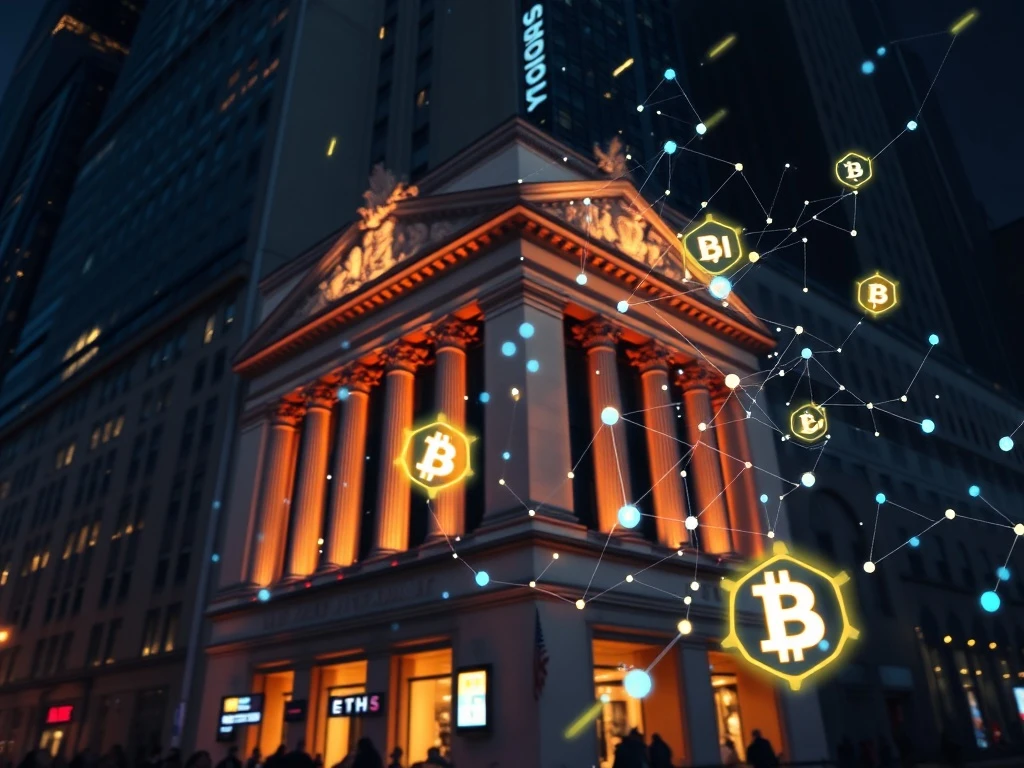
In a landmark announcement that signals a seismic shift for global finance, the New York Stock Exchange (NYSE) has confirmed plans to introduce 24/7 trading through an on-chain tokenization platform. This groundbreaking initiative, first reported by Watcher.Guru, aims to dismantle the traditional constraints of market hours by leveraging blockchain technology. Consequently, it promises to redefine accessibility and liquidity in the world’s most iconic equity marketplace. The move represents a direct response to evolving investor demands and the accelerating convergence of traditional finance (TradFi) with decentralized finance (DeFi).
The NYSE 24/7 Trading Blueprint and Its Core Mechanism
The proposed service will facilitate the continuous buying and selling of U.S. stocks. This will occur through a dedicated, regulated exchange that utilizes on-chain tokenization. Essentially, this process involves creating digital tokens on a blockchain. Each token acts as a direct, legal representation of a share in a publicly traded company. Therefore, ownership and transactions are recorded on an immutable digital ledger. This system operates independently of traditional market hours. It enables investors globally to execute trades at any time.
This model diverges sharply from the current NYSE schedule. Presently, the exchange operates from 9:30 AM to 4:00 PM Eastern Time, Monday through Friday. It also offers limited pre-market and after-hours sessions. The new tokenized framework, however, proposes truly continuous operation. Industry analysts immediately recognized the profound implications. “This is not merely an extension of hours,” noted a financial technology strategist at a major consultancy. “It is a fundamental architectural change. The NYSE is building a parallel, digital-native market structure.”
Understanding the Driving Forces Behind Tokenization
Several powerful trends are compelling this historic pivot. Primarily, investor behavior has evolved dramatically. The rise of retail trading platforms and global markets has created demand for constant access. Furthermore, the success of cryptocurrency markets, which trade 24/7, has set a new expectation for asset liquidity. The NYSE’s initiative directly addresses this competitive pressure.
Secondly, regulatory clarity is gradually emerging. Agencies like the SEC have engaged with digital asset frameworks. Landmark legislation, such as the Financial Innovation and Technology for the 21st Century Act, has laid groundwork. This provides a clearer pathway for regulated entities to explore blockchain integration. The NYSE’s move is a calculated step within this evolving landscape.
Thirdly, operational efficiency is a major incentive. Blockchain-based settlement can theoretically reduce the standard T+2 settlement cycle to near-instantaneous finality. This mitigates counterparty risk and frees up capital. The following table contrasts key aspects of the traditional and proposed systems:
| Feature | Traditional NYSE Trading | Proposed On-Chain 24/7 Model |
|---|---|---|
| Trading Hours | 9:30 AM – 4:00 PM ET (Core Session) | 24 hours a day, 7 days a week |
| Settlement Cycle | T+2 (Trade date plus two days) | Potential for near-instantaneous settlement |
| Record Keeping | Centralized ledger maintained by DTCC | Distributed, immutable blockchain ledger |
| Access Barrier | Requires brokerage account, geographic restrictions may apply | Potentially broader global access via digital wallets |
| Liquidity Source | Designated market makers, institutional orders | Global pool of retail and institutional participants |
Expert Analysis on Market Impact and Challenges
Financial experts are weighing the potential impacts and significant hurdles. A managing director of market structure at a top investment bank provided context. “The technological lift is immense but feasible,” he stated. “The greater challenges are regulatory harmonization and ensuring market stability without traditional circuit breakers.” The integration must maintain the NYSE’s reputation for integrity. It must also prevent manipulation in a continuous trading environment.
Moreover, the move could pressure other major exchanges like Nasdaq and the London Stock Exchange to accelerate their own digital asset plans. It validates years of experimentation by firms like Arca and Securitize. These firms have already issued SEC-registered tokenized securities. The NYSE’s entry lends unprecedented institutional credibility to the entire asset tokenization sector.
The Technical Architecture and Security Imperatives
The exchange will likely employ a permissioned blockchain or a highly optimized layer-2 solution. This balances transparency with the speed and privacy requirements of institutional trading. Interoperability with existing market infrastructure, such as the Depository Trust & Clearing Corporation (DTCC), will be critical. The system must ensure seamless movement between tokenized and traditional share registries.
Security, naturally, is paramount. The platform will require enterprise-grade custody solutions. It must also include robust identity verification (KYC/AML) protocols. These measures are essential to meet regulatory standards. The NYSE’s deep experience in building resilient systems will be its greatest asset in this endeavor. The goal is to create a system that is both innovative and unquestionably secure.
Broader Implications for Global Finance and Investors
The implications extend far beyond convenient trading hours. This initiative could democratize access to U.S. equities for international investors in different time zones. It also introduces the potential for fractional ownership of high-priced stocks through token divisibility. This could lower the entry barrier for retail investors.
For institutions, 24/7 liquidity enables better risk management. It allows for immediate reaction to global news events. However, it also demands new strategies for monitoring and execution. The human element of trading may evolve toward greater reliance on automated, algorithmic systems.
The announcement has already sparked discussion about the future of public markets. Could this model eventually extend to other asset classes like ETFs or bonds? Does it pave the way for a fully digital, global primary issuance platform? While these questions remain, the NYSE’s decision marks a definitive point of departure. It signals that the future of capital markets is hybrid, digital, and continuous.
Conclusion
The NYSE’s plan to launch 24/7 trading via on-chain tokenization is a watershed moment for financial markets. It represents a strategic embrace of blockchain technology to solve for modern demands of accessibility, efficiency, and global integration. While significant regulatory and operational challenges lie ahead, the direction is clear. The convergence of TradFi and DeFi is accelerating. The iconic New York Stock Exchange is positioning itself not as a relic of the past, but as a foundational pillar of the market’s digital future. This move toward continuous, tokenized trading could ultimately reshape how the world interacts with public equities.
FAQs
Q1: What does “on-chain tokenization” mean in this context?
A1: It refers to creating digital tokens on a blockchain that legally represent ownership of a traditional stock. Each token is a digital certificate of ownership, with all transactions recorded on a secure, distributed ledger.
Q2: When will the NYSE 24/7 trading platform launch?
A2: The NYSE has announced plans but has not provided a specific public launch date. Such an initiative requires extensive regulatory approval, technological development, and testing, a process that typically takes multiple quarters or years.
Q3: Will this replace the traditional NYSE stock market?
A3: No, initially it is expected to operate as a parallel service alongside the traditional exchange. It will offer an alternative method for trading the same underlying assets, providing investors with a choice between the conventional system and the new tokenized, continuous one.
Q4: How will this affect the average retail investor?
A4: Retail investors may gain the ability to trade U.S. stocks at any time, potentially including weekends. It could also lower barriers to entry through fractional tokenized shares. However, they will likely need to use a platform or wallet that supports the new tokenized exchange.
Q5: What are the biggest risks associated with 24/7 tokenized trading?
A5: Key risks include potential for increased volatility during off-hours with lower liquidity, the evolving regulatory landscape for digital assets, technological security concerns, and the challenge of integrating new systems with legacy financial infrastructure.
Q6: Has any other major traditional exchange done something similar?
A6: While several exchanges globally (e.g., in Switzerland, Singapore) have explored digital asset platforms, the NYSE’s plan for direct 24/7 trading of mainstream U.S. equities via tokenization is among the most ambitious and significant proposals from a legacy market operator of its size and stature.
Related News
- Trump Tariff Shock: Global Markets Plunge as EU Weighs Retaliatory Trade Measures
- Bitcoin’s Alarming Retreat: Will the $91,000 Support Level Hold Amid Market Turbulence?
- Venezuela USDT Demand Skyrockets 40% After Devastating US Military Intervention