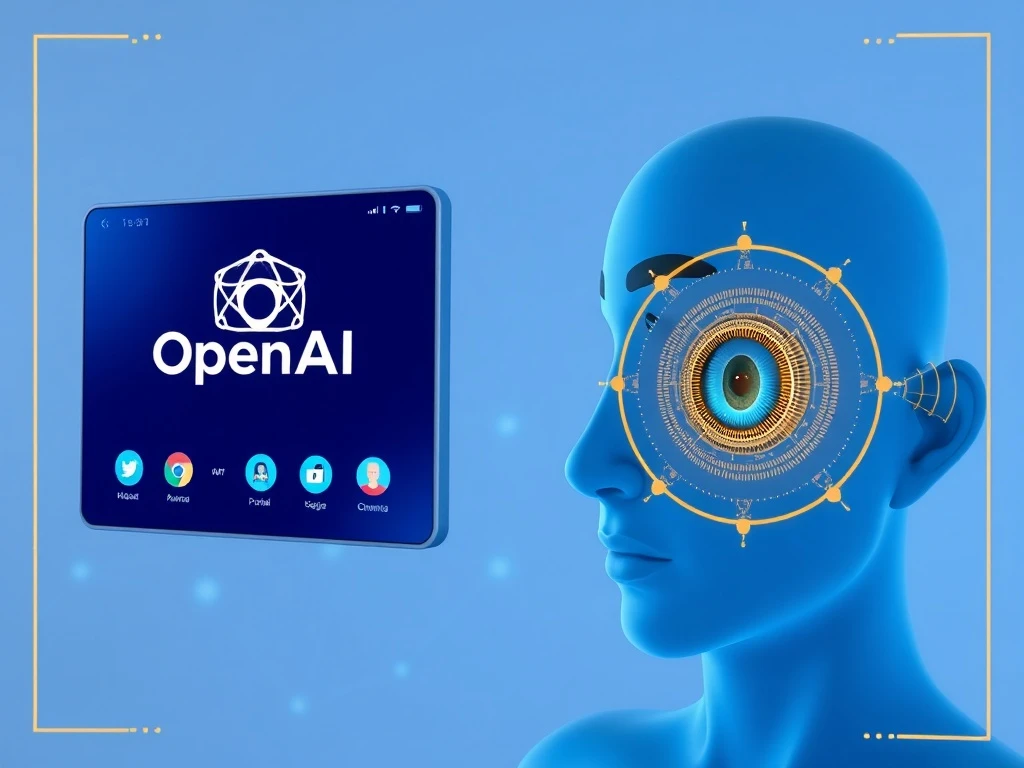
San Francisco, April 2025 – OpenAI, the artificial intelligence research laboratory, has reportedly initiated development on its own social media platform, a move that could fundamentally reshape online interaction. According to a recent Forbes report, the organization is actively considering the integration of a Worldcoin-based identity verification system, potentially leveraging biometric technology to establish proof of personhood. This ambitious project, currently in its nascent stages, represents a significant convergence of advanced AI, cryptocurrency, and digital identity management.
OpenAI Social Media Enters the Arena
The technology landscape witnessed a notable development this week. Sources familiar with the matter indicate that OpenAI has begun building a proprietary social networking environment. Consequently, this initiative marks the company’s first major foray into consumer-facing social platforms. Historically, OpenAI has focused on developing foundational AI models like GPT-4 and DALL-E. Therefore, this pivot toward a direct-user application signals a strategic expansion. The platform’s core differentiator may not be mere content sharing. Instead, it could prioritize authenticated, human-driven conversations facilitated by AI tools.
Industry analysts immediately noted the timing of this revelation. Currently, established social media giants face mounting scrutiny over bot networks, misinformation, and identity fraud. In response, OpenAI’s project appears designed to address these systemic issues directly. The company’s vast expertise in natural language processing could enable sophisticated content moderation and genuine user assistance. Moreover, an AI-native social network might offer personalized, intelligent interactions unlike any existing service.
The Worldcoin Identity Verification Integration
Central to the platform’s reported architecture is a robust identity layer. Specifically, OpenAI is evaluating a proof of personhood procedure based on Worldcoin’s Orb technology. The Worldcoin project, co-founded by Sam Altman who is also the CEO of OpenAI, utilizes a physical device called the Orb. This device performs iris scans to generate a unique, privacy-preserving digital identity known as a World ID. For the social media platform, this system could verify that each account belongs to a distinct human being.
- Biometric Authentication: The Orb’s iris scanning offers a highly secure method for establishing unique human identity.
- Privacy-Preserving Design: Worldcoin’s protocol is designed to verify uniqueness without storing raw biometric data.
- Apple Face ID Synergy: Reports suggest discussions include using Apple’s Face ID as a complementary or accessible verification method.
This approach directly tackles the pervasive problem of fake accounts and AI-generated personas. By requiring biometric verification, OpenAI could create a social graph comprised exclusively of verified humans. Subsequently, this could enhance trust, reduce spam, and create a new foundation for digital community and economy. The potential integration with Apple’s ecosystem also suggests a focus on user-friendly accessibility alongside high-security verification.
Expert Analysis on the Technical and Ethical Landscape
Digital identity experts have weighed in on the profound implications of this development. Dr. Elena Rodriguez, a professor of Cyber Ethics at Stanford University, provided context. “The fusion of OpenAI’s AI capabilities with Worldcoin’s identity protocol is technically formidable,” she stated. “However, it introduces complex questions about accessibility, data sovereignty, and the very definition of personhood in digital spaces.” She further emphasized that the success of such a system would depend entirely on transparent governance and voluntary user adoption.
From a technical standpoint, the challenges are significant. Scaling a biometric verification system to potentially billions of users presents immense logistical hurdles. Furthermore, ensuring the system remains resilient against sophisticated spoofing attacks requires continuous innovation. On the other hand, the potential benefits for democratic discourse and online safety are equally substantial. A platform with verified identities could theoretically diminish coordinated disinformation campaigns and restore authenticity to online debate.
Market Impact and Competitive Response
The announcement has already sent ripples through related markets. Following the Forbes report, the value of Worldcoin’s native token, WLD, experienced notable volatility. This reaction underscores the market’s perception of the proposal’s significance. A successful, large-scale implementation of World ID for social media could dramatically increase the utility and demand for the Worldcoin ecosystem.
| Area | Potential Impact |
|---|---|
| Digital Advertising | Could enable hyper-accurate, human-only audience targeting, shifting market dynamics. |
| Content Moderation | AI + verified identity may allow for more nuanced and effective community governance. |
| Crypto Integration | Worldcoin verification could seamlessly enable digital asset transactions and micro-economies. |
| Regulatory Scrutiny | Will likely attract immediate attention from global data protection and financial regulators. |
Established social media companies are now compelled to observe this development closely. Platforms like Meta and X (formerly Twitter) have experimented with various verification systems, primarily based on phone numbers or government ID. Nevertheless, a biometric-based standard from a player like OpenAI could set a new industry benchmark. The competitive response may involve accelerated investment in alternative decentralized identity solutions or partnerships with other biometric verification providers.
The Road Ahead: Development Timeline and Challenges
All sources stress that the project remains in an early phase. Initial development likely focuses on core architecture and prototype testing. The integration of Worldcoin’s protocol, in particular, involves complex technical and legal engineering. OpenAI must navigate diverse global regulations concerning biometric data, such as the EU’s GDPR and various state laws in the U.S. Additionally, the company must build public trust in a system that collects highly sensitive personal data, despite its privacy-preserving claims.
User adoption represents another critical hurdle. The requirement for an iris scan or facial recognition may deter privacy-conscious individuals. Therefore, OpenAI’s challenge is to clearly communicate the security benefits and privacy safeguards. The platform must offer compelling utility that justifies this novel form of identity verification. Potential features could include exclusive AI tools, enhanced monetization for creators, or governance rights within the network.
Conclusion
The reported development of an OpenAI social media platform integrated with Worldcoin identity verification marks a pivotal moment in the evolution of the internet. This initiative seeks to address fundamental flaws in current social networks by combining cutting-edge AI with secure, biometric proof of personhood. While the project faces substantial technical, ethical, and regulatory challenges, its potential to foster more authentic and trustworthy online communities is significant. As development progresses through 2025, its approach to digital identity will be closely watched by industry, regulators, and users worldwide, potentially setting a new standard for how we prove who we are online.
FAQs
Q1: What is the main goal of OpenAI’s reported social media platform?
The primary goal appears to be creating a social network where every user is a verified human, using biometrics to combat bots, fraud, and misinformation, thereby fostering more authentic interactions.
Q2: How would the Worldcoin identity verification work on the platform?
Users would likely verify their unique identity using Worldcoin’s Orb device for an iris scan or potentially Apple’s Face ID. This generates a World ID, proving they are a real person without storing the raw biometric data, which then authenticates their social media account.
Q3: Is this platform available to use now?
No. According to reports, the project is in very early stages of development. There is no public release date or beta testing timeline announced at this time.
Q4: What are the biggest concerns about this type of system?
Major concerns include data privacy and security of biometric information, global accessibility to verification hardware (like the Orb), potential for exclusion, and the ethical implications of tying social participation to biometric verification.
Q5: How does this affect the Worldcoin (WLD) cryptocurrency?
The news has impacted WLD’s market value, highlighting its perceived utility. If successfully integrated, massive adoption of the social platform could drive significant demand for the Worldcoin protocol and its token, though this remains speculative as the project is not yet live.
Related News
- SEC Tokenized Securities Guidance: Landmark 2025 Rules Transform Digital Asset Regulation
- XRP Secures Decisive Victory as Federal Court Dismisses Major Class-Action Lawsuit
- Coinbase Listing Roadmap Sparks Excitement with HYPE Token Addition