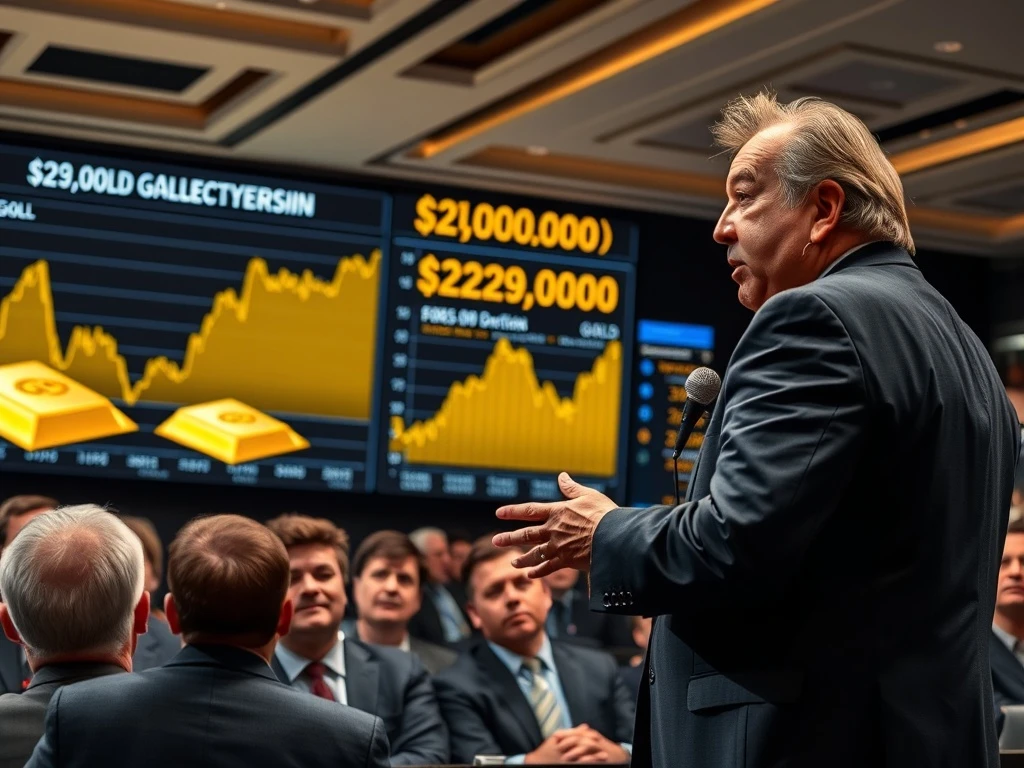
Financial educator Robert Kiyosaki has intensified his bullish stance on gold, predicting the precious metal will reach $27,000 following a significant $5,000 price breakout. This forecast, made in early 2025, arrives during a period of notable volatility across global financial markets. Kiyosaki’s analysis draws attention to fundamental economic shifts that could reshape investment portfolios worldwide. Consequently, investors and analysts are scrutinizing the factors that might propel gold to these unprecedented levels.
Robert Kiyosaki’s Gold Prediction and Market Context
Robert Kiyosaki, author of the bestselling book “Rich Dad Poor Dad,” has consistently advocated for tangible assets like gold. His latest prediction suggests a monumental surge from current price levels. Historically, Kiyosaki’s commentary has focused on currency devaluation and systemic financial risk. Therefore, his $27,000 gold forecast aligns with his long-standing critique of fiat money systems. Market data from the World Gold Council shows increased institutional buying throughout 2024, providing a tangible backdrop for this analysis.
Gold achieved a decisive breakout above the $5,000 per ounce mark in late 2024, a key technical milestone. This movement followed sustained central bank purchasing and geopolitical tensions. Analysts at Bloomberg Intelligence reported a 15% year-over-year increase in gold reserves among emerging market nations. Meanwhile, the Federal Reserve’s monetary policy decisions continue to influence dollar strength and, inversely, gold valuations. These interconnected factors create a complex environment for price discovery in the precious metals market.
Analyzing the $5,000 Gold Breakout
The breakthrough past $5,000 represents a major psychological and technical barrier for gold. This price level had acted as resistance for several quarters prior to the breakout. Trading volume data from the COMEX exchange indicates that the move was supported by substantial institutional participation. Furthermore, gold mining equities, as tracked by the NYSE Arca Gold BUGS Index, showed correlated strength. This suggests a broad-based rally rather than isolated futures market activity.
Fundamental Drivers Behind the Rally
Several fundamental economic drivers underpin gold’s recent performance. First, persistent inflation readings above central bank targets have eroded confidence in cash holdings. Second, escalating sovereign debt levels in major economies have heightened concerns about fiscal sustainability. Third, diversification away from the US dollar in international trade settlements has increased gold’s utility as a neutral reserve asset. The International Monetary Fund’s latest reports confirm a gradual shift in global reserve composition.
The following table illustrates key macroeconomic indicators relevant to gold’s valuation:
| Indicator | 2024 Q4 Value | Impact on Gold |
|---|---|---|
| Global Inflation Rate | 5.2% | Positive |
| US Dollar Index (DXY) | 98.5 | Negative Correlation |
| Central Bank Gold Purchases | +800 Tonnes | Strongly Positive |
| Real Yield on 10-Year Treasuries | -0.8% | Positive |
Historical Precedents and Price Trajectories
Gold’s historical performance during periods of monetary expansion provides context for current predictions. During the 1970s stagflation era, gold prices increased approximately 2,300% over the decade. More recently, the post-2008 financial crisis period saw gold rise from $700 to $1,900 within four years. These precedents demonstrate gold’s capacity for exponential gains during systemic stress. However, each historical period featured unique catalysts and market structures.
Technical analysis from firms like Goldman Sachs Commodities Research identifies several key resistance levels above $5,000. The $6,800 level represents a 1.618 Fibonacci extension from the 2020 low. Subsequently, the $10,000 level constitutes a major round-number psychological barrier. Ultimately, Kiyosaki’s $27,000 target would represent a 440% increase from the $5,000 breakout point. Such a move would require sustained catalysts over multiple years rather than a single event.
Expert Perspectives on the Forecast
Financial experts offer varied assessments of Kiyosaki’s prediction. Some analysts emphasize that while directionally plausible, the timeline remains uncertain. Others note that similar predictions have emerged periodically throughout financial history. For instance, Peter Schiff of Euro Pacific Capital has long advocated for significantly higher gold prices. Meanwhile, mainstream institutions like JPMorgan Chase maintain more conservative year-ahead targets around $6,500 per ounce.
Market technicians highlight that gold must maintain support above $4,800 to validate the breakout’s sustainability. Additionally, the gold-to-silver ratio currently sits at historical extremes, suggesting potential mean reversion. Consequently, some capital may rotate from gold to silver if industrial demand accelerates. These dynamics illustrate the complex interplay within the broader precious metals complex.
Investment Implications and Portfolio Strategy
Kiyosaki’s forecast carries significant implications for investor portfolio construction. Traditional 60/40 stock-bond portfolios have demonstrated vulnerability during recent inflationary periods. Therefore, many financial advisors now recommend strategic allocations to real assets. Gold typically exhibits low correlation to both equities and fixed income, providing diversification benefits. Academic research from the University of Cambridge confirms that optimal portfolio allocations to gold range between 5-10% during uncertain macroeconomic environments.
Investors can gain exposure to gold through several distinct vehicles:
- Physical Bullion: Gold bars and coins offer direct ownership without counterparty risk
- Gold ETFs: Exchange-traded funds like GLD provide liquid, custodial exposure
- Mining Stocks: Equity in gold producers offers operational leverage to price movements
- Futures Contracts: Derivatives enable sophisticated positioning and hedging strategies
- Royalty Companies: Firms providing financing to miners for percentage of future production
Each approach carries distinct risk-return profiles and tax considerations. Physical bullion involves storage and insurance costs but provides tangible security. Conversely, mining stocks introduce operational risks but can amplify returns during bull markets. The VanEck Gold Miners ETF (GDX) has historically demonstrated approximately 2x beta to gold spot prices.
Global Economic Factors Supporting Higher Gold Prices
Multiple structural economic developments could support a continued gold appreciation narrative. First, the ongoing dedollarization trend among BRICS nations increases demand for alternative reserve assets. Second, climate change initiatives are driving gold demand in green technology applications, particularly in electronics and hydrogen catalysts. Third, demographic shifts in Asia are creating new generations of gold consumers with cultural affinity for the metal.
Monetary policy normalization remains a complex challenge for central banks worldwide. The Bank for International Settlements has warned about the “lower for longer” interest rate environment potentially returning. Simultaneously, fiscal deficits continue expanding across developed economies, creating debt sustainability concerns. These conditions historically correlate with strong gold performance as investors seek wealth preservation.
Supply-Side Constraints and Mining Economics
Gold mining production faces increasing challenges that could constrain future supply. The average grade of new discoveries has declined steadily over the past two decades. Additionally, environmental regulations and social license requirements have extended development timelines. Major mining companies like Newmont Corporation report all-in sustaining costs approaching $1,400 per ounce. Consequently, higher gold prices are necessary to justify investment in new production capacity.
Exploration budgets have only partially recovered from cuts made during the 2013-2015 bear market. The mining industry requires sustained prices above $2,000 to fund significant greenfield projects. Junior mining companies, which conduct most exploration, face particular capital constraints. These supply dynamics could create a structural deficit if investment demand accelerates simultaneously.
Conclusion
Robert Kiyosaki’s prediction of gold reaching $27,000 following the $5,000 breakout presents a compelling long-term investment thesis. While the specific price target and timeline remain subjects of debate, the fundamental arguments for gold allocation are strengthening. Global monetary conditions, geopolitical tensions, and portfolio diversification needs all support continued interest in precious metals. Investors should conduct thorough due diligence and consider appropriate allocations based on individual risk tolerance and investment horizons. The gold market’s evolution throughout 2025 will provide crucial evidence regarding the sustainability of the current breakout and the plausibility of Kiyosaki’s ambitious forecast.
FAQs
Q1: What is Robert Kiyosaki’s main argument for gold reaching $27,000?
Kiyosaki primarily cites currency devaluation, excessive debt creation, and loss of confidence in fiat money systems as drivers for substantially higher gold prices. He views gold as a timeless store of value during periods of monetary instability.
Q2: How does the recent $5,000 breakout change gold’s technical outlook?
The breakout above $5,000 represents a major resistance breach that could trigger algorithmic buying and renewed institutional interest. Technical analysts view this as confirming a new bullish phase, with initial targets around $6,800 based on Fibonacci extensions.
Q3: What are the biggest risks to Kiyosaki’s gold prediction?
Major risks include sustained higher real interest rates, unexpected dollar strength, technological disruption in monetary systems, and improved fiscal discipline among major economies that could restore confidence in fiat currencies.
Q4: How does gold typically perform during recessionary periods?
Historical data shows gold often performs well during recessions, particularly when accompanied by monetary easing. However, during deflationary recessions with dollar strength, gold can experience temporary weakness before ultimately benefiting from policy responses.
Q5: What percentage of a portfolio do financial advisors typically recommend for gold allocation?
Most mainstream financial advisors suggest 5-10% allocations to gold and precious metals for diversification purposes. More bullish analysts recommend 10-20% allocations during periods of expected currency debasement or high inflation.
Related News
- Bitmine Stakes a Monumental $610M in ETH, Signaling Unwavering Confidence in Ethereum’s Future
- Crypto Futures Liquidations Surge: $235M Wiped Out in 24-Hour Market Tremor
- Ripple CEO’s Stunning Prediction: Crypto Market Poised for Historic All-Time High in 2025