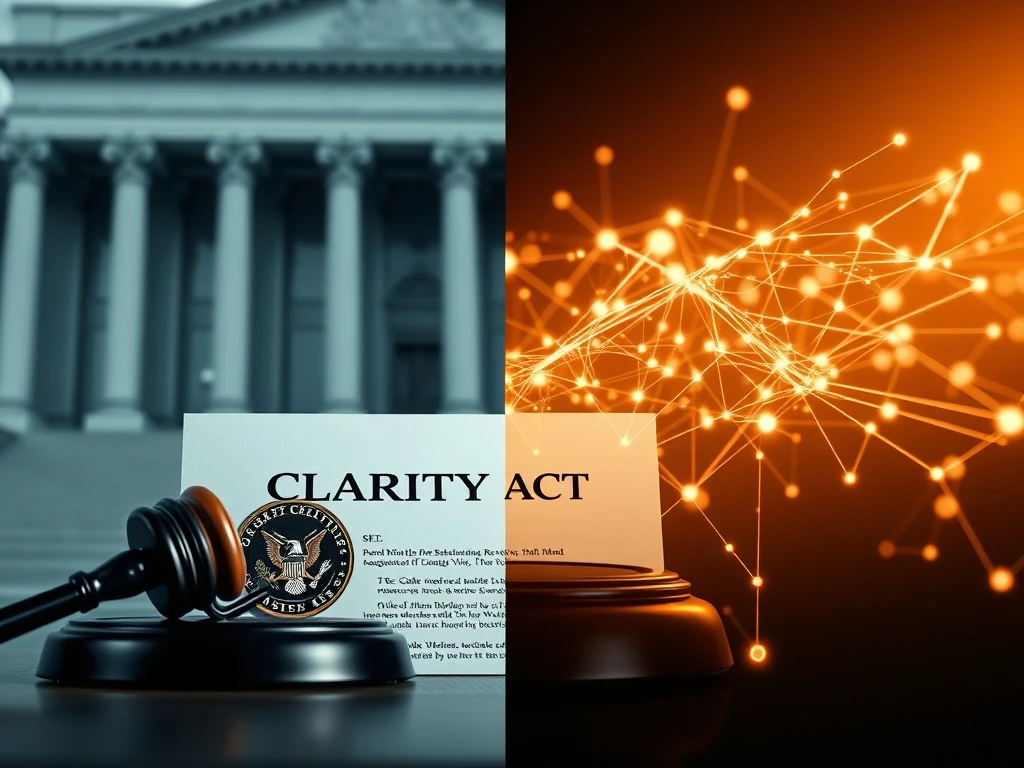
WASHINGTON, D.C. – May 15, 2025 – The U.S. Securities and Exchange Commission (SEC) faces a defining regulatory challenge as its crypto task force receives starkly opposing public comments on the proposed **SEC crypto bill**, formally known as the Clarity Act. This legislative framework aims to establish rules for digital asset markets. Consequently, the agency must now reconcile a fundamental divide between consumer protection advocates and industry proponents seeking regulatory flexibility.
The Core Conflict in the SEC Crypto Bill
Reported initially by Cointelegraph, the SEC’s comment period for the Clarity Act has yielded two pivotal letters. These documents represent a microcosm of the broader national debate. On one side, a submission from DK Willard, acting on behalf of individual Louisiana users, demands robust safeguards. This perspective prioritizes stringent transparency rules and explicit mechanisms to prevent fraud and market manipulation. Therefore, it views the bill as a critical shield for retail investors navigating the volatile crypto landscape.
Conversely, the Blockchain Association, a major industry lobbying group, presents a counter-argument. Their letter contends that entities dealing in tokenized traditional assets, like stocks, and decentralized finance (DeFi) protocols should not automatically be classified as “dealers” under the existing Securities Exchange Act. This classification would mandate extensive registration and compliance burdens. The association argues that such a blanket application would stifle innovation and misapply regulations designed for traditional securities markets.
Historical Context and Legislative Journey
To understand the current impasse, one must examine the legislative history. The Clarity Act emerged from years of congressional hearings following major market disruptions, including the collapse of several crypto platforms. Lawmakers drafted the bill to answer persistent questions about the SEC’s jurisdiction over digital assets. Previously, regulatory actions relied on enforcement rather than clear, forward-looking rules. This approach created significant uncertainty for businesses and investors alike.
Furthermore, the bill’s progression mirrors global trends. Other jurisdictions, like the European Union with its MiCA framework and the UK with its Financial Services and Markets Act 2023, have moved to codify crypto rules. The United States, however, has grappled with overlapping agency mandates between the SEC and the Commodity Futures Trading Commission (CFTC). The Clarity Act represents a concerted effort to resolve this jurisdictional ambiguity, specifically for tokenized securities and certain digital assets.
Analyzing the Stakeholder Positions
The conflicting comments reveal deep-seated philosophical differences. The consumer advocate letter leverages historical precedent, citing past enforcement cases where investors suffered losses due to opaque operations or outright fraud. This position is evidence-driven, referencing academic studies on market integrity. It emphasizes the SEC’s core mission of protecting investors and maintaining fair, orderly, and efficient markets.
Meanwhile, the Blockchain Association’s stance is grounded in technological nuance. It differentiates between a centralized exchange offering tokenized Tesla stock and a decentralized autonomous organization (DAO) facilitating peer-to-peer lending. The association suggests that the technology’s inherent transparency—through public ledgers—can fulfill regulatory goals without imposing traditional broker-dealer models. They propose a new, tailored category for certain digital asset intermediaries.
Potential Impacts on Market Structure
The SEC’s final interpretation of these comments will have profound consequences. A rule leaning heavily toward the consumer protection argument could lead to a more centralized market structure. Many existing DeFi projects and tokenization platforms might need to significantly alter their operations or seek formal registration. This outcome could enhance investor protection but potentially reduce market diversity and innovation.
Alternatively, adopting a more flexible approach, as the industry advocates, might foster continued growth in tokenization and DeFi. However, regulators would then face the complex task of monitoring novel and rapidly evolving systems for emerging risks. This path requires the SEC to develop new technical expertise and supervisory tools. The table below summarizes the potential outcomes:
| Regulatory Emphasis | Potential Market Outcome | Key Challenge |
|---|---|---|
| Strong Consumer Protection Rules | Higher compliance costs, possible consolidation, increased investor confidence. | Potential stifling of legitimate innovation; driving activity offshore. |
| Flexible, Technology-Neutral Rules | Continued experimentation and growth in DeFi/tokenization. | Difficulty in policing bad actors; new systemic risks. |
| Hybrid Approach | Segmented market with clear rules for centralized actors and sandboxes for decentralized ones. | Regulatory complexity and potential for arbitrage between categories. |
Market participants are closely watching this process. Legal experts note that the SEC’s response will signal its long-term posture. Will it act primarily as a market cop enforcing existing statutes, or will it evolve into a facilitator of responsible financial innovation? The answer will shape capital formation and technological adoption for years.
The Road Ahead for the Clarity Act
The SEC task force must now analyze these comments alongside hundreds of others. Agency staff will draft a recommendation that balances the submitted viewpoints with legal constraints and policy objectives. This recommendation will then move through internal reviews before potential publication as a proposed rule. The process includes several key steps:
- Analysis Phase: SEC staff categorize and analyze all comment letters for common themes and legal arguments.
- Economic Assessment: The agency must conduct a cost-benefit analysis of different regulatory options, as required by law.
- Inter-Agency Review: Draft rules are shared with the CFTC, Treasury, and other relevant bodies to ensure consistency.
- Commission Vote: The five SEC commissioners must vote to release any proposed rule for a further public comment period.
This timeline suggests a final rule may not emerge until late 2025 or 2026. Meanwhile, market practices continue to evolve, potentially outpacing the regulatory process. This gap underscores the urgency felt by both commentators.
Conclusion
The conflicting comments on the **SEC crypto bill**, the Clarity Act, highlight a critical juncture for American financial regulation. The SEC must navigate a path between ensuring strong consumer protections and allowing room for technological advancement in digital asset markets. This decision will fundamentally influence how tokenized securities and DeFi protocols operate within the United States. Ultimately, the agency’s response will determine whether the U.S. framework fosters a secure, innovative, and competitive digital asset ecosystem. The world is watching as the SEC deliberates on this pivotal **SEC crypto bill**.
FAQs
Q1: What is the Clarity Act?
The Clarity Act is proposed U.S. legislation designed to create a regulatory framework for digital asset markets, clarifying the rules for crypto securities, tokenized assets, and trading platforms.
Q2: Who is DK Willard, and what did their comment letter say?
DK Willard submitted a comment letter to the SEC on behalf of individual users in Louisiana. The letter argued that the Clarity Act must include strong requirements for transparency and fraud prevention to protect consumers.
Q3: What is the Blockchain Association’s position on the bill?
The Blockchain Association argues that companies trading tokenized stocks and DeFi assets should not be automatically required to register as dealers under the Securities Exchange Act, seeking more tailored regulations.
Q4: Why is the SEC’s decision on this bill so important?
The SEC’s interpretation will set a precedent for how existing securities laws apply to new digital asset technologies, impacting innovation, investor protection, and the U.S.’s competitive position in crypto markets.
Q5: What are tokenized stocks?
Tokenized stocks are digital tokens on a blockchain that represent ownership in a traditional company, like Apple or Tesla, aiming to provide fractional ownership and 24/7 trading but raising questions about regulatory equivalence.
Related News
- Bitcoin Price Plummets: BTC Falls Below $89,000 Amid Market Uncertainty
- Galaxy Crypto Hedge Fund Launch: $100 Million Strategic Move Signals Institutional Confidence
- Cryptocurrency Trust Survey Reveals Stunning 40% of Younger Americans Embrace Digital Assets vs Mere 9% of Baby Boomers