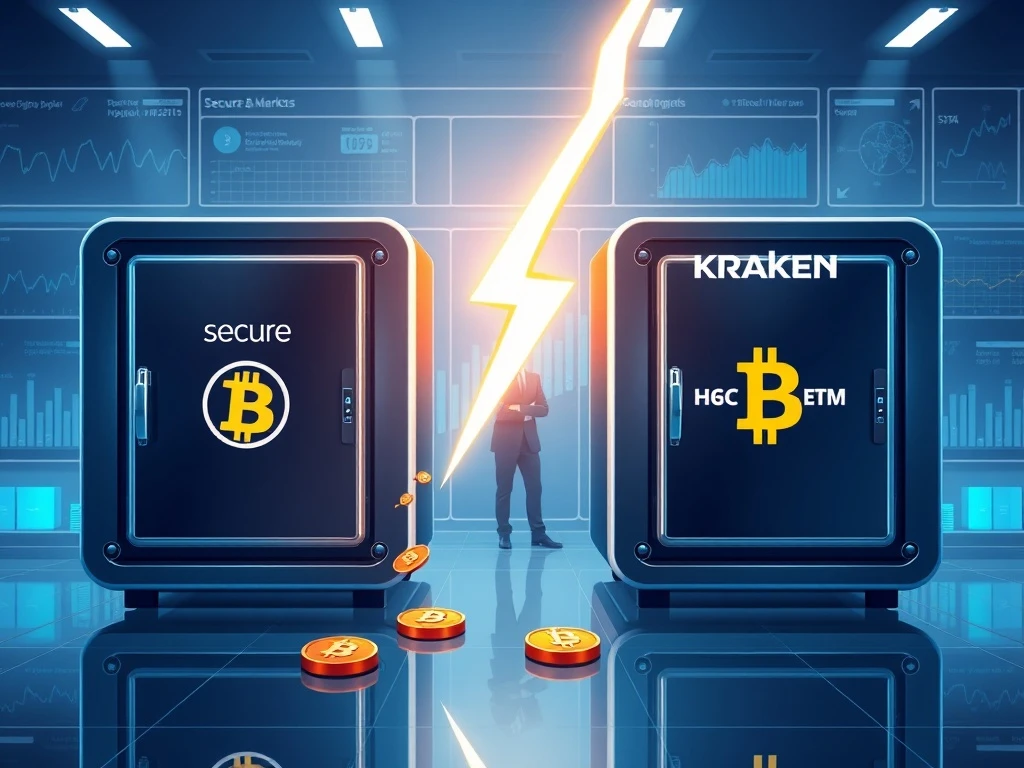
In a landmark demonstration of Bitcoin’s evolving infrastructure, institutional trading firm Secure Digital Markets has successfully executed a $1 million transaction over the Lightning Network with cryptocurrency exchange Kraken, signaling a pivotal moment for enterprise-grade digital asset settlement. This transaction, confirmed on March 21, 2025, represents one of the largest publicly disclosed Lightning transfers between regulated entities, directly addressing long-standing concerns about scalability, speed, and cost in high-value crypto payments. The move underscores a significant shift toward layer-2 solutions as critical infrastructure for the future of finance, providing tangible evidence that Bitcoin’s payment network can support substantial institutional flows with unprecedented efficiency.
Lightning Network Transaction Marks New Era for Institutional Bitcoin Use
The completion of this seven-figure transfer fundamentally challenges traditional narratives about Bitcoin’s utility for large-scale settlements. Historically, concerns about the base layer’s throughput and variable fees have limited its use for major corporate transactions. However, this Lightning Network transaction between Secure Digital Markets and Kraken demonstrates a viable alternative. The Lightning Network operates as a second-layer protocol, enabling instant, high-volume payments through bidirectional payment channels. Consequently, this development provides a compelling case study for other financial institutions observing the space. Moreover, the transaction’s success relied on robust channel liquidity and sophisticated treasury management from both parties, highlighting the operational maturity now achievable.
Industry analysts immediately recognized the broader implications. “This isn’t just a technical test; it’s a commercial proof point,” noted Dr. Anya Petrova, a blockchain infrastructure researcher at the Cambridge Centre for Alternative Finance. “When established entities move sums of this magnitude off-chain, it validates the entire scaling roadmap. It shows trust in the network’s security and the operational readiness of the supporting ecosystem.” The transaction reportedly settled in under two seconds with fees amounting to mere satoshis, a fraction of a cent, contrasting sharply with potential costs and confirmation times on the base chain during periods of congestion. This efficiency gain is not merely incremental but transformative for business models built on frequent, high-value movements of capital.
The Technical and Operational Backbone
Executing a transaction of this scale required meticulous preparation. Both Secure Digital Markets and Kraken had to establish and fund a sufficiently large Lightning channel, a process that involves an on-chain transaction to lock the capital. They utilized a Wumbo channel, a channel type that supports larger capacities than earlier defaults, which were initially limited for security reasons. The firms also employed advanced watchtower services to secure their channels and sophisticated liquidity management tools to ensure the funds could be routed efficiently. This operational stack, largely invisible to the end-user, represents years of development in node software, network analytics, and risk management protocols. It signifies that the Lightning Network is transitioning from a peer-to-peer experiment to a backbone for institutional settlement.
Kraken’s Strategic Embrace of Layer-2 Scaling Solutions
Kraken’s participation as the counterparty in this milestone is strategically significant. The exchange, one of the world’s longest-running and most regulated, has been methodically expanding its Bitcoin service offerings. In 2023, Kraken integrated Lightning Network deposits and withdrawals for all users, a move that positioned it ahead of several major competitors. This $1 million transaction with Secure Digital Markets acts as a powerful stress test and marketing demonstration of that infrastructure. For Kraken, it showcases capability to corporate and high-net-worth clients who prioritize settlement finality and cost predictability. Furthermore, it aligns with a broader industry trend where exchanges are no longer just trading venues but becoming integrated financial hubs offering a suite of transfer and treasury services.
The collaboration also hints at evolving business-to-business (B2B) relationships in crypto. Secure Digital Markets, as an institutional over-the-counter (OTC) trading desk and liquidity provider, frequently needs to move capital between trading partners and custodians. The ability to use the Lightning Network for such transfers could dramatically reshape its treasury operations. For instance, it could enable near-instant replenishment of trading liquidity on various platforms or facilitate rapid off-exchange settlement between OTC counterparties. This reduces capital tied up in transit and minimizes exposure to market volatility during the settlement window. Other OTC desks and hedge funds are likely to scrutinize this model closely, potentially triggering a wave of adoption.
Key technical advantages demonstrated include:
- Finality Speed: Settlement occurs in seconds, not minutes or hours.
- Cost Efficiency: Fees are negligible compared to on-chain alternatives.
- Privacy: Individual transactions are not broadcast to the public blockchain.
- Programmability: Enables complex conditional payments and atomic swaps.
Impact on Bitcoin’s Scalability Narrative and Market Perception
The successful $1 million Lightning Network transaction arrives at a critical juncture for Bitcoin’s development. While Bitcoin remains the dominant store-of-value asset, its use as a medium of exchange has often been questioned due to scalability limits. This real-world application directly counters those critiques, providing empirical data for proponents. Market perception, especially among institutional allocators, is influenced by such demonstrations of technological progress. It shifts the conversation from theoretical scaling solutions to deployed, operational systems handling real economic value. This can influence investment decisions, protocol development funding, and regulatory attitudes, which increasingly recognize layer-2 solutions as essential components of a mature network.
Data from monitoring sites like Amboss.space and 1ML.com show consistent growth in public Lightning Network capacity, which has surpassed 5,000 BTC. However, private institutional channels, like the one likely used in this transaction, are not reflected in these public metrics, meaning the true scale of the network is larger. This “invisible” growth is crucial for professional use. The transaction also has implications for the broader digital asset ecosystem. It sets a precedent that could accelerate the development of Lightning-based services for corporate treasury management, cross-border payroll, and inter-exchange arbitrage. As more entities adopt this standard, network liquidity deepens, creating a positive feedback loop that improves reliability and reduces costs for all participants.
Regulatory and Compliance Considerations
For regulated entities like Secure Digital Markets and Kraken, compliance is non-negotiable. Utilizing the Lightning Network for large transfers introduces novel considerations for Anti-Money Laundering (AML) and Know Your Customer (KYC) protocols. While the channel opening and closing transactions are on-chain and visible, the intermediate payments are not. Firms must therefore maintain robust internal ledgering and audit trails to satisfy regulators. Industry sources indicate both firms employed compliance technology that maps off-chain activity to their internal customer records, ensuring the entire transaction flow remained within regulatory boundaries. This successful navigation of the compliance landscape is as important as the technical achievement, proving that innovation and regulation can coexist in this new paradigm.
Conclusion
The $1 million Lightning Network transaction between Secure Digital Markets and Kraken stands as a definitive milestone, proving the protocol’s readiness for high-stakes institutional use. This event moves the Lightning Network from a promising scaling solution to a validated piece of financial infrastructure, capable of settling significant value instantly and at minimal cost. It highlights the collaborative progress between trading firms, exchanges, and developers in building a more efficient and scalable Bitcoin ecosystem. As the industry looks toward 2025 and beyond, this transaction will likely be referenced as a catalyst for wider enterprise adoption, fundamentally strengthening Bitcoin’s dual role as both a sovereign store of value and a revolutionary settlement network.
FAQs
Q1: What is the Lightning Network?
The Lightning Network is a “layer-2” payment protocol built on top of Bitcoin. It enables fast, low-cost transactions by creating private payment channels between users, only settling the final net result on the main Bitcoin blockchain.
Q2: Why is a $1 million Lightning transaction significant?
It demonstrates that the network can handle institutional-scale value transfer, addressing criticisms about Bitcoin’s scalability. It proves the technology’s security and reliability for serious financial use cases beyond small, everyday payments.
Q3: How does this benefit ordinary Bitcoin users?
Institutional use and investment in Lightning infrastructure improve the network’s overall liquidity, stability, and tooling. This trickles down, making the network faster, cheaper, and more reliable for everyone, from small businesses to individuals sending remittances.
Q4: Are Lightning Network transactions secure?
Yes, they inherit the security of the base Bitcoin blockchain. The protocol uses smart contracts to ensure funds can always be settled on-chain. Users must ensure their node is online periodically or use a watchtower service to monitor for fraud.
Q5: What does this mean for the future of crypto exchanges?
Exchanges are evolving into full-service financial platforms. Integrating advanced features like high-capacity Lightning transactions allows them to offer superior services to professional clients, including instant settlement and sophisticated treasury management tools.
Related News
- Crypto Exchanges 2026: Essential Rankings Revealed as Q1 Market Dynamics Intensify
- Bitcoin Flash Crash: Sudden Plunge to 81.1M Won on Bithumb Exchange Sparks Market Alert
- Gemini Exchange Exits UK, EU, Australia in Strategic Pivot to Dominate American Crypto Markets