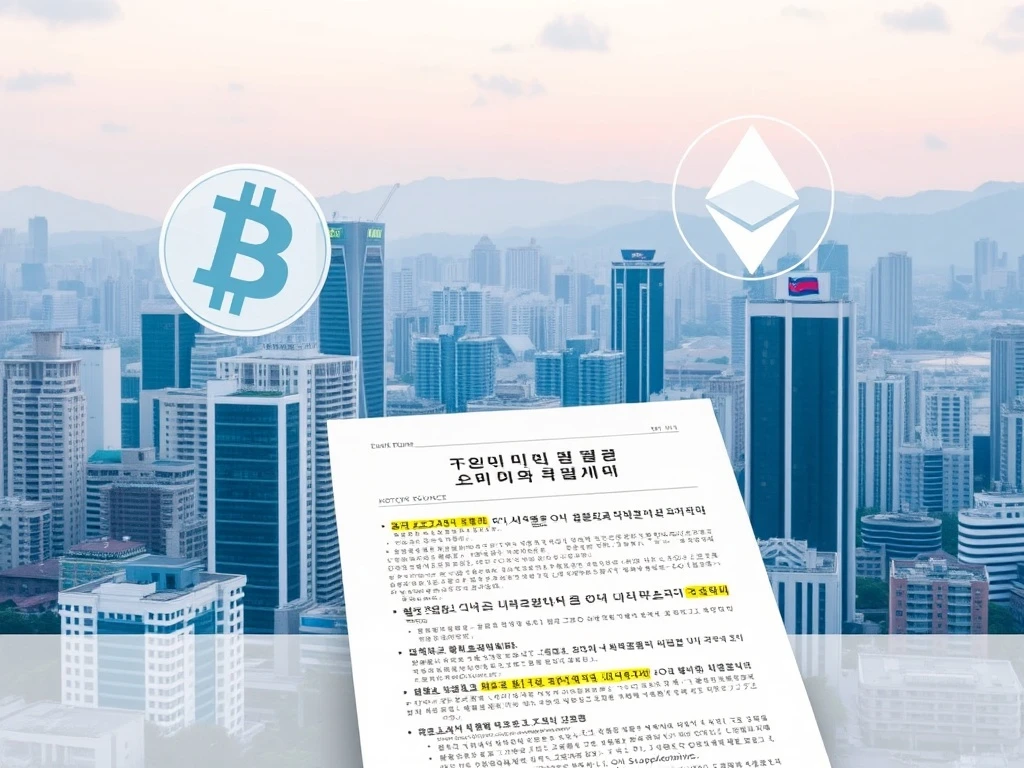
SEOUL, South Korea – February 10, 2025, marks a pivotal shift in the nation’s financial landscape as authorities implement a stringent new mandate requiring foreign nationals to disclose cryptocurrency holdings in all real estate transactions. This groundbreaking policy, announced by the Ministry of Land, Infrastructure and Transport, represents a significant escalation in South Korea’s ongoing campaign to stabilize its property market and curb speculative investment. Consequently, the regulatory net now explicitly captures proceeds from digital asset sales, placing them under the same scrutiny as traditional securities.
South Korea Crypto Disclosure: Decoding the New Real Estate Mandate
The South Korean government is significantly strengthening reporting requirements for real estate transactions by foreigners. According to a report by News1, the updated rules aim directly at speculative investment practices. Starting February 10, foreign buyers must provide extensive documentation beyond previous standards. Firstly, they must report their precise residency status and verified address. Secondly, and most notably, the scope for submitting a mandatory fund procurement plan will expand dramatically.
This expanded plan must now include exhaustive details of all overseas funding. Authorities will require information on foreign bank deposits, international loans, and the names of the involved financial institutions. Furthermore, the plan’s ‘other funding sources’ section will undergo a critical update. It will now mandate the disclosure of proceeds from the sale of cryptocurrency. This requirement sits alongside existing mandates for declaring funds from stock and bond sales, effectively classifying digital assets alongside traditional investment vehicles for regulatory purposes.
The Driving Forces Behind South Korea’s Regulatory Crackdown
This policy does not exist in a vacuum. It is the latest move in a multi-year, concerted effort by South Korean authorities to cool a volatile real estate market. For years, rapid price increases in major metropolitan areas like Seoul and Busan have raised concerns about affordability and economic stability. The government perceives foreign investment, particularly short-term speculative capital, as a contributing factor to this volatility.
Previously, regulations focused on domestic measures like loan-to-value ratios and heavy taxation on multiple homeowners. However, the evolving nature of global finance, especially the rise of cryptocurrencies as a store of value and medium of exchange, created a potential loophole. Officials feared that foreign investors could use opaque digital asset sales to funnel large, untraceable sums into the property market, bypassing traditional financial oversight. This new rule directly addresses that perceived vulnerability.
Expert Analysis: A Global Trend in Financial Transparency
Financial regulation experts view this development as part of a broader, international trend. “South Korea’s move is analytically consistent with global efforts to integrate cryptocurrency transactions into mainstream financial oversight,” explains Dr. Min-ji Park, a professor of Fintech Regulation at Seoul National University. “The Financial Action Task Force (FATF) has long advocated for the ‘Travel Rule,’ which requires VASPs (Virtual Asset Service Providers) to share sender and receiver information. By tying crypto to real estate, South Korea is applying that transparency principle to a tangible asset class, creating a more comprehensive financial picture.”
This analysis is supported by recent actions in other jurisdictions. For instance, the European Union’s Markets in Crypto-Assets (MiCA) framework and enhanced IRS reporting requirements in the United States demonstrate a concerted global push for crypto transparency. South Korea’s policy uniquely links this transparency directly to a specific, high-value physical asset market.
Operational Impact: How the New Rules Change the Transaction Process
For any foreign national purchasing property in South Korea after February 10, 2025, the procedural landscape will change fundamentally. The transaction process will now involve several new, mandatory steps centered on the fund procurement plan. Below is a simplified comparison of the old and new requirements for foreign buyers:
| Reporting Element | Previous Requirement | New Requirement (Post-Feb 10, 2025) |
|---|---|---|
| Residency & Address | Basic information often required | Mandatory detailed report with verification |
| Overseas Funding Details | Limited or general disclosure | Expanded, specific disclosure of foreign deposits, loans, and institution names |
| “Other Funding” Sources | Stocks, bonds, inheritance | Now includes cryptocurrency sale proceeds, alongside stocks and bonds |
| Documentation Standard | Varies by transaction | Standardized, rigorous proof of fund origin required |
Practically, this means foreign buyers must prepare detailed transaction histories from their cryptocurrency exchanges. They must prove the origin of the crypto funds and provide a clear audit trail showing the conversion to fiat currency used for the property purchase. Failure to provide adequate documentation or attempting to conceal such funds could result in transaction rejection, significant fines, or legal penalties for violating foreign exchange and real estate laws.
Potential Consequences and Market Reactions
The immediate market reaction is one of cautious adjustment. Real estate agencies specializing in foreign clientele are rapidly updating their compliance checklists and educating international agents. The long-term consequences, however, could be more profound. Proponents argue the rule will achieve several key outcomes:
- Dampen Speculative Activity: By increasing transparency and administrative burden, the rule may deter quick-flip investments aimed solely at capital gains.
- Integrate Crypto into Formal Economy: It legitimizes cryptocurrency as a recognized source of capital, while simultaneously bringing it into the regulatory fold.
- Level the Playing Field: It ensures all investors, domestic and foreign, are subject to similar standards of financial disclosure.
Conversely, critics within the international investment community voice concerns. Some argue it adds a layer of complexity that could discourage legitimate long-term investment. Others question the logistical challenge of providing verifiable proof for crypto transactions that occurred on decentralized or international exchanges not compliant with Korean regulations. Nonetheless, the government’s position remains firm, prioritizing market stability and anti-money laundering efforts over these procedural concerns.
The Broader Context: South Korea’s Evolving Crypto Landscape
This real estate rule is merely one piece of South Korea’s comprehensive digital asset strategy. The nation has been a global hotspot for cryptocurrency trading, leading to earlier regulations like the ban on anonymous trading accounts in 2018. In 2024, the government implemented the Virtual Asset User Protection Act, establishing a legal framework for consumer protection and market misconduct. The new real estate disclosure requirement logically extends this regulatory architecture, connecting the digital asset ecosystem to the physical economy in a direct and enforceable way.
This approach reflects a nuanced understanding: cryptocurrency is not just a speculative digital token but a potential vehicle for major capital movement. By mandating disclosure in high-value asset purchases, regulators aim to prevent the property market from becoming an exit ramp for laundered or illicit crypto funds. This policy could serve as a model for other nations grappling with similar challenges at the intersection of digital finance and traditional real estate.
Conclusion
South Korea’s new mandate for cryptocurrency disclosure in foreign real estate deals is a decisive and strategically important policy. It closes a significant regulatory gap by bringing digital asset proceeds into the stringent reporting framework for property investment. While presenting new compliance hurdles for foreign buyers, the rule underscores South Korea’s commitment to financial transparency, market stability, and the systematic integration of cryptocurrencies into its regulated economic landscape. As the February 10, 2025, effective date arrives, this policy will be closely watched by global regulators, investors, and cryptocurrency markets as a bellwether for the future of cross-border finance.
FAQs
Q1: Who exactly needs to comply with this new South Korea crypto disclosure rule?
A1: The rule applies to all foreign nationals, including individuals and corporate entities, who are purchasing real estate in South Korea. It covers both residential and commercial property transactions.
Q2: What specific cryptocurrency information must be disclosed?
A2: Buyers must disclose the proceeds from the sale of any cryptocurrencies used to fund the property purchase. This includes providing documentation showing the transaction history, the exchange used, the amount sold, the fiat currency received, and how those funds were transferred for the real estate transaction.
Q3: Does this rule apply to stablecoins or NFTs (Non-Fungible Tokens)?
A3: While the official announcement specifies “cryptocurrency,” the legal definition under South Korea’s Virtual Asset User Protection Act is broad. It likely includes any virtual assets used as a medium of exchange or store of value, which would encompass stablecoins. The status of NFT sale proceeds may require specific clarification from regulators.
Q4: What happens if a foreign buyer fails to disclose cryptocurrency funds?
A4: Failure to accurately disclose all funding sources, including crypto, can lead to severe penalties. These may include the nullification of the property transaction, substantial financial fines, and potential legal charges for violating foreign exchange and real estate laws. The responsible government agency may also block future transactions.
Q5: Are there any exemptions or thresholds for smaller property purchases?
A5: As of the initial announcement, the disclosure requirement appears to apply to all real estate transactions by foreigners, regardless of value. The government’s intent is comprehensive transparency, so no minimum threshold for crypto disclosure has been indicated. All funding sources must be reported in the procurement plan.
Related News
- Quantum Computing Bitcoin Security: Coinshares Reveals Why Cryptocurrency Faces No Immediate Crisis
- Bitcoin Investment Declared Superior by Robert Kiyosaki in Stunning Portfolio Choice
- Crypto Futures Liquidations Unleash $283 Million Storm as Bitcoin Shorts Crush Traders