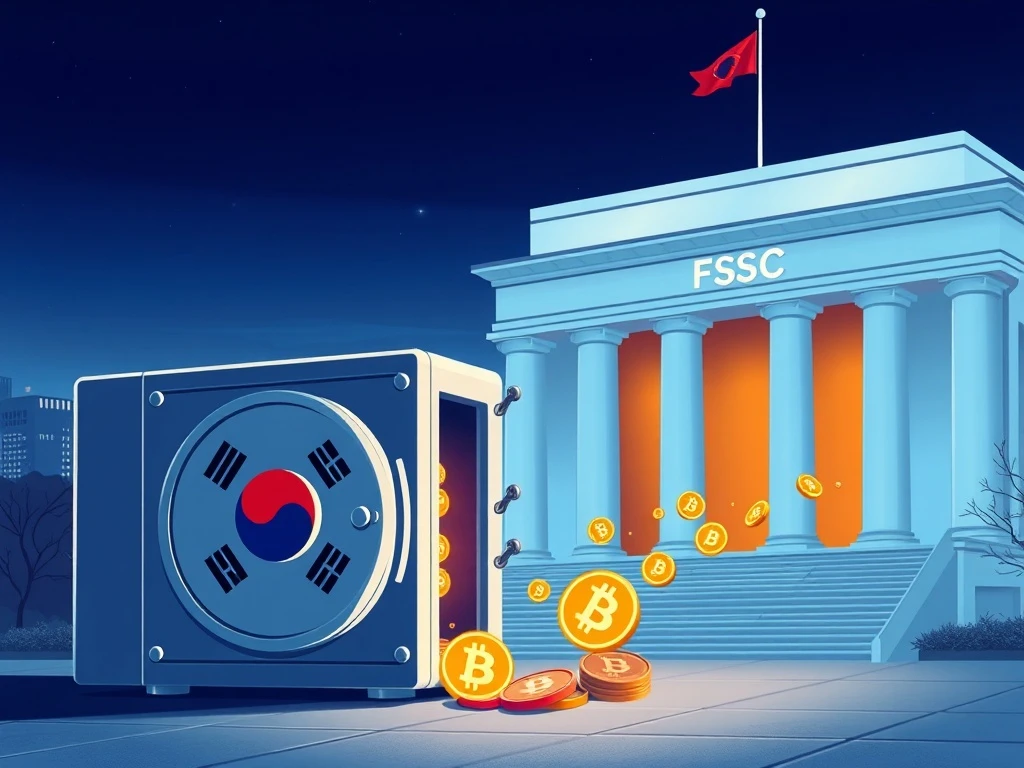
SEOUL, South Korea – March 2025 – In a regulatory move sending shockwaves through Asia’s cryptocurrency sector, South Korea’s Financial Services Commission (FSC) is developing stringent new rules that would impose punitive fines of up to 10% of an exchange’s total revenue following security breaches, fundamentally shifting liability for hacking incidents onto the platforms themselves and raising critical questions about regulatory proportionality and industry sustainability.
South Korea’s Proposed Crypto Exchange Fines: A Regulatory Earthquake
The Financial Services Commission’s draft regulations, first reported by MTN News, represent one of the most aggressive regulatory postures globally toward cryptocurrency exchange security. The proposed framework establishes a strict liability standard, meaning exchanges would be automatically responsible for user losses from hacking incidents regardless of fault or the sophistication of the attack. Furthermore, the regulator is considering imposing punitive financial penalties that could reach a staggering 10% of an exchange’s annual revenue. This dual approach of strict liability coupled with massive fines marks a significant escalation in South Korea’s ongoing efforts to bring order and consumer protection to its vibrant but volatile virtual asset market.
Industry analysts immediately noted the historical context. South Korea has experienced several high-profile exchange hacks over the past decade, including the infamous 2017 Bithumb breach and the 2022 attacks on several smaller platforms. These incidents collectively resulted in losses exceeding $1.5 billion, eroding public trust and prompting repeated calls for stronger oversight. Consequently, the FSC’s proposal appears designed to create a powerful financial incentive for exchanges to invest in state-of-the-art cybersecurity infrastructure. The regulator’s logic follows a clear path: by making the potential penalty for inadequate security prohibitively expensive, exchanges will have no choice but to prioritize and fund robust protective measures.
Comparing the Crypto Penalty to Traditional Finance Standards
The proposed 10% revenue fine has drawn immediate and sharp criticism from the virtual asset industry for its perceived severity. A central point of contention is the stark disparity between the penalty proposed for crypto exchanges and those applied to traditional electronic financial businesses. Under South Korea’s amended Electronic Financial Transactions Act, which governs banks and traditional fintech companies, the maximum penalty for similar security failures is capped at 3% of revenue.
An official from the virtual asset sector, speaking anonymously due to the sensitivity of ongoing regulatory discussions, highlighted this discrepancy. “The 10% fine is more than three times the maximum penalty applied to established electronic financial businesses,” the official stated. “This proposed standard seems excessive and punitive for virtual asset service providers, many of which operate on thinner margins than traditional banks. It creates an unlevel playing field and could stifle innovation.” This comparison raises fundamental questions about regulatory fairness and whether cryptocurrency businesses are being held to a disproportionately higher standard than their traditional counterparts.
The Global Context of Exchange Liability and Security
To understand the potential impact of South Korea’s proposal, it is instructive to examine the global regulatory landscape for exchange security. The following table outlines how different jurisdictions approach liability and penalties for security breaches:
| Jurisdiction | Liability Standard for Hacks | Typical Penalty Framework | Key Legislation/Guide |
|---|---|---|---|
| South Korea (Proposed) | Strict Liability | Fines up to 10% of annual revenue | FSC Draft Regulations |
| Japan | Fault-Based (with heavy oversight) | Business improvement orders, suspension of operations, fines based on severity | Payment Services Act |
| European Union | Fault-Based (under MiCA) | Administrative fines up to €10 million or 5% of turnover | Markets in Crypto-Assets (MiCA) |
| United States | Varies by state; often negligence-based | Civil penalties, enforcement actions, loss of licenses | State Money Transmitter Laws, SEC/CFTC oversight |
| Singapore | Fault-Based with strong custody rules | Monetary penalties, reprimands, license revocation | Payment Services Act 2019 |
As the table illustrates, South Korea’s proposed 10% revenue penalty would be among the most severe globally, surpassing even the EU’s MiCA framework which caps fines at 5% of annual turnover. The strict liability component is also notably more aggressive than the fault-based standards common in other major markets. This positioning suggests South Korea aims to become a global leader in consumer protection within the crypto space, potentially setting a precedent that other nations might later reference or adopt.
Potential Impacts on the South Korean Crypto Ecosystem
The FSC’s proposal, if enacted, would have profound and multifaceted consequences for South Korea’s cryptocurrency industry. Proponents argue it would deliver several key benefits:
- Enhanced Consumer Protection: Users would have clearer recourse and compensation pathways following a breach.
- Market Consolidation Towards Security: Only exchanges with serious, well-funded security postures could afford to operate, weeding out weaker players.
- Increased Institutional Trust: Stringent regulations could make the South Korean market more attractive to conservative institutional investors.
However, critics warn of significant negative repercussions that could reshape the market landscape:
- Barrier to Entry and Innovation: The massive potential liability could deter new startups from entering the market, reducing competition and innovation.
- Capital Flight and Offshoring: Existing exchanges might relocate operations to more lenient jurisdictions, taking jobs and tax revenue with them.
- Increased Operational Costs: The cost of ultra-premium cybersecurity insurance and security infrastructure would skyrocket, potentially being passed on to users through higher fees.
- Unintended Centralization: The market could become dominated by a few large, well-capitalized exchanges, reducing user choice.
Financial risk analyst, Dr. Min-ji Park, who has studied Asian crypto markets for a decade, provided a measured perspective. “The FSC’s intent to protect consumers is unequivocally correct,” Dr. Park noted. “The question is one of calibration. A 10% revenue fine is a potentially existential threat for any exchange, even a large one. The regulator must carefully balance the stick of severe penalties with the carrot of clear security standards and perhaps even government-backed support for best practices. The goal should be a secure ecosystem, not a depopulated one.” This analysis underscores the delicate balancing act regulators face between ensuring safety and fostering a healthy, competitive market.
The Road Ahead: Consultation and Implementation Timeline
The draft regulations are currently in a preliminary stage. The standard South Korean regulatory process involves several critical steps before any proposal becomes law. First, the FSC will likely publish an official draft for public commentary, inviting feedback from exchanges, industry associations, legal experts, and consumer advocacy groups. This consultation period typically lasts 30 to 60 days and often results in significant modifications to the initial proposal.
Following the consultation, the FSC will revise the draft and submit it for broader governmental review, potentially involving the Ministry of Economy and Finance and the National Assembly. The political climate and lobbying efforts from both the crypto industry and consumer protection advocates will heavily influence the final text. Historically, South Korean financial regulations have taken 6 to 18 months to move from draft proposal to enacted law. Given the complexity and high stakes of this proposal, observers predict a timeline on the longer end of that spectrum, with possible enforcement beginning in late 2025 or early 2026 at the earliest.
Conclusion
South Korea’s contemplation of punitive fines reaching 10% of revenue for hacked cryptocurrency exchanges represents a watershed moment in global digital asset regulation. The FSC’s proposal underscores a decisive shift toward strict liability, placing the onus for security squarely on exchange operators. While the goal of bolstering consumer protection and market integrity is widely supported, the severity of the proposed penalties has ignited a fierce debate about proportionality, fairness, and the future health of the innovation-driven crypto sector. As the consultation process unfolds, the world will watch closely to see if South Korea establishes a new, tougher global benchmark for exchange accountability or recalibrates its approach to find a more sustainable equilibrium between security and growth. The final shape of these South Korea crypto exchange fines will undoubtedly influence regulatory discussions from Tokyo to Brussels to Washington, D.C.
FAQs
Q1: What exactly is the FSC proposing for hacked cryptocurrency exchanges in South Korea?
A1: The Financial Services Commission is drafting regulations that would establish a “strict liability” standard, making exchanges automatically responsible for user losses from hacks. Additionally, they are considering imposing punitive fines that could be as high as 10% of an exchange’s total annual revenue as a penalty for security failures.
Q2: How does the proposed 10% fine compare to penalties for traditional banks in South Korea?
A2: The proposed penalty is significantly harsher. Under the Electronic Financial Transactions Act, traditional electronic financial businesses like banks face a maximum fine of 3% of revenue for security breaches. The crypto proposal is therefore more than three times steeper, a point of major industry criticism.
Q3: Why is South Korea considering such strict rules for crypto exchanges?
A3: The move is largely a response to a history of high-profile and costly exchange hacks in the country, which have damaged consumer trust. The FSC aims to create the strongest possible financial incentive for exchanges to invest in top-tier cybersecurity, thereby protecting investors and ensuring market stability.
Q4: What are the potential negative consequences of these proposed regulations?
A4: Critics warn that excessively high fines could drive exchanges out of South Korea, stifle innovation by creating huge barriers to entry, increase costs for users, and lead to excessive market concentration among only a few large, well-funded players.
Q5: Are these new South Korea crypto exchange fines already in effect?
A5: No, they are not. The regulations are currently in a draft and proposal stage. They must go through a formal public consultation process, potential revisions, and further governmental review before becoming law, a process that could take a year or more.
Q6: How does South Korea’s approach compare to other major crypto markets like the EU or Japan?
A6: South Korea’s proposal is among the strictest globally. The EU’s MiCA framework, for comparison, caps fines at 5% of turnover (not revenue) and uses a fault-based liability system. Japan also employs a fault-based system with operational penalties. South Korea’s combination of strict liability and a 10% revenue penalty is uniquely aggressive.
Related News
- Best Crypto Exchanges of 2026: The Essential Guide to Dominant Trading Platforms
- Bitcoin ETF Liquidity Crisis: Alarming Analysis Reveals Recovery Has Not Materialized
- Bitmain Bitcoin Mining Power Play: The Strategic Implications of an 11 EH/s Proxy Expansion