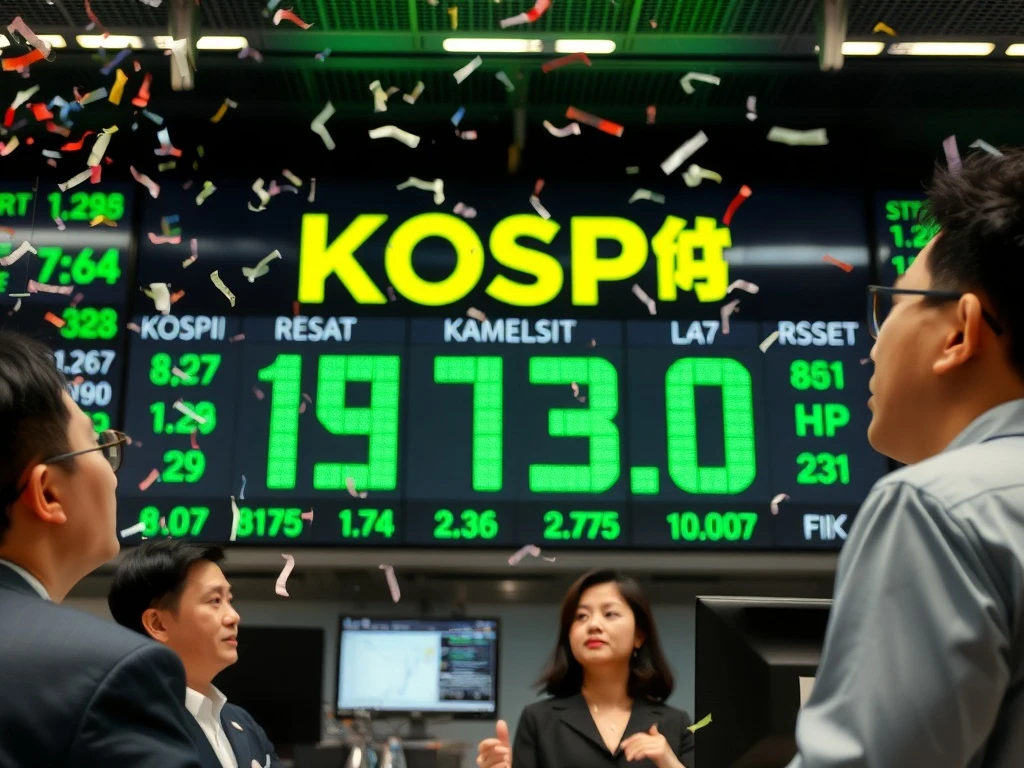
SEOUL, South Korea – March 15, 2025 – Against a backdrop of global market volatility and economic uncertainty, South Korea’s benchmark KOSPI index achieved a remarkable milestone this week, closing at an unprecedented 3,450 points. This historic achievement represents a significant moment for Asia’s fourth-largest economy, particularly as major global indices face downward pressure from inflation concerns and geopolitical tensions.
South Korea’s KOSPI Defies Global Market Trends
The Korea Composite Stock Price Index (KOSPI) demonstrated remarkable resilience during Thursday’s trading session. Meanwhile, global markets experienced substantial turbulence. The index surged 2.8% to reach its record-breaking close. This performance stands in stark contrast to declines witnessed in European and North American markets. Analysts immediately noted the significance of this divergence.
Several key factors contributed to this exceptional performance. First, semiconductor exports showed unexpected strength. Second, domestic consumption indicators exceeded forecasts. Third, government economic policies demonstrated effectiveness. Fourth, foreign investment inflows remained robust. These elements combined to create favorable market conditions.
Semiconductor Sector Drives Market Momentum
The semiconductor industry served as the primary engine for South Korea’s market achievement. Major technology companies reported stronger-than-expected quarterly earnings. Global demand for advanced chips continued to accelerate. Industry leaders maintained their competitive positioning in key markets. This sector performance provided crucial support for the broader index.
Expert Analysis of Market Dynamics
Financial analysts offered detailed perspectives on this development. Dr. Min-ji Park, Chief Economist at Seoul Financial Research Institute, explained the underlying factors. “The KOSPI’s performance reflects structural strengths in South Korea’s export economy,” she stated. “Semiconductor manufacturers have successfully navigated supply chain challenges. Furthermore, they’ve capitalized on growing artificial intelligence infrastructure demand globally.”
Historical context illuminates this achievement’s significance. The KOSPI first surpassed 3,000 points in January 2018. It then experienced volatility during the pandemic period. However, steady recovery followed throughout 2023 and 2024. This latest milestone represents the culmination of sustained economic progress.
| Date | Index Level | Market Context |
|---|---|---|
| January 2018 | 3,000 | First breach of psychological barrier |
| March 2020 | 2,100 | Pandemic-induced low point |
| December 2023 | 3,200 | Post-pandemic recovery peak |
| March 2025 | 3,450 | Current historic milestone |
Global Market Context and Regional Implications
International financial conditions presented significant challenges during this period. Major central banks maintained restrictive monetary policies. Geopolitical tensions affected energy markets. Supply chain disruptions persisted in certain sectors. Despite these headwinds, South Korean markets demonstrated exceptional performance.
Regional comparisons reveal interesting patterns. Japan’s Nikkei 225 remained relatively stable. Meanwhile, Hong Kong’s Hang Seng experienced moderate declines. Chinese markets showed mixed performance. South Korea’s achievement therefore stands out within the Asian financial landscape. This suggests unique domestic factors at work.
Economic Policy Contributions
Government initiatives played a crucial supporting role. The Ministry of Economy and Finance implemented targeted stimulus measures. Regulatory reforms improved business conditions. Export promotion programs enhanced international competitiveness. These policy actions created an environment conducive to market growth.
Foreign investment patterns revealed growing confidence. International institutional investors increased their South Korean equity allocations. Sovereign wealth funds maintained substantial positions. Retail investors from overseas markets participated actively. This diverse investor base provided stability during volatile periods.
Sector Performance Analysis and Future Outlook
Detailed examination reveals varied performance across different industries. Technology stocks led the advance with semiconductor companies showing particular strength. Automotive manufacturers also contributed positively. Financial institutions demonstrated stability. Consumer goods companies posted moderate gains. This broad-based participation strengthened the overall index performance.
Market analysts project continued momentum based on several factors. First, corporate earnings expectations remain positive. Second, export orders show sustained strength. Third, domestic economic indicators suggest stability. Fourth, global technology demand continues growing. These elements support optimistic near-term projections.
Potential challenges warrant careful monitoring. Global economic slowdown risks persist. Currency fluctuations could affect export competitiveness. Geopolitical developments may create uncertainty. Domestic demographic trends present long-term considerations. Market participants must therefore maintain balanced perspectives.
Conclusion
South Korea’s KOSPI index achieved a historic milestone despite challenging global conditions. This accomplishment reflects structural economic strengths and effective policy implementation. Semiconductor exports provided crucial momentum while domestic factors supported broader market stability. The index’s performance demonstrates resilience amid international financial turbulence. This development carries significant implications for regional markets and global investment strategies. South Korea’s financial markets continue demonstrating their capacity for exceptional performance even during periods of global uncertainty.
FAQs
Q1: What specific level did South Korea’s KOSPI index reach?
The KOSPI closed at 3,450 points, representing a historic high for the benchmark index.
Q2: How did other global markets perform during this period?
Many international markets experienced declines or volatility due to inflation concerns and geopolitical tensions, making South Korea’s performance particularly notable.
Q3: Which sector contributed most significantly to this achievement?
The semiconductor industry served as the primary driver, with major technology companies reporting strong earnings and benefiting from global demand for advanced chips.
Q4: What role did government policy play in this market performance?
Targeted economic stimulus measures, regulatory reforms, and export promotion programs created favorable conditions for market growth and stability.
Q5: How does this milestone compare to previous KOSPI achievements?
This represents the highest level in the index’s history, surpassing the previous peak of 3,200 points reached in December 2023 during the post-pandemic recovery period.
Related News
- John McAfee Auction: Unsettling Personal Artifacts Reveal Cybersecurity Pioneer’s Chaotic Legacy
- SEC CFTC Crypto Event: Crucial Joint Meeting Signals Regulatory Unity for Digital Assets
- Trump’s 25% Iran Tariff Threat Sparks Global Crypto Market Uncertainty in 2025