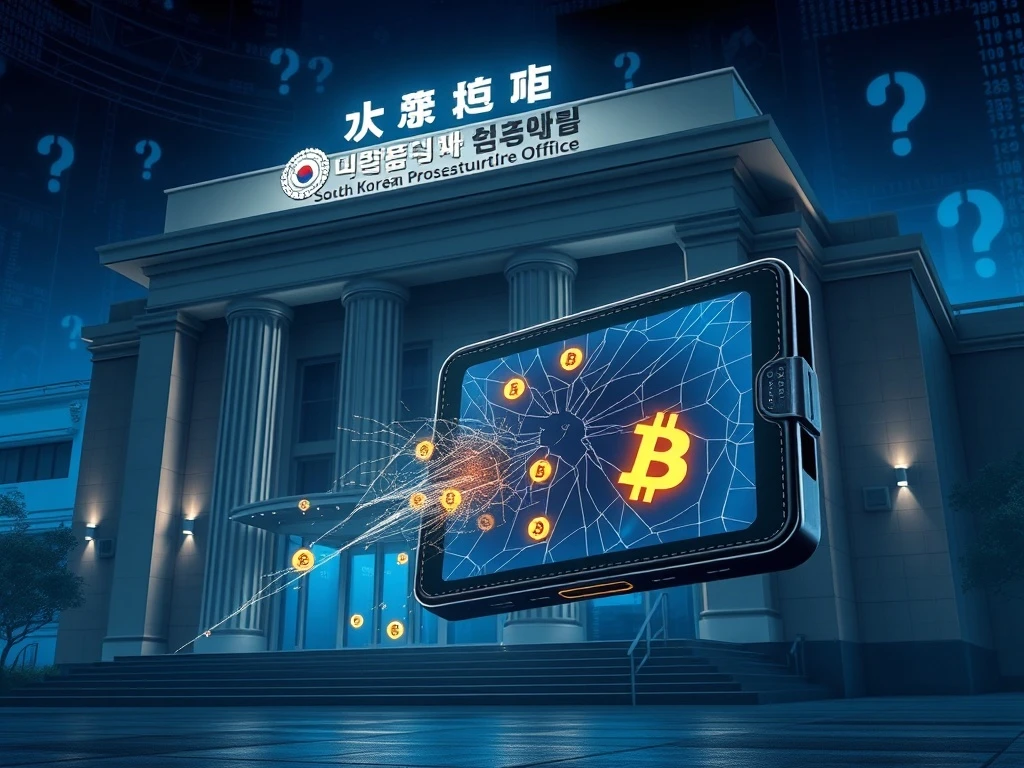
SEOUL, South Korea – In a stunning development that exposes critical vulnerabilities in digital asset custody, South Korean prosecutors now suspect a sophisticated phishing attack led to the catastrophic loss of seized Bitcoin worth tens of billions of won. This incident, first reported by Segye Ilbo, not only represents a significant financial blow but also raises profound questions about the security protocols surrounding cryptocurrency held by law enforcement agencies worldwide. The compromised assets were reportedly stored on a hardware wallet, a device typically considered among the most secure methods for safeguarding digital currency. Consequently, this breach suggests a potentially devastating chain of security failures, where a compromised security key may have provided attackers with access. Furthermore, because the seized Bitcoin was under a shared management system, investigators are also rigorously examining the possibility of intentional insider theft, adding another complex layer to this high-stakes financial investigation.
Anatomy of a South Korean Bitcoin Security Breach
The core of the investigation centers on a hardware wallet. Prosecutors theorize that an individual connected the physical wallet to an internet-enabled device, such as a computer or smartphone. Subsequently, that person likely accessed a malicious phishing website designed to mimic a legitimate service. These deceptive sites often trick users into entering sensitive information, including private keys or seed phrases. Once the attackers obtained the wallet’s cryptographic keys, they could irreversibly drain the funds to anonymous addresses on the blockchain. This method of attack, while not new, highlights a persistent human-factor vulnerability in even the most robust technical systems. The case underscores a harsh reality: the security of a hardware wallet is only as strong as the operational discipline of its users. Moreover, the shared custody arrangement, intended as a checks-and-balances measure, may have inadvertently increased the attack surface, providing more potential points of failure for a phishing scheme to succeed.
The Critical Role of Hardware Wallets in Crypto Security
To understand the gravity of this breach, one must examine the role of hardware wallets. Unlike “hot wallets” connected to the internet, these are physical devices that store private keys offline. They are widely regarded as the gold standard for personal cryptocurrency security. Transactions are signed internally on the device and then broadcast, meaning the private key never leaves the secure hardware element. However, their security model relies entirely on user vigilance. For instance, a user must verify receiving addresses on the device’s screen and must never input their recovery seed into any digital interface. The suspected phishing attack in South Korea likely circumvented these protections by tricking an authorized individual into compromising the wallet’s access credentials, demonstrating that technological fortifications can be undone by a single moment of human error.
Phishing Attacks: The Persistent Threat to Cryptocurrency
Phishing remains one of the most effective and common attack vectors in the digital asset space. Attackers employ increasingly sophisticated tactics, including:
- Fake Wallet Interfaces: Creating counterfeit websites or software that perfectly mimic popular wallet services like Ledger Live or MetaMask.
- Social Engineering: Using targeted emails or messages posing as trusted colleagues, law enforcement officials, or tech support to create urgency.
- Malicious Ads & Search Results: Purchasing ads that appear at the top of search results for common crypto tools, directing users to fraudulent sites.
- Supply Chain Attacks: Intercepting or tampering with hardware wallets before they reach the end user, though this is less common.
In the context of law enforcement, the threat profile intensifies. Prosecutors and asset management teams may become high-value targets for advanced persistent threat (APT) groups. These actors conduct extensive reconnaissance to craft believable lures. The South Korean case suggests the attackers possessed specific knowledge about the seizure and its custody procedures, indicating a highly targeted operation rather than a random scam.
Insider Threat: A Parallel Line of Inquiry
While phishing is the primary suspicion, prosecutors have openly stated they are considering the possibility of intentional theft by an insider. This line of inquiry is standard in major financial investigations but carries unique challenges in the crypto realm. Blockchain analysis can trace the movement of stolen funds, but obfuscation techniques like mixers or decentralized exchanges can complicate the trail. An insider would have legitimate access, meaning their actions might not immediately trigger security alerts. This scenario necessitates a forensic audit of digital and physical access logs, communication records, and financial backgrounds of all individuals with custody privileges. The dual-track investigation—phishing versus insider threat—reflects the complex reality of securing high-value digital assets where trust, technology, and procedure intersect.
Global Implications for Seized Asset Management
The loss in South Korea is not an isolated incident but part of a growing pattern that challenges global law enforcement. As agencies worldwide seize more cryptocurrency from criminal enterprises, they face the novel problem of securely managing these volatile and technically complex assets. Several high-profile cases illustrate this trend:
| Case | Jurisdiction | Asset Type | Key Challenge |
|---|---|---|---|
| Silk Road Seizures | United States | Bitcoin | Secure auction and transfer of billions in BTC. |
| Bitfinex Hack Recovery | United States | Bitcoin | Tracking and seizing stolen funds moved over years. |
| Various Drug Trafficking Cases | European Union | Multiple Cryptos | Liquidating seized assets without crashing markets. |
This incident will likely force a global reassessment of protocols. Agencies may need to adopt institutional-grade custody solutions that utilize multi-party computation (MPC) or multi-signature wallets, requiring multiple, geographically separated authorizations for any transaction. Additionally, mandatory cybersecurity training focused on crypto-specific threats like phishing will become essential for any personnel handling seized digital assets. The South Korean loss serves as a costly but vital lesson for the entire international law enforcement community.
Technical and Investigative Pathways Forward
South Korean investigators now follow a dual-path forensic strategy. On the blockchain, they will employ tracing firms to analyze the movement of the stolen Bitcoin. Every transaction is public, so following the funds to exchanges or known entities can yield identities. However, sophisticated thieves use chain-hopping, moving funds between different cryptocurrencies, and privacy tools to obscure their trail. On the digital forensics side, investigators will scrutinize the compromised device, browser histories, network logs, and email communications for signs of the phishing lure. They will also conduct rigorous audits of the shared management system’s access logs. The success of this investigation could set a precedent for how similar crimes are solved in the future, potentially leading to new international cooperation frameworks for tracking stolen crypto assets across borders.
Conclusion
The suspected phishing attack leading to the massive loss of seized Bitcoin in South Korea represents a watershed moment for cryptocurrency security and asset management. It starkly illustrates that even hardware wallets, the bedrock of crypto security, are vulnerable to sophisticated social engineering and potential insider threats. This event will undoubtedly catalyze stricter security protocols for law enforcement agencies worldwide as they grapple with the responsibility of safeguarding seized digital fortunes. The ongoing investigation will be closely watched, not only for its outcome but for the lessons it provides in hardening defenses against the evolving threats targeting the digital asset ecosystem. The South Korean Bitcoin loss is a powerful reminder that in the world of cryptocurrency, robust technology must be underpinned by unwavering human vigilance and procedural excellence.
FAQs
Q1: What is a hardware wallet, and why is it considered secure?
A hardware wallet is a physical device that stores the private keys to cryptocurrency offline. It is considered secure because the keys never leave the device, making them immune to remote hacking. Transactions are signed internally and then broadcast, providing a strong defense against online threats.
Q2: How could a phishing attack compromise a hardware wallet?
A hardware wallet itself cannot be phished directly. However, a phishing attack can trick the user into revealing their recovery seed phrase (the backup words) or into approving a malicious transaction on the device’s screen by disguising the recipient’s address. In this case, prosecutors suspect a security key was compromised when the wallet was connected to a compromised device.
Q3: What does “shared management” of seized assets mean?
Shared management typically means that control over the assets (like the private keys or transaction approvals) is divided among multiple authorized individuals or entities. This is intended to prevent any single person from having unilateral access, acting as a fraud prevention measure. However, it can also complicate security if protocols are not strictly followed.
Q4: Can the stolen Bitcoin be recovered?
Recovery is difficult but not impossible. If the funds are sent to a custodial exchange that requires identity verification, law enforcement can work with that exchange to freeze the assets. Otherwise, tracking relies on blockchain analysis to follow the funds, which can be obscured by mixers or decentralized exchanges. Recovery often depends on identifying the individuals behind the theft.
Q5: What impact will this have on future cryptocurrency seizures?
This incident will likely lead to significantly enhanced security protocols for seized digital assets globally. Law enforcement agencies may adopt enterprise-grade custody solutions, implement mandatory cybersecurity training focused on crypto threats, and establish stricter operational procedures for accessing and managing hardware wallets to prevent similar breaches.
Related News
- S&P Crypto ETF Filing Reveals Stunning Bitcoin, Ethereum, and XRP Dominance in SEC Proposal
- Ethereum Whale Awakens: Dormant Wallet Deposits $145M to Gemini After 9-Year Slumber
- MVL’s TADA Aims for $100M Blockbuster Investment to Fuel Aggressive U.S. Ride-Hailing Expansion