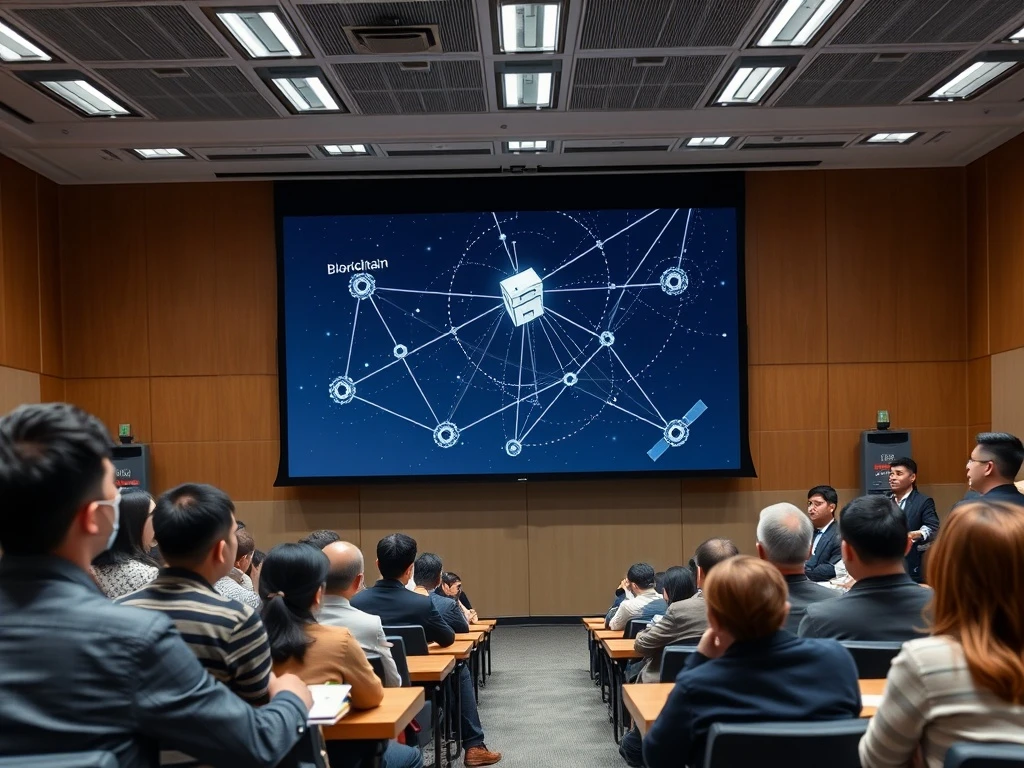
In a significant move bridging academia and frontier blockchain technology, the decentralized satellite internet project Spacecoin (SPACE) has held a pivotal technology seminar with the prestigious Korea Advanced Institute of Science and Technology (KAIST). The event, convened at KAIST’s main campus in Daejeon, South Korea, in early 2025, marks a strategic step for the ambitious SpaceNetwork initiative, aiming to leverage elite engineering talent for its real-world implementation.
Spacecoin and KAIST: A Strategic Academic Partnership
The seminar assembled a formidable group of technical minds. Consequently, the meeting focused intensely on the practical vision and technical roadmap for Spacecoin’s core project, the SpaceNetwork. Attendees included Spacecoin founder Taelim Oh and an advisory panel comprising former senior engineers from Samsung Electronics. Furthermore, key participants came from multiple research laboratories led by five distinguished KAIST professors, including Professor Jun-hyuk Kang from the School of Electrical Engineering. This collaboration signals a shift from theoretical whitepaper concepts to grounded, research-driven development.
Such partnerships are increasingly vital in the cryptocurrency sector. Therefore, projects seeking long-term viability now actively pursue validation and input from established academic institutions. KAIST, consistently ranked as South Korea’s top science and technology university, provides immense credibility. The institute’s history of pioneering research in telecommunications, semiconductor design, and aerospace engineering directly aligns with the multidisciplinary challenges of building a decentralized satellite network.
Decentralizing Connectivity: The SpaceNetwork Vision Explained
The core ambition of Spacecoin’s SpaceNetwork is to create a blockchain-governed, decentralized internet service provider (ISP) using a constellation of low-earth orbit (LEO) satellites. Unlike traditional models controlled by single corporations, this network would operate on a decentralized protocol. Users could potentially earn SPACE tokens by sharing bandwidth or hosting ground station infrastructure. The seminar at KAIST likely addressed critical technical hurdles, including:
- Network Latency and Architecture: Designing a mesh network that minimizes data relay times between satellites and ground nodes.
- Consensus Mechanism for Physical Infrastructure: Adapting blockchain consensus to reliably manage and validate the state of physical satellite assets.
- Spectrum Management and Regulation: Navigating the complex international regulatory landscape for satellite communications and frequency allocation.
- Hardware-Software Integration: Ensuring the blockchain layer seamlessly interacts with satellite telemetry, tracking, and control systems.
This initiative enters a competitive but nascent field. Established players like Starlink have demonstrated the viability of LEO satellite internet. However, their centralized ownership contrasts sharply with Spacecoin’s proposed decentralized model. The involvement of former Samsung engineers is particularly noteworthy, as it brings mass-scale electronics manufacturing and supply chain expertise to the table.
Expertise and Authoritativeness: The KAIST and Samsung Connection
The composition of the seminar’s participants underscores the project’s commitment to E-E-A-T principles—Experience, Expertise, Authoritativeness, and Trustworthiness. KAIST professors like Jun-hyuk Kang bring authoritative, peer-reviewed research credentials. Simultaneously, the advisory group of ex-Samsung engineers offers decades of hands-on experience in bringing cutting-edge consumer electronics from R&D to global markets. This blend is crucial for a project that must excel in both theoretical cryptography and practical aerospace engineering.
Historically, blockchain projects have faced criticism for a lack of tangible, off-chain development. Spacecoin’s public engagement with a top-tier engineering school provides a measurable counterpoint. It creates a transparent channel for peer scrutiny and technical validation. Moreover, South Korea’s position as a global leader in broadband penetration and consumer technology adoption makes it an ideal testing ground for such an innovative connectivity solution.
The Roadmap Ahead: From Seminar to Implementation
The KAIST seminar represents a single, though important, milestone. The true test for Spacecoin will be translating academic dialogue into prototype hardware and testnet software. The next logical steps, inferred from similar deep-tech projects, would involve sponsored PhD or master’s research projects at KAIST labs. Subsequently, these could focus on specific sub-problems like efficient antenna design for user terminals or secure communication protocols between satellites.
The timeline for satellite internet projects is inherently long-term. Deploying even a minimal viable constellation requires significant capital, regulatory approvals, and successful launch campaigns. Therefore, the partnership with KAIST may serve a dual purpose: advancing R&D while building institutional legitimacy to attract further investment and partnerships. The table below contrasts key aspects of decentralized versus traditional satellite internet models.
| Aspect | Decentralized Model (e.g., SpaceNetwork Vision) | Centralized Model (e.g., Starlink) |
|---|---|---|
| Governance | Token-holder or DAO-based decisions | Corporate board and executive decisions |
| Infrastructure Ownership | Potentially distributed among users/operators | Owned solely by the parent company |
| Revenue Distribution | Shared with network participants via tokens | Retained by the company and shareholders |
| R&D Approach | Open-source, collaborative (e.g., with KAIST) | Proprietary, in-house development |
| Primary Challenge | Coordinating complex hardware via decentralized software | Capital intensity and rapid global deployment |
Ultimately, the success of this model hinges on achieving reliability and cost-competitiveness with centralized alternatives. The KAIST seminar is a clear investment in the foundational research required to meet that challenge.
Conclusion
The technology seminar between Spacecoin and KAIST’s School of Electrical Engineering is a substantive development for the decentralized satellite internet sector. It moves the SpaceNetwork project beyond community speculation and into the realm of academic and industrial engineering collaboration. By leveraging the expertise of KAIST researchers and former Samsung engineers, Spacecoin is attempting to address the profound technical hurdles of its ambition. While the path to a functioning decentralized SpaceNetwork remains long and fraught with challenges, partnerships of this caliber are essential for building the credibility and technical depth necessary to potentially redefine global internet connectivity.
FAQs
Q1: What is the main goal of Spacecoin’s SpaceNetwork?
The primary goal is to build a decentralized internet service provider using a constellation of satellites, operated and governed by a blockchain protocol rather than a single central company.
Q2: Why is partnering with KAIST important for Spacecoin?
KAIST is a world-renowned research university. Partnering with it provides technical validation, access to cutting-edge academic research, and credibility, which are critical for a complex hardware-software project like satellite internet.
Q3: Who attended the tech seminar at KAIST?
Attendees included Spacecoin founder Taelim Oh, an advisory group of former senior Samsung Electronics engineers, and researchers from labs led by five KAIST professors, including Professor Jun-hyuk Kang.
Q4: How does a decentralized satellite network differ from Starlink?
While both use LEO satellites, a decentralized network like the one Spacecoin proposes would be governed by its users or token holders. In contrast, Starlink is owned and fully controlled by SpaceX, a centralized corporation.
Q5: What are the biggest technical challenges for Spacecoin’s project?
Key challenges include integrating blockchain with physical satellite hardware, managing network latency in space, obtaining regulatory approval for spectrum use, and designing a sustainable economic model for network participants.
Related News
- South Korea’s Bold Move: Mandatory Crypto Fund Disclosure in Real Estate Deals Takes Effect February 2025
- Peter Schiff Gold Warning: $170 Surge Signals Imminent US Dollar Crisis
- South Dakota Bitcoin Bill: Bold Legislation Reintroduced for State Cryptocurrency Investment