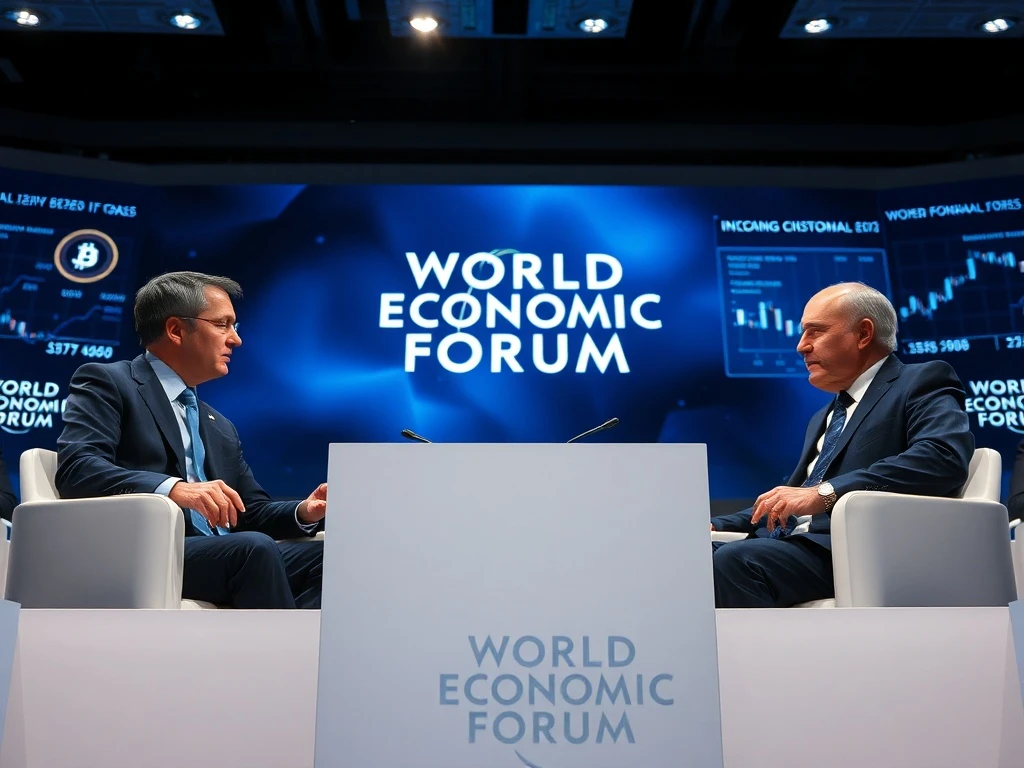
DAVOS, SWITZERLAND – JANUARY 2025: A fundamental debate over the future of money erupted at the World Economic Forum, pitting cryptocurrency innovation directly against traditional financial stability. The clash over stablecoin interest payments between Coinbase CEO Brian Armstrong and Bank of France Governor François Villeroy de Galhau reveals a deep global schism on how to regulate the next generation of digital currency. This pivotal discussion underscores the urgent policy choices facing nations as they balance technological competitiveness with systemic risk.
The Core Debate on Stablecoin Interest Payments
During a high-profile panel, Armstrong and Villeroy de Galhau presented diametrically opposed visions. Armstrong championed user rights and national competitiveness. He argued that holders of digital dollars or euro-pegged tokens deserve yield. “Users have a fundamental right to earn a return on their money,” Armstrong stated. He framed the issue as a matter of economic competition, pointing to China’s digital yuan, which already permits interest-like features. Armstrong warned that a U.S. or European ban would cede ground to global competitors, potentially stifling innovation in Western financial technology sectors.
Conversely, Governor Villeroy de Galhau represented the cautious stance of major central banks. He identified a clear threat to the traditional banking model. Private tokens paying interest could trigger massive deposit flight from commercial banks to less-regulated crypto platforms. This exodus could undermine banks’ ability to lend, threatening broader financial stability. “The primary public objective must be to preserve financial stability,” Villeroy de Galhau asserted, adding he does not believe a potential digital euro should pay interest, setting a clear boundary for public digital currency design.
Global Context and the Precedent of China’s Digital Yuan
The debate did not occur in a vacuum. Armstrong’s reference to China’s central bank digital currency (CBDC) is a critical piece of real-world context. The People’s Bank of China has integrated programmable features into the digital yuan, including the capacity for controlled, time-limited “red packets” that function similarly to interest promotions. This development places pressure on other major economies. Analysts from the Bank for International Settlements (BIS) note that CBDC design choices directly influence private sector innovation. A CBDC that pays interest could crowd out private stablecoins, while one that does not may create space for them to offer competitive yields.
The global regulatory landscape is fragmented:
- United States: Regulatory bodies like the SEC and OCC have issued conflicting guidance, creating uncertainty for stablecoin issuers regarding interest-bearing products.
- European Union: The Markets in Crypto-Assets (MiCA) regulation provides a framework but leaves specific rules on interest payments to national competent authorities and future technical standards.
- Asia-Pacific: Jurisdictions like Singapore and Hong Kong are exploring sandbox environments to test interest-bearing digital assets under strict supervision.
Expert Analysis on Financial Stability Risks
Financial stability experts echo Villeroy de Galhau’s concerns but add nuance. Dr. Sarah Bloom, a former financial regulator and fintech scholar, explains the transmission mechanism of risk. “A widely adopted, interest-bearing stablecoin could create a new shadow banking system,” she notes. “During times of stress, a ‘digital run’ could happen in minutes, not days, as users click to withdraw billions globally. The lack of a traditional lender of last resort for these private entities is a critical vulnerability.” However, other economists, like Professor Ken Rogoff, suggest that with proper regulation—including high-quality liquid asset backing and access to central bank facilities—some risks could be mitigated, allowing for innovation within guardrails.
Broader Disagreement on Bitcoin and Monetary Sovereignty
The panel’s divergence extended beyond stablecoins to the role of Bitcoin and decentralized cryptocurrencies. Armstrong highlighted Bitcoin’s unique value proposition as an asset without a single issuer, framing it as a check on monetary policy. “Bitcoin is more independent than central banks because it lacks an issuer and cannot be controlled by any single entity,” he argued, positioning it as a form of digital gold and a hedge against systemic financial risk.
Villeroy de Galhau viewed this independence as a threat, not a feature. He warned that widespread adoption of unregulated private currencies could erode a state’s most fundamental economic tool: monetary sovereignty. “This could become a political threat,” he cautioned, implying that the ability to conduct monetary policy, manage inflation, and act as a lender of last resort could be compromised if significant economic activity migrates to uncontrolled digital currencies. This tension between individual financial autonomy and collective economic governance lies at the heart of the global crypto debate.
The Path Forward: Regulation, Innovation, and Coexistence
The Davos clash is a microcosm of a larger, ongoing negotiation. Policymakers worldwide are grappling with a trilemma: fostering innovation, ensuring consumer protection, and maintaining financial stability. Potential compromise models are emerging. One model involves strictly limiting interest-bearing stablecoins to institutional and wholesale markets, insulating retail depositors. Another proposes “synthetic” CBDCs, where the central bank provides a settlement layer for privately issued, regulated stablecoins, allowing for some yield generation under strict oversight.
The timeline for resolution is uncertain but pressing. The European Central Bank’s digital euro project continues its investigation phase, with design decisions on interest functionality pending. In the U.S., the progress of the Clarity for Payment Stablecoins Act and similar legislation will directly address the questions Armstrong raised. The outcome will shape not just the crypto industry, but the architecture of the entire financial system for decades.
Conclusion
The debate over stablecoin interest payments between Coinbase’s Brian Armstrong and the Bank of France’s François Villeroy de Galhau is far more than a theoretical disagreement. It is a concrete battle over the future architecture of money, balancing the drive for innovation and competitiveness against the imperative of financial stability. As nations observe China’s digital yuan experiments and craft their own CBDC and stablecoin policies, the arguments presented at Davos will echo in legislative halls and central bank meetings globally. The resolution will determine whether stablecoins evolve into a disruptive, yield-bearing parallel system or become a tightly integrated, utility-focused component of the traditional financial landscape.
FAQs
Q1: What are stablecoin interest payments?
Stablecoin interest payments refer to yield or returns paid to holders of stablecoins—digital tokens pegged to assets like the US dollar. These payments are typically generated by the issuer lending out or investing the reserve assets backing the stablecoin, similar to how a bank pays interest on deposits.
Q2: Why does the Bank of France Governor oppose them?
Governor Villeroy de Galhau opposes them primarily due to financial stability risks. He fears that if private stablecoins offer attractive interest rates, they could draw massive deposits away from traditional banks, undermining those banks’ lending capacity and potentially creating a fragile, unregulated shadow banking system.
Q3: What was Brian Armstrong’s main argument in favor?
Armstrong argued from principles of user rights and national competitiveness. He stated that users deserve a return on their digital money and that banning such payments would put the U.S. and Europe at a disadvantage against jurisdictions like China, which are advancing their own interest-bearing digital currencies.
Q4: How does China’s digital yuan relate to this debate?
China’s digital yuan (e-CNY) is a central bank digital currency (CBDC) that has tested features allowing it to distribute time-limited “red packets” with value, functioning similarly to promotional interest. Armstrong cited this as evidence that competitors are moving forward, making restrictive policies in the West potentially self-defeating.
Q5: What is the broader implication for Bitcoin mentioned in the debate?
The broader implication touches on monetary sovereignty. Armstrong viewed Bitcoin’s lack of a central issuer as a strength providing independence. In contrast, Villeroy de Galhau saw the rise of such uncontrolled private currencies as a political threat that could weaken a nation’s control over its own monetary policy and economic stability.
Related News
- Justin Sun’s Strategic $8M DeFi Investment in River Project Signals Major Ecosystem Expansion
- Mirana Ventures Executes Strategic $12.2M MNT Transfer to Bybit After Three-Year Holding Period
- Bitcoin Price Analysis Reveals Alarming Sideways Trap: Glassnode Warns of Prolonged Range-Bound Movement