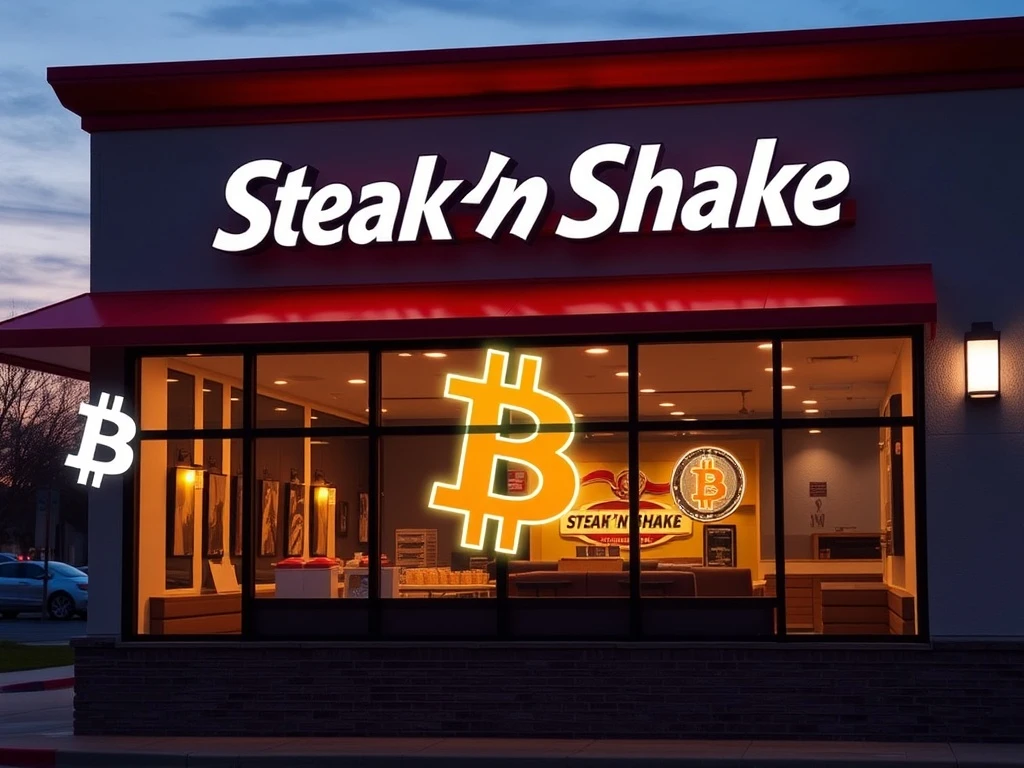
In a decisive move that underscores growing corporate confidence in digital assets, American fast-food chain Steak ‘n Shake has announced a substantial $10 million Bitcoin purchase this week. This strategic acquisition represents a significant escalation of the company’s cryptocurrency initiatives, following its earlier commitment to accept BTC payments. The transaction, executed through regulated cryptocurrency exchanges, demonstrates how traditional retail businesses increasingly view Bitcoin as a legitimate treasury asset. Moreover, this development signals a maturing relationship between mainstream commerce and decentralized finance.
Steak ‘n Shake’s Strategic Bitcoin Accumulation
Steak ‘n Shake’s latest $10 million Bitcoin purchase builds directly upon its previously announced cryptocurrency strategy. The company first revealed plans to accept Bitcoin payments across its U.S. locations in late 2024. Importantly, management committed to holding all cryptocurrency received from customers rather than converting it to fiat currency. Consequently, this new institutional purchase represents a deliberate expansion of that reserve strategy. The company now joins a growing cohort of publicly-traded corporations allocating portions of their treasury to Bitcoin.
Corporate treasury strategies involving Bitcoin have evolved significantly since MicroStrategy’s pioneering moves in 2020. Initially, companies treated Bitcoin primarily as a speculative hedge against inflation. However, the narrative has shifted toward viewing Bitcoin as a strategic long-term reserve asset. Steak ‘n Shake’s approach appears particularly innovative because it combines customer-facing cryptocurrency acceptance with direct institutional purchasing. This dual strategy creates a natural Bitcoin acquisition pipeline while demonstrating confidence in the asset’s future value.
The Mechanics of Corporate Bitcoin Purchases
Executing a $10 million Bitcoin purchase requires careful planning and compliance. Typically, corporations work through registered cryptocurrency custodians and exchanges to facilitate large transactions. These entities provide institutional-grade security, insurance, and regulatory compliance. Furthermore, proper accounting treatment under Generally Accepted Accounting Principles (GAAP) remains essential for publicly-traded companies. Steak ‘n Shake likely utilized Over-The-Counter (OTC) trading desks to minimize market impact during acquisition.
The following table outlines key aspects of corporate Bitcoin treasury strategies:
| Strategy Component | Description | Steak ‘n Shake’s Approach |
|---|---|---|
| Acquisition Method | How corporations purchase Bitcoin | Combined OTC purchases and customer payments |
| Storage Solution | Security and custody arrangements | Institutional custodial services with multisig wallets |
| Accounting Treatment | Financial reporting methodology | Intangible asset classification with impairment testing |
| Strategic Rationale | Business justification for allocation | Long-term reserve, innovation signaling, payment integration |
Corporate Bitcoin Adoption Trends in 2025
The landscape of corporate Bitcoin adoption has transformed dramatically in recent years. Initially dominated by technology companies, the trend now encompasses diverse sectors including retail, manufacturing, and services. Several factors drive this expansion. First, regulatory clarity has improved in major jurisdictions. Second, institutional infrastructure has matured significantly. Third, macroeconomic conditions continue to favor alternative store-of-value assets. Therefore, Steak ‘n Shake’s move reflects broader market evolution rather than isolated experimentation.
Retail and restaurant chains face unique considerations when adopting Bitcoin strategies. Unlike technology companies with natural cryptocurrency synergies, traditional businesses must justify digital asset allocation to shareholders accustomed to conventional metrics. Key considerations include:
- Customer adoption rates for cryptocurrency payments
- Volatility management strategies for treasury assets
- Regulatory compliance across multiple jurisdictions
- Competitive positioning within the industry
- Long-term strategic alignment with business objectives
Industry analysts observe that early-adopting restaurants often experience secondary benefits beyond direct financial returns. These include increased media attention, technology-forward branding, and attraction of cryptocurrency-using customer segments. However, successful implementation requires robust technical infrastructure and employee training programs.
Bitcoin as a Treasury Reserve Asset
The concept of Bitcoin as a corporate treasury asset has gained substantial traction since 2020. Traditional treasury management typically emphasizes liquidity, safety, and yield. Bitcoin introduces different characteristics including decentralization, programmability, and non-sovereign issuance. Consequently, corporations allocate relatively small percentages of total reserves to Bitcoin, usually between 1% and 10%. This approach balances innovation with risk management.
Financial experts note that Bitcoin’s value proposition for corporate treasuries centers on several key attributes. Its fixed supply contrasts with expanding fiat currency supplies. Its global liquidity enables cross-border value transfer without traditional banking intermediaries. Additionally, its digital nature facilitates programmable financial applications. Nevertheless, volatility remains a significant consideration requiring sophisticated risk management frameworks.
Impact on the Restaurant Industry and Cryptocurrency Ecosystem
Steak ‘n Shake’s substantial Bitcoin purchase carries implications beyond its own balance sheet. The restaurant industry traditionally operates with thin margins and conservative financial management. Therefore, this move may encourage competitors to evaluate similar strategies. Already, several restaurant chains have begun accepting cryptocurrency payments. However, direct treasury allocation represents a more significant commitment. This development could accelerate cryptocurrency integration throughout the hospitality sector.
The cryptocurrency ecosystem benefits from increased corporate adoption in multiple ways. First, it validates Bitcoin’s store-of-value narrative at an institutional level. Second, it stimulates development of enterprise-grade cryptocurrency services. Third, it enhances regulatory dialogue by demonstrating serious business applications. Furthermore, corporate purchases contribute to Bitcoin’s distribution beyond early adopters and retail investors. This broader ownership base potentially increases network security and decentralization.
Payment processors and point-of-sale providers have responded to growing restaurant interest in cryptocurrency acceptance. Modern systems now integrate cryptocurrency payments seamlessly with traditional payment methods. Customers typically scan QR codes or tap NFC-enabled devices to complete transactions. Behind the scenes, solutions often convert cryptocurrency to fiat instantly if desired, though Steak ‘n Shake has chosen the HODL strategy instead. This infrastructure development lowers barriers to entry for other restaurants considering similar initiatives.
Regulatory and Accounting Considerations
Corporate Bitcoin holdings operate within evolving regulatory and accounting frameworks. In the United States, the Financial Accounting Standards Board (FASB) issued updated guidance for cryptocurrency accounting in 2023. Companies now report Bitcoin holdings at fair value with changes recognized in earnings. This treatment reduces accounting complexity compared to previous impairment-only models. Regulatory oversight involves multiple agencies including the SEC for public companies and FinCEN for anti-money laundering compliance.
International operations introduce additional complexity for global restaurant chains. Different jurisdictions maintain varying approaches to cryptocurrency regulation. Some countries embrace digital assets with clear frameworks, while others impose restrictions or outright bans. Consequently, multinational corporations must navigate this patchwork landscape carefully. Steak ‘n Shake, primarily operating in the United States, faces relatively favorable conditions compared to chains with broader international presence.
Future Outlook for Corporate Cryptocurrency Adoption
The trajectory of corporate cryptocurrency adoption suggests continued growth through 2025 and beyond. Several indicators support this projection. Institutional investment products have gained regulatory approval in major markets. Traditional financial institutions increasingly offer cryptocurrency custody and trading services. Moreover, technological advancements improve scalability and reduce transaction costs. These developments create a more hospitable environment for corporate participation.
Potential future developments could further accelerate adoption. Central bank digital currencies (CBDCs) might create bridges between traditional and cryptocurrency systems. Improved layer-2 solutions could enable faster and cheaper Bitcoin transactions for retail payments. Additionally, standardized reporting frameworks might simplify compliance for corporate treasurers. However, challenges remain including regulatory uncertainty in some jurisdictions and persistent volatility concerns.
Industry observers will monitor several key metrics following Steak ‘n Shake’s announcement. These include competitor responses, customer payment behavior, and financial performance indicators. Successful implementation could establish a blueprint for other traditional businesses. Conversely, challenges might prompt strategic adjustments. Regardless of immediate outcomes, this development represents another milestone in cryptocurrency’s journey toward mainstream financial integration.
Conclusion
Steak ‘n Shake’s $10 million Bitcoin purchase represents a significant development in corporate cryptocurrency adoption. The move demonstrates growing institutional confidence in Bitcoin as a treasury asset. Furthermore, it combines with the company’s existing cryptocurrency payment acceptance strategy. This integrated approach reflects sophisticated understanding of digital assets’ potential roles in modern business. As traditional corporations increasingly explore cryptocurrency strategies, Steak ‘n Shake’s experience may inform broader industry trends. The restaurant chain’s bold Bitcoin investment ultimately highlights digital assets’ evolving position within mainstream corporate finance.
FAQs
Q1: How does Steak ‘n Shake’s Bitcoin purchase compare to other corporate acquisitions?
Steak ‘n Shake’s $10 million purchase represents a mid-sized corporate Bitcoin allocation. It follows similar but larger moves by companies like MicroStrategy and Tesla, though it stands out within the restaurant industry where such allocations remain rare.
Q2: Can customers pay with Bitcoin at Steak ‘n Shake restaurants?
Yes, Steak ‘n Shake began accepting Bitcoin payments in late 2024. The company converts customer Bitcoin payments to its corporate treasury rather than immediately converting to U.S. dollars.
Q3: How does corporate Bitcoin accounting work under current regulations?
Under updated FASB guidelines, companies report Bitcoin holdings at fair market value with changes recognized in earnings each reporting period. This represents an improvement over previous impairment-only accounting models.
Q4: What risks do corporations face when holding Bitcoin?
Primary risks include price volatility, regulatory changes, cybersecurity threats, and operational complexity. Corporations typically mitigate these through professional custody solutions, risk management frameworks, and limited allocation percentages.
Q5: Will other restaurant chains follow Steak ‘n Shake’s example?
Industry analysts believe increased cryptocurrency adoption by major chains could create competitive pressure for others to follow. However, individual decisions will depend on each company’s risk tolerance, strategic objectives, and technical capabilities.
Related News
- Strategic Shift: Canada’s Calculated Economic Pivot Toward China Signals New Global Alignment
- Coinbase Listing Roadmap Expands with Strategic SKR and FIGHT Token Additions
- Elon Musk OpenAI ICO: The Stunning $10 Billion Crypto Plan He Abandoned