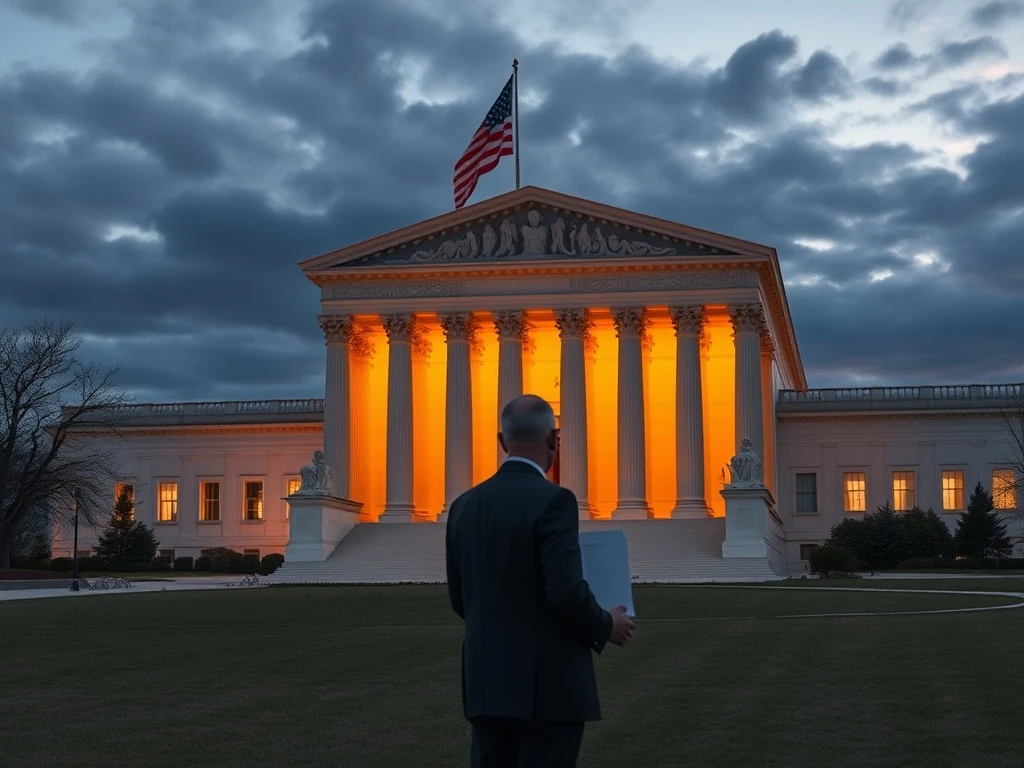
WASHINGTON, D.C., January 19, 2025 – In a significant development for U.S. economic policy, Treasury Secretary Scott Bessent expressed strong confidence that the Supreme Court will uphold President Donald Trump’s cornerstone economic measures. This statement arrives just hours before the Court’s scheduled ruling on controversial tariff policies, setting the stage for a pivotal moment in American trade and constitutional law.
Supreme Court Trump Tariffs Decision Approaches
Walter Bloomberg first reported Secretary Bessent’s assessment on Monday. Consequently, financial markets and policy analysts immediately scrutinized the implications. The Treasury Secretary specifically addressed the legal challenges facing Trump-era economic policies. Moreover, he highlighted the constitutional framework supporting executive authority in trade matters. Bessent served as a key economic advisor during Trump’s presidency before assuming his current role. Therefore, his perspective carries substantial weight in Washington circles.
The Supreme Court will announce its decision at 3:00 p.m. UTC on January 20. This timing coincides with significant anniversaries in American political history. Legal experts have tracked this case for months through lower courts. Additionally, the ruling could establish lasting precedents for presidential power over international trade. The Court’s conservative majority has previously shown deference to executive branch authority in economic policy areas.
Constitutional Framework and Executive Authority
Several legal scholars support Bessent’s prediction about the Court’s direction. They point to established constitutional interpretations of presidential power. Specifically, Article II grants the executive branch considerable authority in foreign affairs and national security. Historically, courts have granted presidents wide latitude in these domains. Furthermore, Congress has delegated significant trade policy powers through legislation like the Trade Expansion Act of 1962 and the International Emergency Economic Powers Act.
The following table outlines key legal authorities relevant to the case:
| Legal Authority | Relevant Section | Potential Application |
|---|---|---|
| Trade Expansion Act of 1962 | Section 232 | National security tariffs |
| International Emergency Economic Powers Act | Section 1701 | Emergency economic measures |
| U.S. Constitution | Article II, Section 2 | Executive treaty and appointment powers |
Previous Supreme Court decisions provide important context for the upcoming ruling. For instance, the 2014 case Zivotofsky v. Kerry reinforced presidential supremacy in foreign policy recognition. Similarly, the 2019 decision in Gundy v. United States addressed congressional delegation of authority to executive agencies. These precedents suggest judicial reluctance to interfere with established executive branch functions.
Economic Impacts and Market Reactions
Financial markets have demonstrated notable volatility ahead of the Court’s announcement. Major stock indices fluctuated throughout Monday’s trading session. Meanwhile, bond markets showed increased demand for Treasury securities as investors sought safety. Currency markets particularly reacted to the potential implications for international trade flows. The U.S. dollar strengthened against several major currencies following Bessent’s comments.
Several key economic sectors face direct consequences from the ruling:
- Manufacturing: Tariff policies significantly affect domestic producers and importers
- Agriculture: Export-dependent industries await clarity on trade relationships
- Technology: Global supply chains require predictable trade policies
- Energy: Fossil fuel and renewable sectors both face tariff implications
International trade partners have closely monitored the legal proceedings. The European Union, China, and Canada previously challenged Trump’s tariff policies through World Trade Organization mechanisms. However, the Supreme Court’s decision will primarily affect domestic enforcement and legal standing for future challenges.
Historical Context of Presidential Trade Powers
Presidential authority over trade policy has evolved significantly throughout American history. Early presidents exercised considerable discretion in trade matters. For example, Thomas Jefferson implemented the Embargo Act of 1807 without specific congressional authorization for its enforcement mechanisms. The twentieth century witnessed expanded presidential trade powers through various legislative delegations. Congress passed the Trade Act of 1974 during a period of economic uncertainty. This legislation created the modern framework for executive trade negotiations.
The late twentieth century saw further expansion of presidential trade authority. The North American Free Trade Agreement implementation required careful navigation of constitutional boundaries. More recently, presidents from both parties have utilized executive actions to implement trade policies. President Barack Obama employed executive orders to address trade with Cuba and Iran. Similarly, President Joe Biden has maintained certain Trump-era tariffs while adjusting others through executive action.
Legal challenges to presidential trade actions have produced mixed results. The Supreme Court’s 1996 decision in Clinton v. City of New York struck down the Line Item Veto Act as unconstitutional. However, the Court has generally upheld broad delegations of trade authority to the executive branch. This historical pattern informs current predictions about the pending tariff decision.
Expert Analysis and Institutional Perspectives
Constitutional law experts offer nuanced interpretations of the case’s potential outcomes. Professor Elena Kagan of Harvard Law School, not to be confused with the Supreme Court Justice, notes the Court’s traditional deference to executive branch expertise in complex policy areas. “The judiciary recognizes its institutional limitations in evaluating economic policy,” Kagan explained in a recent interview. “Courts typically require clear constitutional violations before intervening in executive trade decisions.”
Former federal judge Michael McConnell, now a Stanford Law professor, emphasizes the statutory interpretation questions at stake. “The case ultimately turns on congressional intent in delegating trade authority,” McConnell stated. “The Court must determine whether previous legislation authorized the specific tariff implementations challenged in this case.” This statutory analysis will likely prove decisive in the ruling.
Economic policy analysts highlight the practical implications of different potential outcomes. A decision upholding the tariffs would validate current enforcement mechanisms. Conversely, a ruling against the administration could trigger rapid policy adjustments across multiple agencies. The Treasury Department, Commerce Department, and U.S. Trade Representative would need coordinated responses to any adverse decision.
Conclusion
Treasury Secretary Scott Bessent’s prediction about Supreme Court Trump tariffs reflects both legal analysis and policy confidence. The Court’s imminent decision will shape presidential authority over trade policy for years to come. Furthermore, the ruling will affect international economic relationships and domestic market conditions. Historical precedents and constitutional principles suggest judicial restraint in this policy domain. Consequently, market participants and policy makers should prepare for continuity in trade policy enforcement regardless of the specific legal reasoning employed. The Supreme Court’s decision will ultimately demonstrate the enduring balance between executive authority and constitutional limits in American governance.
FAQs
Q1: What specific Trump economic policies face Supreme Court review?
The Court will primarily rule on tariff policies implemented under Section 232 of the Trade Expansion Act. These include tariffs on steel, aluminum, and various other imports justified on national security grounds.
Q2: When will the Supreme Court announce its decision?
The ruling is scheduled for 3:00 p.m. UTC on January 20, 2025. This corresponds to 10:00 a.m. Eastern Time in the United States.
Q3: What legal authority does the president have to implement tariffs?
Presidents derive tariff authority from congressional delegations in statutes like the Trade Expansion Act of 1962 and the Trade Act of 1974. The Constitution grants Congress primary power over international trade but permits legislative delegation to the executive branch.
Q4: How have markets reacted to the pending Supreme Court decision?
Financial markets have shown increased volatility, with particular sensitivity in sectors most affected by trade policies. Treasury securities have seen increased demand as investors seek stability ahead of the ruling.
Q5: What happens if the Supreme Court rules against the tariff policies?
An adverse ruling would require the administration to modify or eliminate specific tariff implementations. However, the executive branch would retain authority to pursue similar policies through alternative statutory mechanisms or new legislative authorizations.
Related News
- Bitmine Ethereum Treasury Soars: Strategic 35,000 ETH Acquisition Cements Dominant Position
- Russian Crypto Mining Crackdown: Lawmakers Propose Stiff Fines for Illegal Operations
- Supreme Court Tariff Ruling Delayed: Critical Trump Policy Decision Postponed Amidst Market Uncertainty