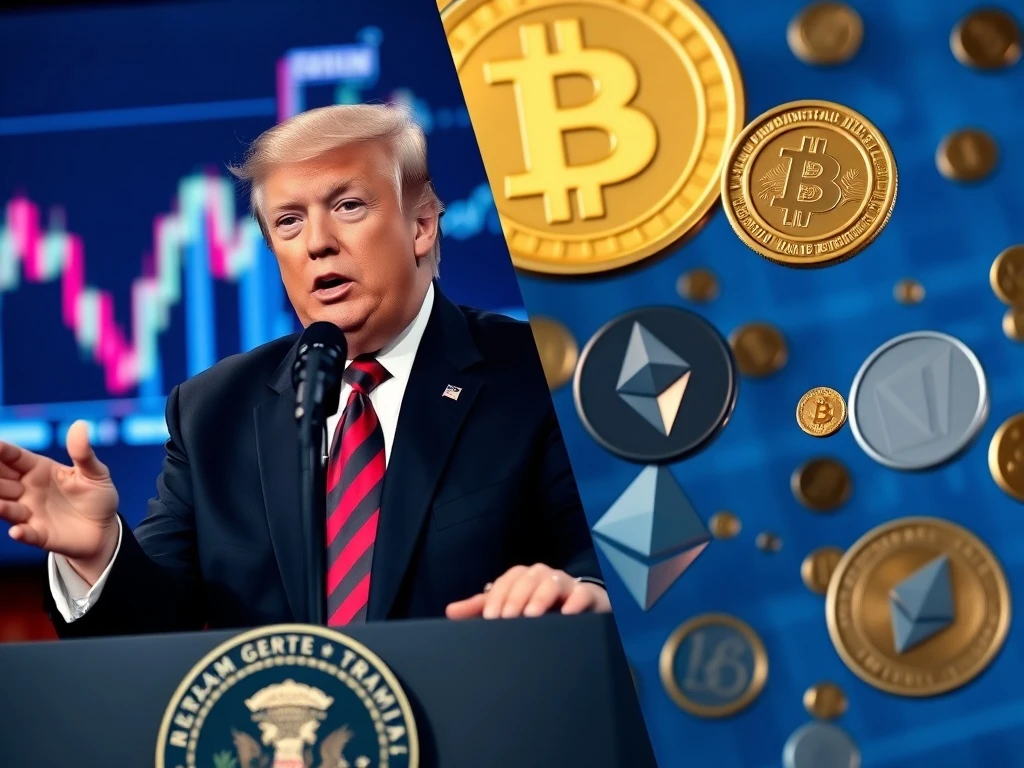
Former President Donald Trump has made a remarkable assertion about his impact on digital assets, claiming he delivered the biggest contribution to cryptocurrency—a statement that demands thorough examination against his actual policy record and market effects.
Trump’s Cryptocurrency Contribution Claim Explained
According to a recent report from SolidIntel, Donald Trump declared he made the most significant contribution to the cryptocurrency industry. This statement emerged during a private gathering in Florida last week. Meanwhile, journalists immediately began scrutinizing this bold proclamation. The claim requires careful analysis within the broader context of his presidential administration’s actual policies toward digital assets. Furthermore, cryptocurrency experts have expressed mixed reactions to this self-assessment. The digital asset market showed minimal immediate reaction to the statement, suggesting traders focused more on concrete regulatory developments than political rhetoric.
Trump’s relationship with cryptocurrency has evolved considerably over time. Initially, he expressed skepticism about Bitcoin and other digital currencies during his presidency. However, his position appears to have shifted in recent years. The former president now frequently discusses cryptocurrency in campaign speeches and media appearances. This changing stance reflects broader political recognition of cryptocurrency’s growing importance among voters. Additionally, regulatory approaches to digital assets have transformed significantly since Trump left office.
Historical Context of Presidential Crypto Policies
To properly evaluate Trump’s claim, we must examine his administration’s concrete actions toward cryptocurrency. The Trump White House operated during cryptocurrency’s early maturation phase from 2017 to 2021. During this period, several significant developments occurred in the regulatory landscape. The Securities and Exchange Commission under Trump’s appointees pursued numerous enforcement actions against initial coin offerings they deemed unregistered securities. Simultaneously, the Commodity Futures Trading Commission approved Bitcoin futures contracts, providing institutional investors with regulated exposure to cryptocurrency markets.
Regulatory Framework Development
The Trump administration oversaw important regulatory clarifications for cryptocurrency businesses. Treasury Department officials issued guidance on cryptocurrency taxation and anti-money laundering requirements. Financial Crimes Enforcement Network (FinCEN) published rules requiring cryptocurrency exchanges to implement know-your-customer protocols. These regulatory developments created clearer operating parameters for legitimate cryptocurrency businesses. However, critics argue the administration could have done more to establish comprehensive federal cryptocurrency legislation. The lack of clear legislative framework created ongoing uncertainty for the industry.
Several key events occurred during Trump’s presidency that impacted cryptocurrency markets. The 2017 Bitcoin bull run reached its peak shortly after Trump took office. Regulatory crackdowns on certain cryptocurrency projects followed in subsequent years. China’s intensified cryptocurrency mining restrictions began affecting global hash rate distribution. The COVID-19 pandemic’s economic stimulus measures arguably contributed to cryptocurrency’s appeal as an inflation hedge. These complex factors make isolating presidential impact particularly challenging for analysts.
Comparing Presidential Crypto Approaches
Evaluating Trump’s claim requires comparison with other administrations’ cryptocurrency approaches. The Obama administration witnessed Bitcoin’s emergence but took limited regulatory action. The Biden administration has pursued more active cryptocurrency regulation through executive orders and agency actions. Current regulatory proposals under consideration could significantly reshape the industry. International approaches vary considerably, with some nations embracing cryptocurrency innovation while others implement strict prohibitions.
Key policy differences include:
- Regulatory clarity versus restrictive measures
- Tax treatment of digital asset transactions
- Banking system access for cryptocurrency businesses
- Central bank digital currency development
- International cryptocurrency regulation coordination
Market data provides another perspective for evaluating presidential impact on cryptocurrency. Bitcoin’s price increased approximately 500% during Trump’s presidency. However, correlation does not necessarily indicate causation in financial markets. Multiple factors influence cryptocurrency valuations beyond political developments. Global adoption rates, technological advancements, and macroeconomic conditions all play significant roles. Professional analysts typically consider presidential policies as just one factor among many influencing cryptocurrency markets.
Expert Analysis of the Claim
Cryptocurrency policy experts have offered measured responses to Trump’s assertion. Dr. Sarah Chen, blockchain regulation professor at Stanford University, notes that “presidential impact on cryptocurrency remains difficult to quantify objectively.” She emphasizes that regulatory agencies maintain considerable independence in their enforcement approaches. Meanwhile, Michael Rodriguez, former CFTC digital assets director, suggests that “the most significant presidential contribution would involve comprehensive legislation rather than incremental regulatory actions.” He points to ongoing congressional efforts to establish clearer cryptocurrency frameworks.
Industry leaders have expressed diverse perspectives on political contributions to cryptocurrency. Some emphasize the importance of regulatory certainty for business planning. Others highlight the value of presidential advocacy in legitimizing digital assets. Several cryptocurrency executives have noted that bipartisan interest in cryptocurrency has increased substantially in recent years. This growing political engagement reflects cryptocurrency’s expanding user base and economic significance. The industry now employs sophisticated lobbying efforts to influence policy development.
Market Impact Assessment
Financial analysts have examined cryptocurrency market reactions to political developments. Historical data shows mixed responses to regulatory announcements from various administrations. Some cryptocurrency sectors prove more sensitive to political developments than others. Exchange-traded products and institutional investment vehicles particularly respond to regulatory clarity. Retail cryptocurrency adoption appears less directly tied to specific political actions. Long-term cryptocurrency trends seem driven more by technological utility than political factors according to most analysts.
International cryptocurrency developments provide important context for evaluating U.S. political impact. Several nations have implemented more comprehensive cryptocurrency frameworks than the United States. El Salvador made Bitcoin legal tender in 2021, creating an important precedent. The European Union recently approved comprehensive cryptocurrency regulation through MiCA legislation. Asian financial centers like Singapore and Hong Kong have developed sophisticated digital asset regulatory regimes. These international developments influence global cryptocurrency markets independently of U.S. political actions.
Future Implications for Crypto Policy
Trump’s claim arrives during heightened political attention to cryptocurrency regulation. Congressional committees have advanced several digital asset bills in recent months. Regulatory agencies continue refining their approaches to cryptocurrency oversight. The 2024 election campaign has featured cryptocurrency policy discussions from multiple candidates. This political engagement suggests cryptocurrency will remain a significant policy issue regardless of election outcomes. Future presidential administrations will likely face increasing pressure to establish clearer digital asset frameworks.
Several emerging issues will shape future cryptocurrency policy debates. Central bank digital currency development continues advancing at the Federal Reserve. Stablecoin regulation represents another pressing concern for policymakers. Cryptocurrency mining’s environmental impact has attracted congressional scrutiny. Consumer protection in decentralized finance platforms presents additional regulatory challenges. These complex issues require thoughtful policy responses that balance innovation with appropriate safeguards.
Conclusion
Donald Trump’s claim about making the biggest contribution to cryptocurrency invites careful examination against his administration’s actual record. While his presidency coincided with important cryptocurrency regulatory developments, quantifying presidential impact remains challenging. The cryptocurrency industry has evolved through complex interactions between technological innovation, market forces, and regulatory approaches. Future presidential contributions to cryptocurrency will likely involve establishing comprehensive legislative frameworks rather than incremental regulatory actions. As digital assets continue maturing, balanced policy approaches that foster innovation while protecting consumers will prove most valuable for sustainable industry growth.
FAQs
Q1: What specific cryptocurrency policies did the Trump administration implement?
The Trump administration oversaw regulatory guidance from Treasury and FinCEN on cryptocurrency taxation and anti-money laundering requirements. The SEC pursued enforcement actions against unregistered securities offerings, while the CFTC approved Bitcoin futures contracts, enabling institutional participation.
Q2: How did cryptocurrency markets perform during Trump’s presidency?
Bitcoin’s price increased approximately 500% during Trump’s administration from January 2017 to January 2021. However, cryptocurrency markets experience volatility from multiple factors beyond political developments, including technological adoption and macroeconomic conditions.
Q3: How does Trump’s cryptocurrency approach compare to other presidents?
The Obama administration witnessed Bitcoin’s emergence with minimal regulation. The Biden administration has pursued more active cryptocurrency regulation through executive orders. Trump’s approach involved incremental regulatory guidance without comprehensive legislation.
Q4: What do experts say about measuring presidential impact on cryptocurrency?
Experts note that presidential impact remains difficult to quantify, as regulatory agencies maintain independence and multiple factors influence cryptocurrency markets. Most emphasize that comprehensive legislation would represent a more significant contribution than regulatory actions alone.
Q5: What are the most important current issues in cryptocurrency policy?
Key issues include establishing clear regulatory frameworks, addressing stablecoin oversight, managing central bank digital currency development, mitigating environmental concerns about cryptocurrency mining, and protecting consumers in decentralized finance platforms.
Related News
- Bitcoin Warning: Galaxy’s Head of Research Flags Critical Risk of Deeper Pullback in 2025
- Coinbase Listing Roadmap Expands: Strategic Addition of DEEP and WAL Tokens Signals New Market Focus
- Changpeng Zhao Denies Binance Role in Crypto Crash, Reveals Crucial SAFU Fund Strategy