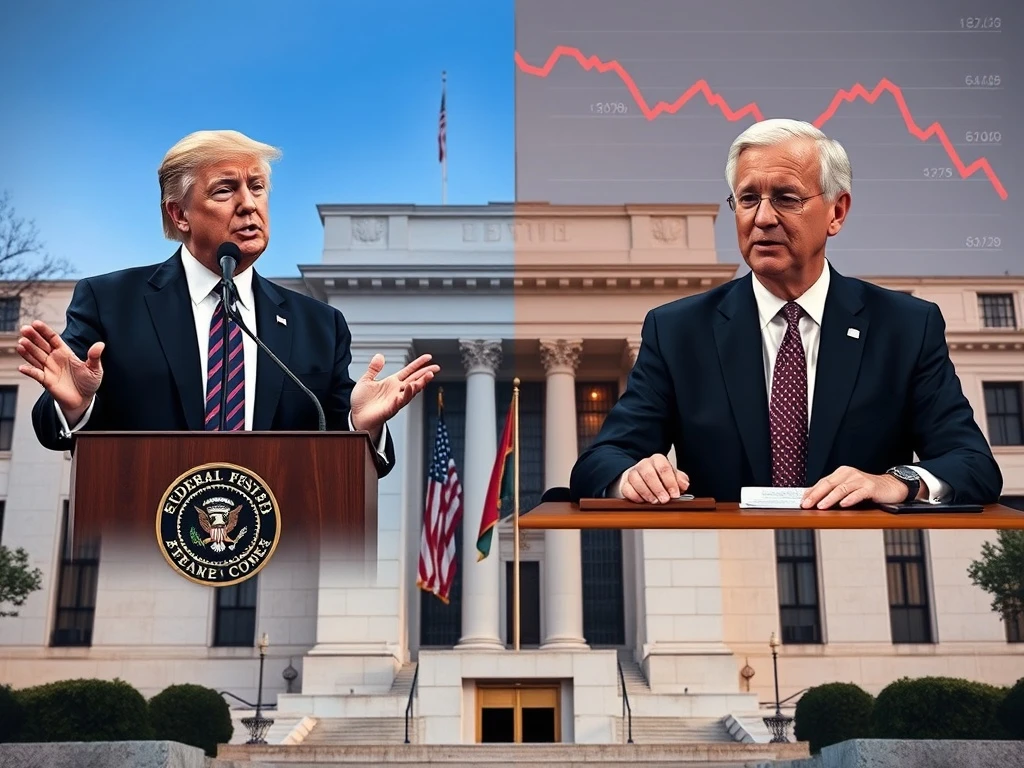
WASHINGTON, D.C. – March 2025: Former President Donald Trump has intensified pressure on the Federal Reserve to implement what he describes as “significant and immediate” interest rate reductions, reigniting a longstanding debate about central bank independence and monetary policy direction during a period of global economic realignment.
Trump’s Renewed Push for Aggressive Fed Action
According to reports from Walter Bloomberg, Trump recently argued that the Federal Reserve should accelerate its monetary easing cycle. The former president specifically contends that other nations maintain artificially low interest rates because of United States monetary policy decisions. This position represents Trump’s latest intervention in Federal Reserve affairs, continuing a pattern established during his 2017-2021 administration when he frequently criticized then-Chair Jerome Powell’s interest rate decisions.
Monetary policy experts note that Trump’s renewed pressure comes during a delicate economic transition period. The Federal Reserve has already implemented several rate reductions throughout 2024 and early 2025, responding to moderating inflation and signs of economic softening. However, Trump’s call for more aggressive action suggests he believes current policy remains too restrictive for optimal economic growth.
The Global Interest Rate Landscape in 2025
Trump’s argument references actual disparities in global monetary policy. Several major economies currently maintain lower benchmark rates than the United States. The European Central Bank’s main refinancing rate stands at 2.25%, while the Bank of Japan continues its negative interest rate policy at -0.1%. Meanwhile, the People’s Bank of China maintains its one-year loan prime rate at 3.45%.
By comparison, the Federal Reserve’s current target range for the federal funds rate sits between 3.75% and 4.00%. This differential creates what economists call “policy divergence,” which can influence currency valuations, capital flows, and trade competitiveness. Trump’s assertion that other nations benefit from U.S. policy reflects concerns about dollar strength potentially hampering American export industries.
Historical Context of Presidential Fed Pressure
Presidential criticism of Federal Reserve policy is not unprecedented, though traditionally restrained. President Lyndon Johnson famously confronted Fed Chair William McChesney Martin in 1965 over rate increases. More recently, President George H.W. Bush attributed his 1992 election loss partly to Fed Chair Alan Greenspan’s monetary tightening.
However, Trump’s public and persistent criticism during his presidency marked a departure from recent norms. The Federal Reserve operates with statutory independence, established to shield monetary policy from short-term political pressures. This independence allows the central bank to make potentially unpopular decisions necessary for long-term price stability.
Economic Implications of Accelerated Rate Cuts
Accelerated interest rate reductions would produce several immediate economic effects:
- Consumer borrowing costs: Mortgage rates, auto loans, and credit card APRs would likely decrease further
- Business investment: Lower capital costs could stimulate corporate expansion and equipment purchases
- Currency valuation: The U.S. dollar might weaken against other major currencies
- Inflation risks: Excessive easing could reignite inflationary pressures later in the economic cycle
- Financial markets: Equity markets typically respond positively to rate cuts, while bond yields decline
Federal Reserve officials must balance these potential benefits against the risk of prematurely declaring victory over inflation. The central bank’s dual mandate requires it to pursue both maximum employment and price stability, objectives that sometimes conflict during policy transitions.
The Federal Reserve’s Delicate Balancing Act
Current Federal Reserve Chair Jerome Powell and the Federal Open Market Committee face complex decisions in 2025. While inflation has moderated from its 2022 peak, core measures remain above the Fed’s 2% target. Simultaneously, employment indicators show signs of softening, with unemployment gradually rising from historic lows.
The central bank’s preferred inflation gauge, the Personal Consumption Expenditures Price Index, currently shows:
| Metric | Current Reading | Federal Reserve Target |
|---|---|---|
| Headline PCE Inflation | 2.4% | 2.0% |
| Core PCE Inflation | 2.6% | 2.0% |
| Unemployment Rate | 4.2% | ~4.0% |
This data suggests the Federal Reserve faces what economists term a “soft landing” challenge – attempting to guide inflation back to target without triggering a significant economic downturn. Political pressure for faster rate cuts complicates this already delicate policy navigation.
Expert Perspectives on Monetary Policy Independence
Former Federal Reserve officials and monetary policy scholars express concern about sustained political pressure on central bank decisions. “The Federal Reserve’s independence exists for important reasons,” explains Dr. Sarah Jensen, monetary policy historian at Georgetown University. “Political cycles operate on shorter timeframes than economic cycles. Without independence, there’s constant temptation to stimulate the economy before elections, regardless of long-term consequences.”
Other experts note that global economic conditions genuinely complicate U.S. monetary policy. “We operate in an interconnected financial system,” says Michael Chen, chief economist at the Brookings Institution. “While the Fed primarily focuses on domestic conditions, it cannot ignore international developments. The challenge is responding appropriately without appearing reactive to political commentary.”
Potential Market and Economic Consequences
Financial markets monitor Federal Reserve communications closely for policy signals. Trump’s public pressure creates additional uncertainty about future rate decisions. Bond market volatility typically increases during periods of political-central bank tension, as investors struggle to predict policy direction.
Furthermore, international observers watch U.S. monetary policy developments carefully. Many emerging market economies tie their monetary policies indirectly to Federal Reserve decisions through currency pegs or managed exchange rate regimes. Accelerated U.S. rate cuts could force difficult adjustments in these economies, potentially creating global financial stability concerns.
The International Monetary Fund’s most recent World Economic Outlook highlighted the importance of clear, predictable central bank communication. Political interventions that cloud policy signals could undermine this predictability, potentially increasing global financial volatility.
Conclusion
Donald Trump’s call for immediate Federal Reserve interest rate cuts reflects ongoing debates about monetary policy direction amid evolving global economic conditions. While the former president emphasizes international competitiveness concerns, Federal Reserve officials must balance multiple factors including inflation control, employment objectives, and financial stability. The central bank’s statutory independence faces continued testing as political figures advocate for policies aligned with their economic visions. Ultimately, the Federal Reserve’s interest rate decisions will significantly influence the trajectory of the U.S. economy throughout 2025 and beyond, with implications extending far beyond domestic political considerations.
FAQs
Q1: Why does Donald Trump want the Federal Reserve to cut interest rates?
Trump argues that lower interest rates would enhance U.S. economic competitiveness, particularly against nations with lower borrowing costs. He believes current policy disadvantages American businesses and consumers relative to international counterparts.
Q2: How independent is the Federal Reserve from political pressure?
The Federal Reserve operates with considerable statutory independence, established by Congress to insulate monetary policy from short-term political considerations. However, presidents appoint Fed chairs and board members, creating inherent political connections despite operational independence.
Q3: What are the risks of cutting interest rates too quickly?
Premature or excessive rate reductions could reignite inflationary pressures, devalue the U.S. dollar, create asset bubbles, and reduce the Fed’s policy flexibility during future economic downturns.
Q4: How do U.S. interest rates compare globally in 2025?
The Federal Reserve’s benchmark rate remains higher than those of the European Central Bank, Bank of Japan, and People’s Bank of China. This differential affects currency exchange rates, capital flows, and international trade competitiveness.
Q5: What factors does the Federal Reserve consider when setting interest rates?
The Fed evaluates numerous indicators including inflation metrics (particularly PCE inflation), employment data, GDP growth, wage trends, financial market conditions, and global economic developments, all within its dual mandate of price stability and maximum employment.
Related News
- US Dollar Dominance: The Shocking Truth Behind Why Top Analysts Read Identical Data—And Reach Opposite Conclusions
- Stablecoin Regulation Faces Crucial Scrutiny as UK House of Lords Launches Landmark Review
- Robinhood Lists Spot RENDER: A Strategic Leap for Decentralized Computing Access