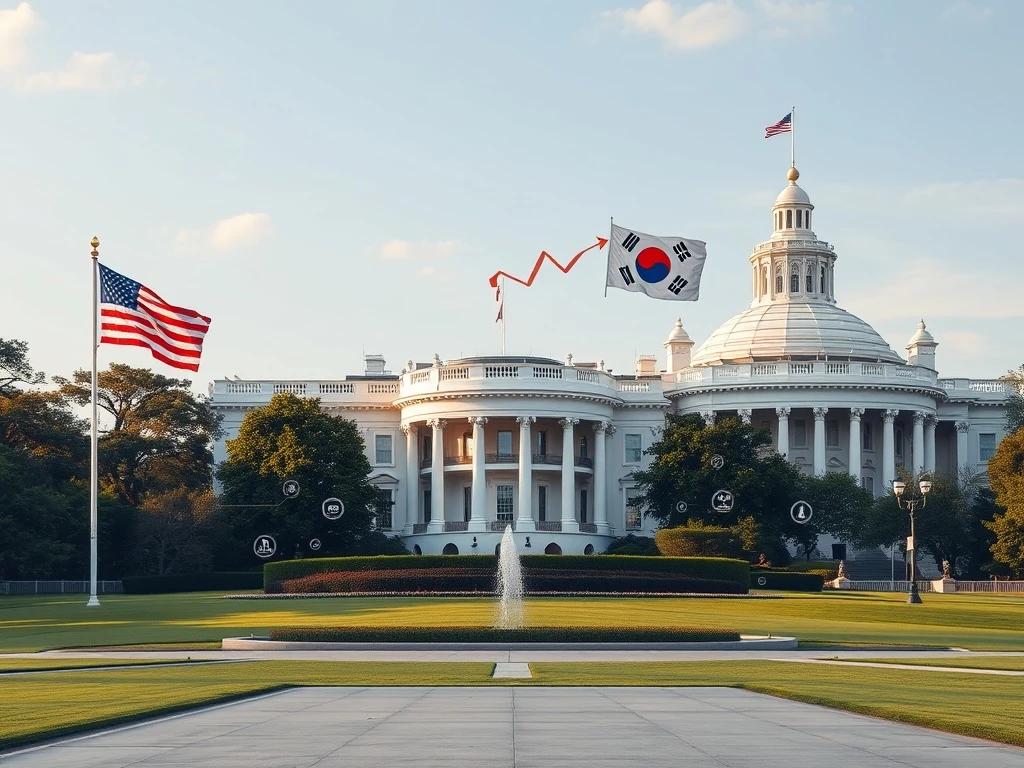
WASHINGTON, D.C., January 27, 2025 – In a significant diplomatic development, President Donald Trump announced his commitment to work with South Korea on resolving proposed tariff increases, marking a potential turning point in bilateral trade relations following his earlier announcement of substantial duty hikes on Korean products including automobiles.
Trump South Korea Tariffs Announcement and Immediate Context
President Trump made his remarks to reporters at the White House before departing for Iowa, according to Yonhap News Agency. Consequently, this statement represents a notable shift from his previous position. Specifically, the President had announced on Truth Social just one day earlier his intention to raise tariffs on South Korean goods from 15% to 25%. He explicitly cited delays in the passage of a special act on investment in the United States by South Korea’s National Assembly as the primary reason for this proposed action.
This development occurs within a broader context of ongoing trade negotiations between the two nations. Furthermore, the United States and South Korea have maintained a complex economic relationship since implementing the Korea-U.S. Free Trade Agreement (KORUS) in 2012. Trade experts immediately noted the significance of this diplomatic pivot. For instance, Dr. Eleanor Vance, Senior Fellow at the Peterson Institute for International Economics, observed, “This rapid movement from tariff announcement to collaborative dialogue reflects the intricate interdependence of modern global supply chains, particularly in the automotive and technology sectors.”
Historical Background of US-Korea Trade Relations
The United States and South Korea have developed substantial economic ties over decades. Initially, bilateral trade exceeded $168 billion in 2023, according to U.S. Census Bureau data. Moreover, South Korea represents America’s sixth-largest goods trading partner. The automotive sector specifically forms a crucial component of this relationship. For example, Hyundai and Kia collectively sold over 1.5 million vehicles in the U.S. market during 2024.
The KORUS agreement underwent significant renegotiation during the Trump administration’s first term. Subsequently, modifications addressed automotive trade provisions and other sectors. Currently, the proposed tariff increase would primarily affect several key categories:
- Automobiles and automotive parts – Representing approximately 30% of South Korean exports to the United States
- Electronics and semiconductors – Including memory chips and display technologies
- Industrial machinery – Particularly precision manufacturing equipment
- Steel and aluminum products – Already subject to previous trade measures
Legislative Delays and Investment Act Implications
The specific legislation referenced by President Trump involves South Korea’s Special Act on Strategic Investment in the United States. This proposed legislation aims to facilitate Korean corporate investments in American manufacturing and technology sectors. However, parliamentary procedures in South Korea’s National Assembly have encountered unexpected delays. Political analysts attribute these delays to several factors including committee reviews, opposition party concerns, and broader legislative priorities.
According to Seoul-based political correspondent Min-ji Park, “The investment act represents a strategic priority for both administrations, but legislative calendars face competing demands. Additionally, technical details regarding investment guarantees and regulatory frameworks require careful examination.” The table below illustrates recent U.S.-Korea trade developments:
| Date | Event | Trade Impact |
|---|---|---|
| March 2018 | KORUS modifications implemented | Revised automotive quotas and customs procedures |
| January 2023 | Bilateral supply chain agreement signed | Enhanced cooperation on semiconductors and batteries |
| September 2024 | Investment act introduced in Korean Assembly | Proposed $15 billion in manufacturing investments |
| January 26, 2025 | Trump announces tariff increases | Proposed 10 percentage point increase on multiple categories |
| January 27, 2025 | Trump commits to collaborative solution | Diplomatic engagement announced |
Economic Impacts and Industry Responses
Automotive industry representatives expressed immediate concern following the initial tariff announcement. Subsequently, they welcomed the commitment to diplomatic engagement. The proposed increase from 15% to 25% would significantly affect vehicle pricing and market competitiveness. For instance, the American International Automobile Dealers Association noted that such tariffs could increase average vehicle prices by $2,500 to $5,000 for affected models.
Global supply chain analysts emphasize the interconnected nature of modern manufacturing. Specifically, many “American” vehicles contain substantial Korean components, while “Korean” vehicles incorporate American parts. This reality creates complex economic implications. Moreover, Korean companies maintain substantial manufacturing facilities in the United States, employing approximately 35,000 American workers directly according to Korean Chamber of Commerce data.
Strategic Considerations in Bilateral Negotiations
Trade negotiations between the United States and South Korea involve multiple strategic dimensions. First, both nations share significant security partnerships beyond economic relations. Second, technological cooperation in semiconductors and batteries represents a critical area of mutual interest. Third, both economies face competitive pressures from other global manufacturing centers.
Professor James Chen of Georgetown University’s School of Foreign Service explains, “The rapid shift from tariff announcement to collaborative dialogue suggests both parties recognize the strategic costs of escalating trade measures. Furthermore, the timing coincides with broader realignments in Asian trade patterns and supply chain diversification efforts.”
Comparative Analysis with Previous Trade Actions
This development follows patterns observed in previous U.S. trade policy approaches. For example, the Trump administration previously utilized tariff announcements as negotiating leverage before reaching modified agreements. Similarly, the Biden administration employed targeted trade measures while pursuing diplomatic resolutions. However, the specific focus on legislative progress represents a distinctive element in this situation.
International trade attorney Rebecca Torres notes, “The linkage between tariff measures and legislative timelines creates a novel dynamic in trade diplomacy. Additionally, this approach emphasizes the interconnected nature of investment policies and trade relationships in contemporary economic statecraft.”
Conclusion
President Trump’s commitment to work with South Korea on tariff solutions represents a significant development in bilateral economic relations. This diplomatic engagement follows his proposed increase of duties on Korean products from 15% to 25%, which specifically targeted delays in legislative action on investment measures. The evolving situation demonstrates the complex interplay between trade policy, legislative processes, and diplomatic negotiation in contemporary international relations. Ultimately, the resolution of these Trump South Korea tariffs will substantially influence economic cooperation, supply chain stability, and strategic partnership between these important allies.
FAQs
Q1: What specific tariff increase did President Trump initially propose?
President Trump announced his intention to raise tariffs on South Korean goods, including automobiles, from the existing 15% rate to 25%, representing a 10 percentage point increase.
Q2: What reason did President Trump cite for the proposed tariff increase?
He specifically cited delays in the passage of a special act on investment in the United States by South Korea’s National Assembly as the justification for his proposed action.
Q3: How did President Trump’s position change following the initial announcement?
One day after announcing the tariff increases, President Trump stated he would work with South Korea to find a solution regarding the proposed tariff measures, indicating a shift toward diplomatic engagement.
Q4: What is the Korea-U.S. Free Trade Agreement (KORUS)?
KORUS is a comprehensive free trade agreement implemented in 2012 and subsequently modified in 2018 that governs most economic relations between the United States and South Korea, including provisions on tariffs, investments, and intellectual property.
Q5: How might these tariff developments affect consumers?
If implemented, increased tariffs could raise prices for South Korean products in the U.S. market, particularly affecting automotive consumers, while diplomatic resolution could maintain existing pricing and availability patterns.
Related News
- Australian Crypto Regulation Crackdown: Federal Court Slams BPS Financial With Landmark Fine for Misrepresentation
- Cryptocurrency Scam Exposed: Chinese National Receives 46-Month Sentence for $37M Devastating Fraud Scheme
- Base Network Active Addresses Plunge to 18-Month Low Despite Alarming Token Issuance Surge