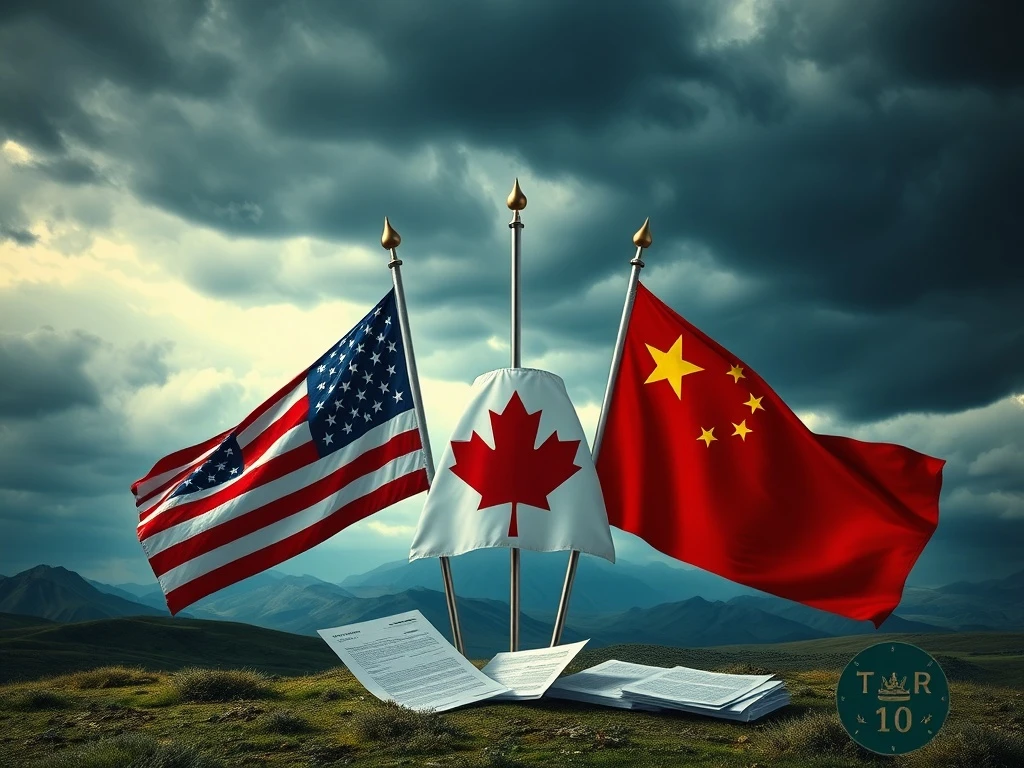
WASHINGTON, D.C., March 2025 – Former President Donald Trump has issued a stark warning to Canada, threatening to impose unprecedented 100% tariffs on Canadian products if the country proceeds with a potential trade agreement with China. This explosive declaration, made via Trump’s Truth Social platform, immediately sent shockwaves through international trade circles and raised concerns about renewed global economic tensions.
Trump’s Tariff Threat and Canada-China Trade Relations
In his characteristically direct social media post, Trump declared that China is “successfully and completely taking over Canada.” He further described any potential trade agreement between Ottawa and Beijing as “one of the worst in history.” This statement represents the most aggressive trade threat against Canada from a major U.S. political figure in recent memory. Trade analysts immediately began assessing the potential economic impact of such a tariff, which would effectively double the cost of Canadian goods entering the United States.
Canada’s trade relationship with China has evolved significantly over the past decade. Bilateral trade between the two nations reached approximately $100 billion CAD in 2023, according to Statistics Canada data. However, negotiations for a comprehensive trade agreement have proceeded cautiously, particularly following diplomatic tensions related to Huawei executive Meng Wanzhou’s detention and China’s subsequent imprisonment of two Canadian citizens. The current Canadian government has maintained a “progressive trade” approach that includes labor and environmental standards, creating potential sticking points in negotiations with Beijing.
Historical Context of US-Canada Trade Relations
The United States and Canada share the world’s largest bilateral trading relationship, with goods and services trade totaling nearly $1 trillion annually. This economic interdependence makes Trump’s threat particularly significant. During his presidency from 2017 to 2021, Trump renegotiated the North American Free Trade Agreement (NAFTA), replacing it with the United States-Mexico-Canada Agreement (USMCA). That negotiation process included tensions over automotive rules of origin, dairy market access, and dispute resolution mechanisms.
Trump’s previous administration utilized Section 232 of the Trade Expansion Act of 1962 to impose tariffs on steel and aluminum imports from Canada in 2018, citing national security concerns. Canada responded with retaliatory tariffs on approximately $16.6 billion worth of U.S. goods. These tariffs were eventually lifted in 2019, but the episode demonstrated the vulnerability of the trading relationship to political decisions. The current threat represents a potential escalation beyond those previous measures.
Expert Analysis of the Tariff Threat
Trade policy experts have expressed concern about the potential consequences of such a tariff. Dr. Meredith Thompson, Director of International Trade Studies at the Peterson Institute for International Economics, noted: “A 100% tariff on Canadian goods would represent an unprecedented escalation in trade relations between two close allies. The economic impact would be immediate and severe, potentially disrupting integrated supply chains that have developed over decades.”
Canadian manufacturers, particularly in the automotive sector, would face immediate challenges. The industry operates on an integrated North American basis, with parts crossing the border multiple times during production. According to the Canadian Vehicle Manufacturers’ Association, the automotive sector supports approximately 500,000 direct and indirect jobs in Canada and contributes significantly to the country’s manufacturing GDP. A disruption of this magnitude could have cascading effects throughout both economies.
Potential Economic Impacts and Sector Analysis
The threatened tariffs would affect numerous sectors of the Canadian economy. The following table illustrates key Canadian exports to the United States that would be impacted:
| Export Category | 2024 Value (USD billions) | Potential Impact |
|---|---|---|
| Vehicles and Parts | 53.2 | Severe disruption to integrated supply chains |
| Mineral Fuels | 41.8 | Energy security concerns for both nations |
| Machinery | 22.4 | Manufacturing cost increases |
| Agricultural Products | 19.7 | Food price inflation in U.S. markets |
| Wood Products | 11.3 | Construction industry impacts |
Beyond these direct impacts, economists warn of broader consequences including:
- Supply chain disruptions affecting U.S. manufacturers dependent on Canadian inputs
- Consumer price increases for American households purchasing Canadian goods
- Retaliatory measures from Canada targeting U.S. exports
- Investment uncertainty in cross-border business operations
- Currency volatility affecting the Canadian dollar’s stability
Geopolitical Implications and Strategic Considerations
The tariff threat occurs against a complex geopolitical backdrop. China has been actively pursuing trade agreements with various nations as part of its broader economic strategy. Meanwhile, the United States has maintained a cautious approach to China relations across multiple administrations. Canada finds itself navigating between its largest trading partner (the United States) and the world’s second-largest economy (China).
Strategic analysts note that Canada’s potential trade agreement with China represents more than just economic considerations. Professor Arjun Singh of the Center for Strategic and International Studies explains: “Trade agreements increasingly serve as instruments of geopolitical alignment. Canada’s negotiations with China occur within a broader context of great power competition. The U.S. response reflects concerns about strategic alignment as much as economic competition.”
This situation presents Canada with a difficult balancing act. The country must consider its economic interests, its historical alliance with the United States, and its position in an increasingly multipolar world. Canadian officials have traditionally emphasized rules-based international trade while maintaining strong bilateral relationships with multiple partners.
Legal and Institutional Framework Considerations
The threatened tariffs would face legal and institutional challenges. Under the USMCA, parties agreed to eliminate tariffs on substantially all trade between the three countries. While the agreement includes national security exceptions, legal experts debate whether Trump’s stated rationale would qualify. Additionally, the World Trade Organization’s dispute settlement mechanism, though currently hampered by U.S. objections to appellate body appointments, provides another potential avenue for challenge.
Institutional relationships would also face strain. The Canada-United States Regulatory Cooperation Council, established to align regulations and reduce trade barriers, represents years of careful work that could be undermined. Similarly, joint initiatives on supply chain resilience and critical minerals cooperation might face reconsideration in a more adversarial trade environment.
Market Reactions and Business Community Response
Financial markets reacted cautiously to the news. The Canadian dollar experienced moderate volatility against the U.S. dollar, while stocks of companies with significant cross-border operations showed mixed performance. Business organizations on both sides of the border expressed concern about the potential disruption.
The Canadian Chamber of Commerce issued a statement emphasizing the importance of stable trade relations: “The deep economic integration between Canada and the United States supports millions of jobs in both countries. Unilateral tariff actions would harm businesses, workers, and consumers on both sides of the border. We urge all parties to engage in constructive dialogue.”
Similarly, the U.S. Chamber of Commerce highlighted the interconnected nature of North American production: “Modern manufacturing depends on seamless cross-border movement of components and materials. Disrupting these flows through punitive tariffs would increase costs for American manufacturers and consumers while undermining North American competitiveness.”
Conclusion
Former President Trump’s threat of 100% tariffs on Canadian goods represents a significant escalation in trade rhetoric with potentially far-reaching consequences. This Trump tariff threat comes as Canada explores enhanced trade relations with China, creating a complex triangular dynamic. The situation underscores the continuing evolution of global trade relationships amid geopolitical realignments. While the immediate implementation of such tariffs remains uncertain, the statement itself has already influenced trade policy discussions and business planning. Market participants and policymakers will monitor developments closely, recognizing that stable trade relations between the United States and Canada serve both nations’ economic interests. The Trump tariff threat against Canada over potential China trade negotiations highlights the ongoing tension between economic interdependence and strategic competition in contemporary international relations.
FAQs
Q1: What exactly did Trump threaten regarding Canadian trade?
Former President Donald Trump threatened to impose 100% tariffs on Canadian products if Canada proceeds with a potential trade agreement with China. He made this declaration on his Truth Social platform in March 2025.
Q2: How would 100% tariffs affect Canadian exports to the United States?
A 100% tariff would effectively double the cost of Canadian goods entering the U.S. market. This would make Canadian products less competitive, potentially reducing export volumes significantly and disrupting integrated North American supply chains, particularly in automotive and manufacturing sectors.
Q3: What is the current status of Canada-China trade negotiations?
Canada and China have engaged in exploratory trade discussions, but no comprehensive agreement has been finalized. Negotiations have proceeded cautiously due to various diplomatic and policy considerations, including human rights concerns and differing approaches to labor and environmental standards in trade agreements.
Q4: How have previous U.S.-Canada trade disputes been resolved?
Previous disputes, such as the 2018-2019 tariffs on Canadian steel and aluminum, were resolved through negotiations that resulted in the removal of tariffs. The countries have historically utilized established mechanisms including the USMCA dispute settlement process and bilateral discussions to resolve trade disagreements.
Q5: What legal mechanisms could Canada use to challenge such tariffs?
Canada could potentially challenge the tariffs through several mechanisms: dispute settlement procedures under the USMCA, World Trade Organization dispute procedures (though the appellate body is currently non-functional due to U.S. objections), or bilateral negotiations. The national security justification that might be invoked could face legal scrutiny regarding its appropriateness.
Related News
- Bitcoin Sell Signal: Veteran Trader Peter Brandt Issues Critical Warning as Bear Channel Completes
- Spot Gold Shatters Records with Stunning Surge Above $5,000 Milestone
- Michael Saylor BTC Purchase Hint Sparks Market Anticipation: ‘Unstoppable Orange’ Signals Continued Bitcoin Accumulation