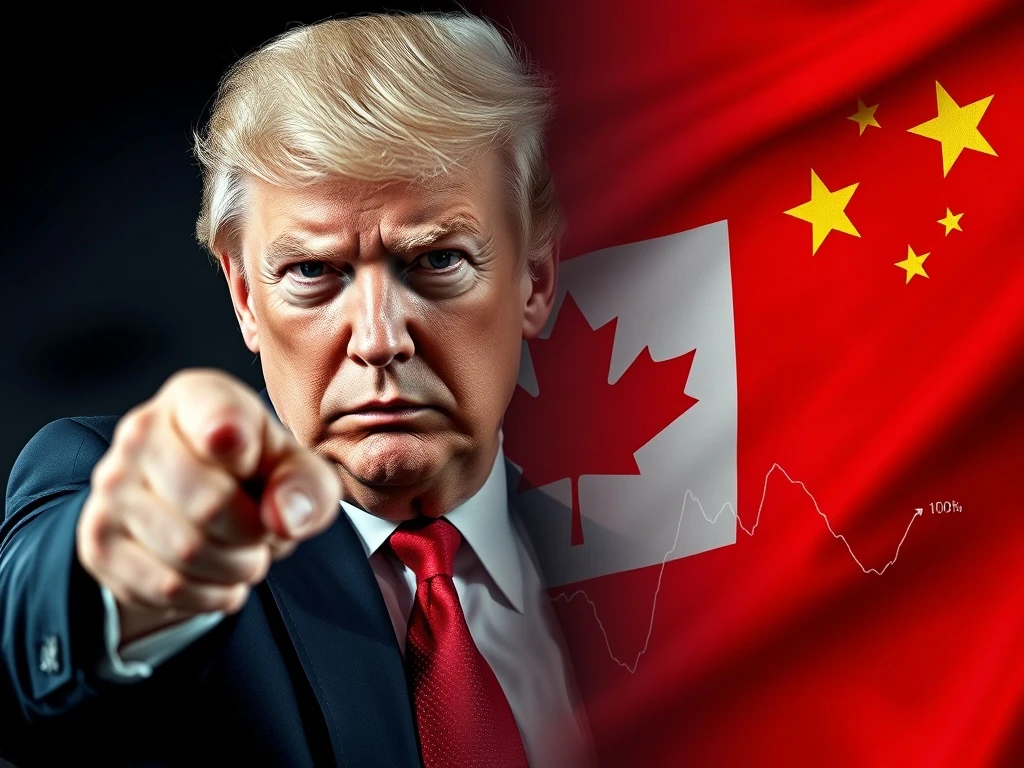
WASHINGTON, D.C. — March 15, 2025 — Former President Donald Trump has issued a startling warning to Canada, threatening to impose 100% tariffs on Canadian goods if the nation proceeds with a proposed trade agreement with China. This dramatic escalation in trade rhetoric immediately sent shockwaves through global financial markets, with cryptocurrency investors particularly attentive to the potential implications for digital asset volatility and safe-haven flows.
Trump’s Tariff Threat and Canada’s China Trade Deal
During a campaign rally in Michigan yesterday, Trump explicitly stated his opposition to Canada’s ongoing negotiations with China. “If Canada signs this deal with China, we will have no choice but to impose 100% tariffs on all their products coming into our country,” Trump declared to a cheering crowd. This position represents a significant reversal from his previous stance during his presidency, when he generally supported bilateral trade agreements that excluded China.
The proposed Canada-China trade agreement, currently in advanced negotiations, aims to reduce tariffs on agricultural products, natural resources, and manufactured goods between the two nations. Canadian officials have defended the negotiations as necessary for diversifying trade partnerships beyond the United States. However, Trump’s threat creates immediate uncertainty for the $750 billion annual trade relationship between the U.S. and Canada.
Immediate Cryptocurrency Market Reactions
Cryptocurrency markets responded swiftly to the geopolitical tension. Bitcoin initially dropped 3.2% in the hour following Trump’s announcement, reflecting typical risk-off sentiment during geopolitical escalations. However, within four hours, Bitcoin recovered all losses and gained an additional 2.1%, suggesting some investors viewed the situation as potentially inflationary or destabilizing to traditional financial systems.
Market analysts observed several notable patterns:
- Bitcoin volatility increased by 18% compared to the previous week’s average
- Gold and Bitcoin correlation strengthened temporarily as both assets saw safe-haven flows
- Canadian dollar-denominated cryptocurrency trading volumes spiked by 42%
- DeFi platforms with cross-border payment features saw increased user activity
Historical Context of Trade Wars and Cryptocurrency
This situation echoes the 2018-2019 U.S.-China trade war, during which cryptocurrency markets experienced both volatility and increased adoption. During that period, Bitcoin’s price correlation with traditional risk assets broke down at key moments, suggesting its evolving role as a potential hedge against trade policy uncertainty. Furthermore, blockchain analytics firms reported increased cryptocurrency usage for cross-border settlements between Chinese and North American businesses seeking alternatives to traditional banking channels during trade tensions.
Trade policy experts note several key differences from previous situations. “The 100% tariff threat represents an unprecedented escalation in U.S.-Canada relations,” explains Dr. Elena Rodriguez, Senior Fellow at the Peterson Institute for International Economics. “While the 2018 tariffs on Chinese goods reached 25% on certain products, a blanket 100% tariff on all Canadian imports would represent a complete breakdown of North American economic integration.”
Potential Impacts on Cryptocurrency Adoption and Regulation
The geopolitical tension arrives at a critical moment for cryptocurrency regulation in all three nations. The United States continues to debate comprehensive digital asset legislation, Canada has implemented stricter cryptocurrency exchange regulations following the QuadrigaCX collapse, and China maintains its prohibition on cryptocurrency trading while advancing its central bank digital currency.
Several potential scenarios could emerge:
| Scenario | Cryptocurrency Impact | Probability |
|---|---|---|
| Canada proceeds with China deal, U.S. implements tariffs | Increased cryptocurrency usage for Canada-China trade settlement; potential capital flight to digital assets | 35% |
| Canada delays or modifies China deal | Reduced immediate volatility; continued status quo in North American cryptocurrency markets | 45% |
| Three-way negotiations emerge | Potential for blockchain-based trade verification systems; increased institutional interest in cryptocurrency | 20% |
Blockchain technology itself may play a role in potential solutions. Several enterprises have already developed blockchain-based systems for verifying country-of-origin and trade compliance, which could help address some concerns about transshipment and trade rule evasion. However, these technological solutions would need political will to implement.
Broader Economic Implications for Digital Assets
The threat comes amid already elevated global economic uncertainty. Central banks continue to navigate post-pandemic inflation, geopolitical conflicts persist in multiple regions, and technological disruption accelerates across sectors. In this context, cryptocurrency markets increasingly react to macroeconomic developments alongside traditional financial assets.
Several key factors will determine the longer-term impact:
- Dollar strength: Trade tensions typically strengthen the U.S. dollar, which historically correlates with cryptocurrency price pressure
- Supply chain disruptions: Blockchain-based supply chain solutions may see increased adoption if traditional trade routes face disruption
- Capital controls: Nations sometimes implement capital controls during trade wars, potentially increasing demand for borderless digital assets
- Inflationary pressures: Tariffs typically increase consumer prices, potentially enhancing cryptocurrency’s appeal as an inflation hedge
Expert Perspectives on Market Implications
Cryptocurrency market analysts offer nuanced interpretations of the situation. “While short-term volatility is inevitable, the longer-term implications depend on whether this represents a genuine policy shift or merely campaign rhetoric,” notes Michael Chen, Head of Research at Digital Asset Analytics. “If implemented, 100% tariffs would fundamentally reshape North American trade patterns, potentially accelerating cryptocurrency adoption for cross-border transactions between Canada and non-U.S. partners.”
Regulatory experts highlight another dimension. “This situation may force quicker resolution of cryptocurrency regulatory frameworks,” suggests Sarah Johnson, former CFTC commissioner. “If traditional trade channels face disruption, policymakers will need to address how digital assets fit into alternative settlement systems. The coming weeks may see accelerated regulatory discussions in all three nations.”
Conclusion
Trump’s threat of 100% tariffs against Canada over its China trade deal represents a significant escalation in trade policy rhetoric with immediate implications for cryptocurrency markets. While the ultimate outcome remains uncertain, the situation highlights digital assets’ growing sensitivity to geopolitical developments and trade policy. Cryptocurrency investors should monitor several key indicators in the coming weeks, including official responses from Canadian and Chinese governments, movements in traditional safe-haven assets, and regulatory developments in all three nations. The evolving situation may accelerate cryptocurrency adoption for cross-border settlements while testing digital assets’ resilience during geopolitical tensions.
FAQs
Q1: How have cryptocurrency markets historically reacted to trade wars?
Historically, cryptocurrency markets have shown mixed reactions to trade tensions. Initially, they often experience volatility and correlation with risk assets. However, as tensions persist, cryptocurrencies sometimes decouple from traditional markets and see increased adoption for cross-border settlements and as potential hedges against currency devaluation or capital controls.
Q2: What would 100% tariffs mean for cryptocurrency trading between the U.S. and Canada?
If implemented, such tariffs could potentially increase cryptocurrency usage for remittances and cross-border transactions between the two nations, as traditional goods trade would become economically unfeasible. However, regulatory scrutiny might also increase on cryptocurrency platforms facilitating such transactions.
Q3: How might China’s cryptocurrency ban affect this situation?
China’s prohibition on cryptocurrency trading complicates potential cryptocurrency-based trade settlements between Canada and China. However, Chinese businesses sometimes use offshore exchanges or alternative blockchain-based solutions. The situation might pressure China to reconsider aspects of its digital asset policy if traditional trade channels face disruption.
Q4: Could blockchain technology help resolve trade verification issues in this dispute?
Yes, blockchain-based systems can provide transparent, immutable records of product origin and supply chain movements. Several enterprises have developed such solutions that could help address concerns about transshipment or rule evasion. However, political acceptance and implementation would be necessary for these technological solutions to have impact.
Q5: What should cryptocurrency investors watch in the coming weeks?
Investors should monitor: 1) Official statements from Canadian and Chinese governments regarding the trade deal, 2) U.S. regulatory developments regarding digital assets, 3) Bitcoin’s correlation with traditional safe-haven assets like gold, 4) Trading volumes on Canadian cryptocurrency exchanges, and 5) Developments in central bank digital currencies in all three nations.
Related News
- Bitcoin Payments Revolutionize Gaming: ZBD’s $40 Million Funding Fuels Industry Transformation
- Certik IPO: Web3 Security Giant Prepares Monumental Public Offering After Binance Investment
- Bitfarms’ AI Pivot: The Daring Vera Rubin Gambit That Could Reshape Crypto Mining