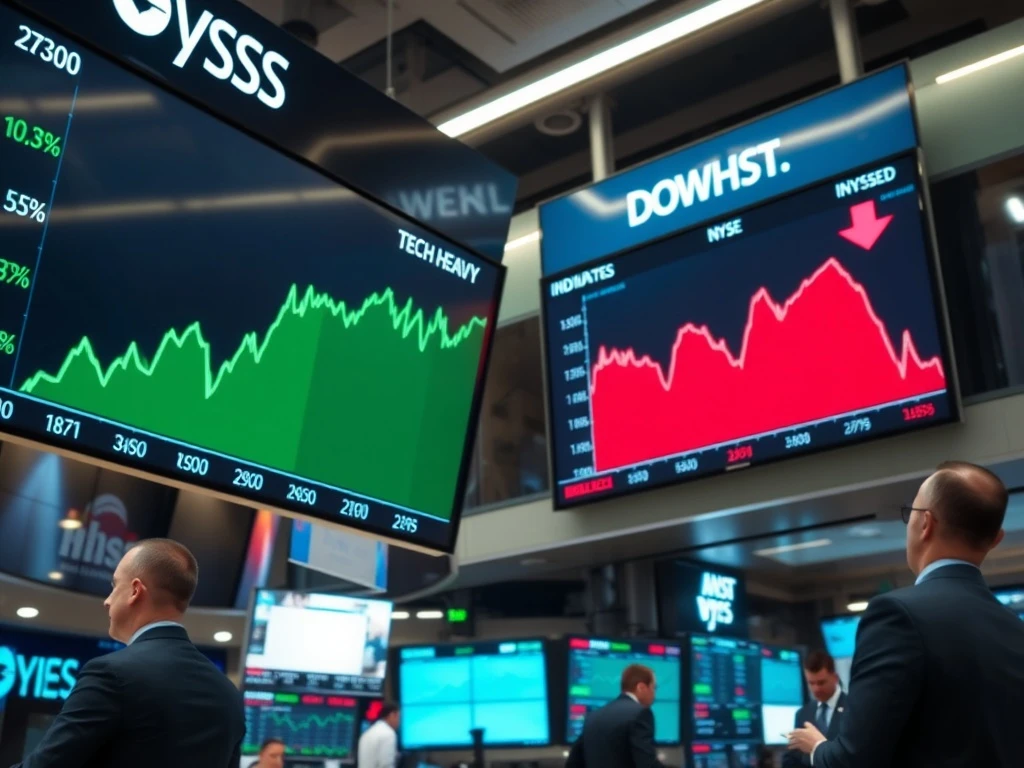
NEW YORK, March 15, 2025 – The US stock market delivered a sharply divided performance today, revealing underlying sector tensions that are reshaping investment strategies. The three major indices closed with significant divergence, highlighting contrasting investor sentiment toward different economic segments. This mixed session provides crucial insights into current market dynamics and future economic expectations.
US Stock Market Shows Clear Sector Divergence
The trading session produced notably different outcomes across major indices. The S&P 500 gained 0.41%, demonstrating moderate strength across its diversified holdings. Meanwhile, the Nasdaq Composite surged 0.91%, continuing its technology-driven momentum. Conversely, the Dow Jones Industrial Average declined 0.83%, reflecting pressure on traditional industrial and financial components.
Market analysts immediately noted this divergence pattern. Technology stocks propelled the Nasdaq higher, while industrial and consumer goods companies weighed on the Dow. This split performance suggests investors are making distinct sector allocations based on economic outlook. The Federal Reserve’s latest policy statements likely influenced these allocation decisions significantly.
Historical data reveals this isn’t an isolated occurrence. Similar divergence patterns emerged during previous economic transitions. For instance, technology stocks often outperform during innovation cycles, while industrial stocks may struggle with higher interest rates. Today’s market action reflects these fundamental economic relationships clearly.
Technology Sector Powers Nasdaq’s Strong Performance
The Nasdaq Composite’s 0.91% gain represents its strongest showing this month. Semiconductor companies led the advance, with several major chip manufacturers reporting better-than-expected earnings. Artificial intelligence infrastructure providers also contributed substantially to the index’s positive performance. These companies benefit from continued digital transformation across multiple industries.
Software-as-a-service (SaaS) companies showed particular resilience. Their subscription-based revenue models provide predictable cash flows that investors value during uncertain economic periods. Cloud computing providers similarly demonstrated strength, as businesses continue migrating operations to digital platforms. This technological adoption trend appears firmly established.
Several factors explain technology’s outperformance. First, innovation cycles continue accelerating across multiple sectors. Second, productivity-enhancing technologies remain in high demand despite economic headwinds. Third, many tech companies maintain strong balance sheets with minimal debt exposure. These characteristics attract investors seeking growth opportunities.
Market Structure Analysis: Why Indices Diverge
The differing index compositions explain much of today’s performance gap. The Nasdaq concentrates heavily on technology and growth companies. These businesses often thrive during periods of economic transformation. The S&P 500 offers broader diversification across eleven sectors. Its moderate gain reflects balanced exposure to both advancing and declining industries.
The Dow Jones Industrial Average contains just thirty blue-chip companies. Its traditional industrial and financial components faced multiple headwinds today. Manufacturing data showed slight contraction in several regions. Banking stocks declined amid concerns about commercial real estate exposure. These sector-specific challenges created downward pressure on the price-weighted index.
Consider this comparative performance table:
| Index | Performance | Key Drivers | Sector Exposure |
|---|---|---|---|
| Nasdaq Composite | +0.91% | Technology, Semiconductors, AI | Heavy Technology |
| S&P 500 | +0.41% | Balanced Sector Performance | Diversified Across 11 Sectors |
| Dow Jones Industrial | -0.83% | Industrial, Financial, Consumer Goods | Traditional Blue Chips |
This structural analysis reveals why identical economic conditions produce different index outcomes. Investors must understand these compositional differences when interpreting market movements. The indices measure different segments of the economy, not the entire market uniformly.
Economic Indicators Influencing Market Sentiment
Multiple economic reports shaped today’s trading activity. Inflation data showed continued moderation, though services inflation remains elevated. Employment figures indicated steady job growth without excessive wage pressure. Manufacturing surveys revealed regional variations, with some districts reporting contraction while others expanded modestly.
The Federal Reserve’s policy stance remains particularly influential. Recent minutes suggest cautious optimism about inflation control. However, officials emphasize data dependency for future decisions. This balanced approach creates uncertainty about interest rate trajectories. Market participants are adjusting portfolios accordingly.
Global economic conditions also affect US markets. European manufacturing data showed improvement this month. Asian export figures exceeded expectations in several technology categories. These international developments support certain US sectors while challenging others. The interconnected global economy transmits these effects rapidly.
Key economic factors influencing today’s session include:
- Inflation trends: Moderate goods inflation, persistent services inflation
- Employment data: Steady job growth, manageable wage increases
- Manufacturing activity: Regional variations, overall modest expansion
- Consumer spending: Resilient but selective consumption patterns
- Corporate earnings: Technology sector strength, industrial sector challenges
Expert Perspectives on Market Divergence
Financial analysts offer several interpretations of today’s mixed performance. Some emphasize sector rotation as investors reposition for changing economic conditions. Others highlight valuation disparities between growth and value stocks. Most agree that today’s action reflects thoughtful portfolio adjustments rather than panic selling or euphoric buying.
Market strategists note that such divergence often precedes broader market movements. When indices move in different directions, it typically signals shifting leadership. Technology’s strength today suggests investors anticipate continued innovation-driven growth. Industrial weakness may indicate concerns about traditional economic cycles.
Historical analysis provides context for current patterns. Similar divergence occurred during the early 2000s technology transition. It also appeared before the 2008 financial crisis resolution. While today’s divergence doesn’t predict specific outcomes, it does indicate active market reassessment. Investors are clearly distinguishing between different economic exposures.
Investment Implications and Portfolio Considerations
Today’s mixed session carries important implications for investment strategies. Diversification across sectors and styles becomes particularly valuable during divergent markets. Investors relying heavily on any single index may experience unexpected performance outcomes. A balanced approach incorporating multiple asset classes seems prudent.
Sector allocation decisions require careful analysis. Technology exposure has provided strong returns recently, but concentration risk increases accordingly. Industrial and financial stocks offer different risk-return characteristics that may complement technology holdings. The optimal portfolio balance depends on individual investment objectives and risk tolerance.
Market timing based on daily index movements proves notoriously difficult. However, understanding underlying sector dynamics informs better long-term decisions. Today’s divergence highlights the importance of fundamental analysis over index-level observations. Individual company prospects often differ significantly from broad index movements.
Several portfolio considerations emerge from today’s session:
- Sector balance: Avoid excessive concentration in single sectors
- Style diversification: Combine growth and value approaches appropriately
- Risk management: Adjust positions based on changing economic conditions
- Time horizon alignment: Match investments with appropriate holding periods
- Fundamental analysis: Focus on individual company prospects beyond index movements
Conclusion
The US stock market’s mixed performance today reveals important sector dynamics and investor sentiment. The Nasdaq Composite’s technology-driven gain contrasts sharply with the Dow Jones Industrial Average’s decline. This divergence reflects thoughtful portfolio adjustments based on economic outlook and sector prospects. The S&P 500’s moderate advance demonstrates the value of diversified exposure during uncertain periods.
Investors should interpret today’s US stock market action as information rather than definitive direction. Market divergence often signals transition rather than sustained trend. Careful analysis of underlying sector fundamentals provides better guidance than index-level observations alone. The coming sessions will reveal whether today’s patterns represent temporary rotation or more lasting reallocation.
FAQs
Q1: Why did the Nasdaq outperform the Dow Jones today?
The Nasdaq Composite concentrates heavily on technology companies that benefit from innovation cycles and digital transformation. The Dow Jones contains more traditional industrial and financial companies facing different economic headwinds, creating today’s performance divergence.
Q2: What does mixed market performance indicate about the economy?
Divergent index performance often signals sector rotation and changing economic leadership. It suggests investors are distinguishing between companies based on their exposure to different economic trends rather than reacting uniformly to broad conditions.
Q3: How should investors respond to such mixed market sessions?
Investors should maintain diversified portfolios aligned with their risk tolerance and time horizons. Daily market movements provide information but rarely justify drastic portfolio changes. Fundamental analysis of individual holdings matters more than index-level fluctuations.
Q4: Does today’s divergence predict future market direction?
While market divergence sometimes precedes broader trends, it doesn’t reliably predict specific outcomes. Today’s action indicates active reassessment of sector prospects rather than definitive directional signals about overall market trajectory.
Q5: How often do major indices show such different performances?
Significant divergence occurs periodically, particularly during economic transitions or when different sectors face contrasting conditions. The frequency varies based on economic cycles, but several divergence episodes typically occur each year.
Related News
- Australian Crypto Regulation Crackdown: Federal Court Slams BPS Financial With Landmark Fine for Misrepresentation
- Cryptocurrency Scam Exposed: Chinese National Receives 46-Month Sentence for $37M Devastating Fraud Scheme
- Base Network Active Addresses Plunge to 18-Month Low Despite Alarming Token Issuance Surge