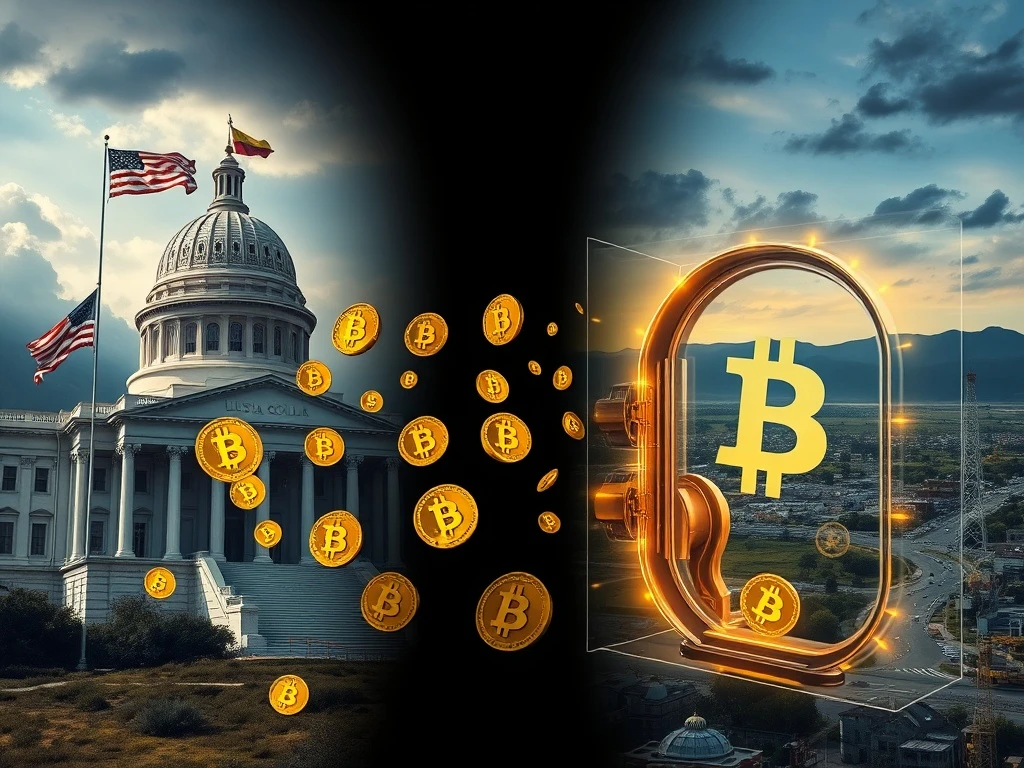
WASHINGTON, D.C. – April 2025 – The geopolitical intersection of cryptocurrency and international sanctions has reached a critical juncture, as former U.S. Securities and Exchange Commission (SEC) Commissioner Paul Atkins offered a notably cautious perspective on the potential for the United States to seize Venezuela’s alleged Bitcoin reserves. This development follows intense speculation, reported by Cointelegraph, that the sanctioned South American nation may hold a clandestine crypto vault worth billions, a claim that remains largely unverified but carries significant implications for global finance and enforcement.
Venezuela’s Alleged Bitcoin Reserves Face Scrutiny
During a recent interview with Fox Business, Atkins addressed swirling reports that Venezuela’s government, led by President Nicolás Maduro, holds a substantial cache of Bitcoin and Tether (USDT) specifically to circumvent international economic sanctions. Consequently, analysts have suggested these holdings could reach a staggering $60 billion. However, Atkins maintained a neutral, fact-based stance. He explicitly stated he could not confirm the authenticity of these reports. Moreover, he emphasized that any potential U.S. action would depend on concrete evidence and legal authority.
The speculation intensified dramatically after the U.S. Department of Justice indicted President Maduro and several associates on charges including narcoterrorism and money laundering. Subsequently, investigators and blockchain analysts began probing for digital asset trails. A stark discrepancy exists between the rumored billions and the officially confirmed on-chain reserves. Public blockchain data reveals wallets identifiable as belonging to the Venezuelan state hold approximately 240 BTC, valued at roughly $15 million as of April 2025—a fraction of the speculated amount.
- Reported Value: Up to $60 billion in BTC/USDT.
- Confirmed On-Chain Holdings: ~240 BTC (~$15 million).
- Primary Allegation: Sanctions evasion via cryptocurrency.
- Catalyst: U.S. indictment of President Nicolás Maduro.
The Legal and Logistical Hurdles of Cryptocurrency Seizure
Atkins’ noncommittal stance underscores the profound legal and operational complexities involved in seizing sovereign digital assets. Unlike traditional bank accounts frozen by Treasury orders, cryptocurrency stored in private wallets requires control of the private keys. Therefore, unless Venezuelan officials custody assets with a regulated exchange that complies with U.S. jurisdiction, physical or cyber-kinetic action might be necessary. Such a move would represent an unprecedented escalation in digital asset enforcement.
Furthermore, the use of privacy tools, mixers, or decentralized exchanges could obfuscate transaction trails. International law experts note that seizing another nation’s sovereign assets, even during sanctions, typically requires a formal legal process and often a court order. The novel nature of cryptocurrency adds layers of uncertainty to this established framework. For instance, determining the exact location and control of the assets presents a unique challenge for authorities.
Expert Analysis on Enforcement Precedents
Historical context provides crucial insight. The U.S. has previously seized cryptocurrency from criminal organizations and, notably, from nation-state actors like North Korean hacking groups. However, seizing assets directly from a recognized government’s alleged reserve would establish a new precedent. Financial compliance specialists point to the seizure of Iranian oil tankers or frozen Russian central bank assets as analogies, but the decentralized and borderless nature of Bitcoin creates distinct hurdles.
Atkins, drawing from his regulatory expertise, likely considered these enforcement precedents. His measured comments reflect an understanding that any action must be legally defensible and strategically sound. Additionally, a failed seizure attempt could undermine U.S. authority or inadvertently legitimize Venezuela’s use of crypto to bypass the global dollar system. The potential for setting a precedent that other nations might use against U.S. digital assets in the future is also a significant consideration.
The Broader Impact on Cryptocurrency and Geopolitics
This situation highlights a pivotal trend: the weaponization and counter-weaponization of financial technology. Venezuela, suffering under hyperinflation and capital controls, has previously launched its own state-backed cryptocurrency, the Petro, with limited success. A shift to holding major decentralized cryptocurrencies like Bitcoin would represent a strategic adaptation. This scenario places digital assets squarely at the center of 21st-century economic statecraft.
For the global cryptocurrency market, the prospect of a nation-state’s multi-billion dollar Bitcoin holdings being suddenly liquidated or seized introduces a element of systemic risk. Conversely, validation of such holdings could be interpreted as a bullish signal for Bitcoin’s role as a sovereign reserve asset, albeit for pariah states. The table below contrasts the potential implications of both confirmed reserves and a successful seizure.
| Scenario | Potential Impact on Crypto Markets | Geopolitical Implication |
|---|---|---|
| Reserves Confirmed at $60B | Increased volatility; debate on BTC as a reserve asset intensifies. | Legitimizes crypto as a sanctions-busting tool for other nations. |
| U.S. Successfully Seizes Assets | Short-term sell pressure; long-term demonstration of U.S. crypto enforcement power. | Sets a powerful precedent for digital asset seizure in international disputes. |
| Reserves Proven Minimal or False | Reduced geopolitical risk premium in BTC price. | Undermines narrative of crypto as a viable, large-scale sanctions evasion method. |
Conclusion
Former SEC Commissioner Paul Atkins’ guarded comments on the potential seizure of Venezuela’s alleged Bitcoin reserves illuminate the complex frontier where cryptocurrency meets international law and diplomacy. The gap between sensational $60 billion rumors and the modest confirmed on-chain holdings of 240 BTC remains vast, underscoring the need for verified evidence. Ultimately, this episode serves as a critical case study. It demonstrates how digital assets are reshaping the tools of economic coercion and national strategy. The world will closely watch whether speculation transforms into actionable intelligence and how the United States navigates the uncharted waters of sovereign cryptocurrency seizure.
FAQs
Q1: What did former SEC Commissioner Paul Atkins actually say about Venezuela’s Bitcoin?
Atkins, speaking to Fox Business, stated he could not confirm reports of Venezuela holding large Bitcoin reserves. He was noncommittal on potential U.S. seizure, indicating it would depend on the circumstances and legal authority if such an opportunity arose.
Q2: How much Bitcoin does Venezuela officially hold according to public data?
Blockchain analysis identifies wallets linked to the Venezuelan state holding approximately 240 Bitcoin. This is significantly less than the speculated $60 billion (which would equate to over 900,000 BTC at current prices).
Q3: Why would the U.S. consider seizing another country’s cryptocurrency?
The primary context is Venezuela’s status under extensive U.S. and international sanctions. If cryptocurrency holdings are being used to illegally evade these sanctions, the U.S. government may pursue seizure as an enforcement action, similar to freezing traditional bank accounts.
Q4: What makes seizing cryptocurrency different from seizing traditional money?
Seizing cryptocurrency requires control of the private keys to the digital wallets. Unless the assets are held on a compliant exchange, seizure can be technically challenging. It also involves novel legal questions about jurisdiction over decentralized, borderless assets.
Q5: Has the U.S. ever seized cryptocurrency from a foreign government before?
While the U.S. has seized crypto from state-sponsored hacking groups (e.g., North Korea), there is no public precedent for the seizure of cryptocurrency officially held as reserves by a recognized national government. Such an action would be unprecedented.
Related News
- Trump’s Decisive 25% Iran Trade Tariff Shakes Global Markets and Foreign Policy
- Cryptocurrency Futures Liquidated: $104 Million Wiped Out in One Hour Amidst Market Turmoil
- Bitcoin Price Surge: How Federal Reserve Policy Decisions Could Trigger the Next Major Rally