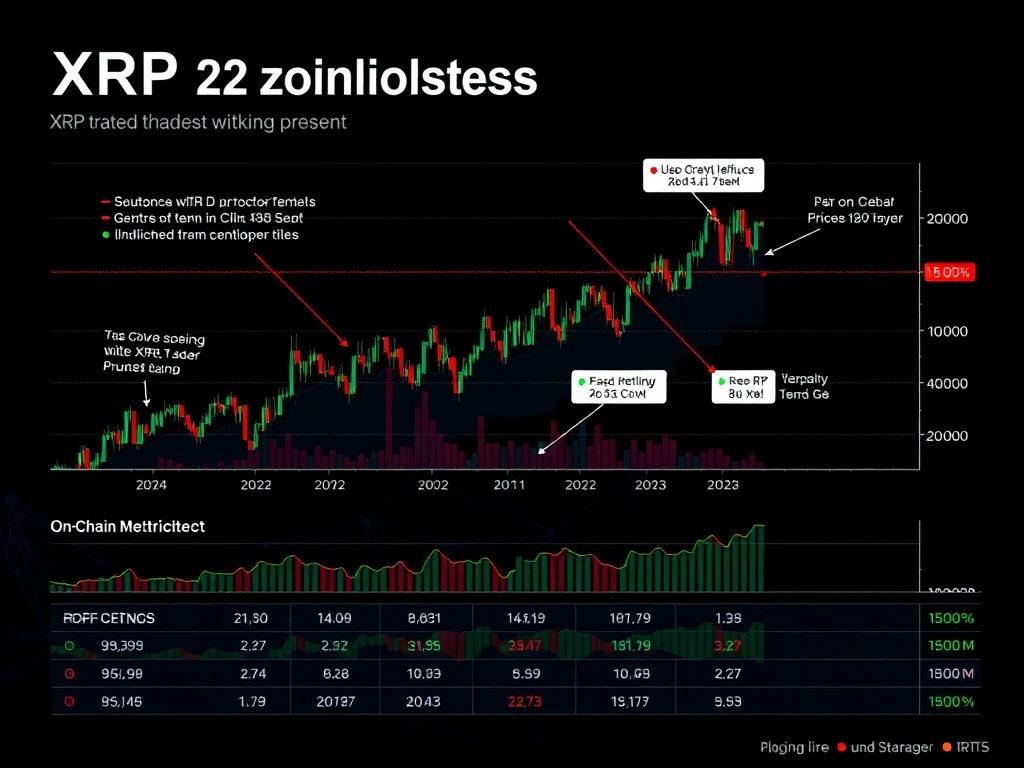
Recent blockchain data analysis reveals concerning patterns in XRP’s on-chain metrics that closely resemble those observed before the 2022 cryptocurrency bear market, potentially signaling increased volatility ahead for the digital asset. According to comprehensive data from blockchain analytics firm Glassnode, current investor behavior patterns mirror those seen in early 2022, when XRP experienced significant price declines following similar on-chain activity. This analysis, conducted in March 2025, examines the structural similarities between current market conditions and previous bearish periods, providing crucial insights for investors and market observers.
XRP On-Chain Metrics Show Disturbing Parallels to 2022
Glassnode’s detailed blockchain analysis indicates that XRP’s current on-chain indicators demonstrate remarkable similarity to patterns observed in February 2022. The data reveals that investors who entered the market within the last month have been accumulating XRP at lower average prices compared to those who invested six to twelve months ago. Consequently, this situation creates an asymmetric profit structure where recent buyers find themselves in profitable positions while longer-term holders face unrealized losses. This divergence in investor cost basis represents a critical metric that historically precedes increased market volatility.
Furthermore, blockchain transaction data shows that XRP has been experiencing stagnation around the $2 price level, a psychological barrier that consistently influences investor sentiment. Since mid-2024, each retest of this price point has resulted in weekly losses ranging between $500 million and $1.2 billion in market capitalization. This pattern suggests that many investors have chosen to sell their positions rather than increase exposure when XRP approaches this level. The consistent selling pressure at this threshold indicates strong resistance that could potentially limit upward momentum in the near term.
Understanding the Asymmetric Profit Structure
The current market structure presents a complex scenario where different investor cohorts experience contrasting financial positions. Recent buyers, having entered at lower price points, maintain profitable positions despite the asset’s stagnation. Meanwhile, investors who purchased XRP six to twelve months ago face paper losses due to their higher average entry prices. This divergence creates potential selling pressure from two distinct sources: profit-taking by recent buyers and loss-cutting by longer-term holders.
Historical Context and Market Psychology
Examining the February 2022 parallel provides crucial context for understanding current market dynamics. During that period, XRP traded at approximately $0.78 before declining to around $0.30 throughout the subsequent bear market. The similar on-chain patterns observed today suggest comparable market psychology may be developing. When investors with different cost bases face contrasting financial outcomes, market stability often becomes compromised. Glassnode analysts note that if price rebounds prove slow to materialize amid this structural imbalance, existing holders may increasingly turn to selling, potentially accelerating downward pressure.
Blockchain analytics provide several key metrics that illuminate these patterns:
- Realized Price Distribution: Shows concentration of investor entry prices
- Network Profit/Loss Metrics: Tracks overall investor profitability
- Exchange Flow Data: Monitors movement between wallets and exchanges
- Holder Composition Analysis: Examines distribution among investor cohorts
Market Impact and Potential Scenarios
The widening disparity between holders’ average costs represents a significant concern for market stability. As this gap increases, the potential for coordinated selling pressure grows proportionally. While historical patterns don’t guarantee identical outcomes, they provide valuable frameworks for understanding potential market developments. The $2 price level has demonstrated particular significance, acting as both psychological barrier and practical resistance point that triggers substantial selling activity.
Market analysts emphasize several critical factors that could influence XRP’s trajectory:
| Factor | Current Status | Potential Impact |
|---|---|---|
| Recent Buyer Profitability | High | Increased profit-taking potential |
| Long-term Holder Position | Loss-making | Possible capitulation events |
| $2 Resistance Level | Strong | Limited upward momentum |
| Overall Market Sentiment | Cautious | Reduced buying pressure |
Expert Analysis and Market Observations
Cryptocurrency market analysts note that while on-chain metrics provide valuable insights, they represent just one dimension of market analysis. Fundamental developments, regulatory changes, and broader market conditions all contribute to price movements. The Glassnode analysis specifically highlights the importance of monitoring these on-chain patterns as early indicators of potential market shifts. However, experts caution against interpreting these patterns as definitive predictions, emphasizing instead their value as risk assessment tools.
Additionally, the cryptocurrency market has evolved significantly since 2022, with increased institutional participation, regulatory clarity in some jurisdictions, and broader adoption of blockchain technology. These factors may influence how similar on-chain patterns manifest in current market conditions. The relationship between on-chain metrics and price action has become more complex as market maturity increases, requiring nuanced interpretation of blockchain data.
Comparative Analysis: 2022 vs. 2025 Market Conditions
While on-chain patterns show similarities between 2022 and current conditions, important differences exist in market structure and environment. The cryptocurrency market in 2025 features greater institutional participation, more sophisticated derivatives markets, and different regulatory landscapes. These factors may influence how similar on-chain patterns translate into price action. However, the fundamental principles of investor psychology and market mechanics remain consistent, making historical comparisons valuable for risk assessment.
Key differences between the two periods include:
- Market Maturity: Increased institutional participation in 2025
- Regulatory Environment: Evolving but more defined frameworks
- Derivatives Market: More sophisticated hedging instruments available
- Adoption Levels: Broader acceptance of cryptocurrency technology
Conclusion
The analysis of XRP on-chain metrics reveals concerning parallels to patterns observed before the 2022 bear market, particularly regarding asymmetric profit structures and resistance at key price levels. While historical patterns don’t guarantee identical outcomes, they provide valuable frameworks for understanding potential market developments and assessing risk. The widening disparity between investor cost bases, combined with persistent resistance at the $2 level, suggests increased potential for volatility in the XRP market. Investors and market observers should monitor these on-chain metrics alongside fundamental developments and broader market conditions for comprehensive market assessment.
FAQs
Q1: What do XRP on-chain metrics currently indicate about market conditions?
Current XRP on-chain metrics show patterns similar to those observed before the 2022 bear market, with recent buyers in profit while longer-term holders face losses, creating an asymmetric profit structure that could increase selling pressure.
Q2: How does the current $2 price level affect XRP investor behavior?
The $2 price level has consistently triggered selling activity, with each retest since mid-2024 resulting in weekly losses between $500 million and $1.2 billion, indicating strong resistance and potential profit-taking behavior.
Q3: What is an asymmetric profit structure in cryptocurrency markets?
An asymmetric profit structure occurs when different investor cohorts have significantly different average entry prices, resulting in some investors being profitable while others face losses, potentially leading to conflicting selling motivations.
Q4: How reliable are historical patterns in predicting cryptocurrency price movements?
While historical patterns provide valuable context and risk assessment frameworks, they don’t guarantee identical outcomes due to evolving market conditions, regulatory changes, and different fundamental factors.
Q5: What should investors consider when evaluating on-chain metric analyses?
Investors should consider on-chain metrics as one component of comprehensive analysis, alongside fundamental developments, technical indicators, regulatory changes, and broader market conditions for balanced decision-making.
Related News
- Bitcoin Price Plummets: BTC Falls Below $89,000 Amid Market Uncertainty
- Galaxy Crypto Hedge Fund Launch: $100 Million Strategic Move Signals Institutional Confidence
- Cryptocurrency Trust Survey Reveals Stunning 40% of Younger Americans Embrace Digital Assets vs Mere 9% of Baby Boomers