Slippage in Crypto Trading: What It Is and How to Limit It
Slippage is the gap between expected and actual trade price. Learn why it happens in crypto and practical ways to reduce it on exchanges and DEXs.
Key points
- Slippage is the difference between the price you expect and the price you get when a trade executes.
- It happens because prices move between order placement and execution, and because large orders can eat through thin order books.
- You can limit slippage by using limit orders, trading liquid pairs, splitting large orders, and adjusting slippage tolerance on decentralized exchanges.
What Is Slippage?
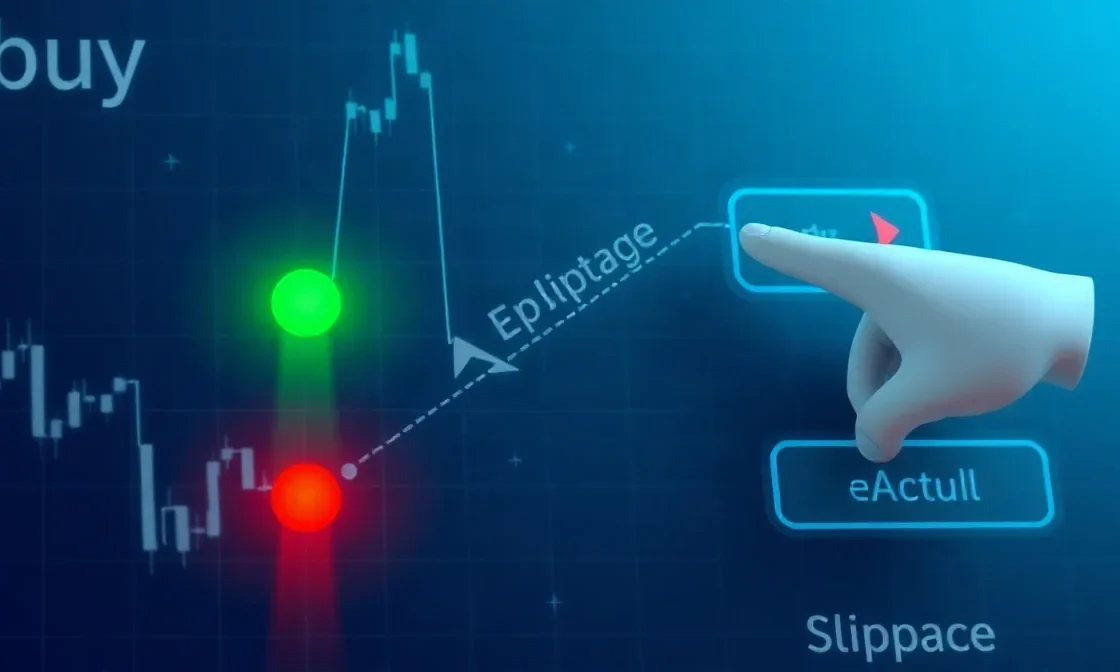
Slippage is the difference between the price you expected for a trade and the price you actually got. If you place an order to buy a token at $10 but it fills at $10.20, that $0.20 gap is slippage. It can work in your favor (you pay less) or against you (you pay more), but in fast or thin markets it usually costs you money.
Slippage is not a fee charged by an exchange. It is the natural result of prices changing while your order is being matched. On centralized exchanges (CEXs) like Coinbase or Binance, slippage often appears as an average fill price that differs from the last traded price. On decentralized exchanges (DEXs) like Uniswap, you see it as the difference between the quote you are shown and the final amount you receive.
Why Slippage Happens
Two main forces create slippage: speed and depth.
- Speed: Crypto markets trade 24/7 and can move quickly. Between the moment you click “buy” and the moment your order is filled, the price may have changed. On blockchains, this delay includes the time for your transaction to be included in a block.
- Depth: Every market has an order book or a liquidity pool. If your order is larger than the available liquidity at the best price, it will eat into the next price levels. The result is an average price that is worse than the top of the book.
On DEXs, an automated market maker (AMM) formula sets prices based on the ratio of assets in a pool. The larger your trade relative to the pool, the more the price moves against you. This is called price impact, and it is a major component of slippage on DEXs.
How to Limit Slippage: Practical Steps
1. Use Limit Orders
A limit order lets you specify the exact price you are willing to accept. If the market never reaches that price, the order does not fill. This gives you full control over slippage: you either get your price or you don’t trade. Market orders, by contrast, execute immediately at whatever price is available, which can lead to unpleasant surprises.
2. Trade Liquid Pairs
Liquidity is your best defense. Major pairs like BTC/USDT or ETH/USDT on large exchanges have deep order books, so even sizable orders cause little slippage. Smaller altcoins or new tokens often have thin liquidity, where a modest trade can move the price several percent. Before trading, check the 24-hour volume and the order book depth.
3. Split Large Orders
If you need to buy or sell a large amount, consider breaking it into smaller chunks and executing them over time. This reduces the price impact of any single trade. Some exchanges offer algorithmic orders (like TWAP) that do this automatically, but you can also do it manually.
4. Adjust Slippage Tolerance on DEXs
On DEXs, you set a slippage tolerance before swapping. This is the maximum percentage difference between the quoted price and the final price you will accept. If the price moves beyond that, the transaction reverts (fails) and you only lose the gas fee. A common default is 0.5% or 1%, but for volatile or low-liquidity tokens you may need to raise it to 2% or more. Be careful: setting it too high exposes you to sandwich attacks and bad fills.
5. Time Your Trades
Slippage tends to be worse during high volatility, such as major news events or when a token first lists. If you can, trade during quieter periods. Also avoid trading right after a large market order has swept the book, as prices may be temporarily distorted.
6. Use Aggregators
DEX aggregators like 1inch or Jupiter split your trade across multiple liquidity sources to find the best overall price. They can reduce slippage by routing through several pools instead of one. The trade-off is a small service fee, but for larger trades the savings often outweigh it.
Common Mistakes and Risks
- Ignoring slippage tolerance: On DEXs, if you set tolerance too low, your transaction may fail repeatedly, wasting gas. Too high, and you may accept a terrible price or become a target for MEV bots.
- Using market orders in thin markets: This is a recipe for large slippage. Always check liquidity first.
- Forgetting about gas and fees: Slippage is separate from trading fees and gas. Your total cost includes all three.
- Assuming the quote is final: On DEXs, the quote you see is an estimate. The actual execution price can differ, especially if the pool balance changes before your transaction is mined.
- Sandwich attacks: Bots can front-run and back-run your trade if your slippage tolerance is high, profiting at your expense. This is a form of MEV (maximal extractable value) that is common on public blockchains.
Example: Slippage in Action
Suppose you want to buy 10,000 USDT worth of a small-cap token on a DEX. The pool has 100,000 USDT and 100,000 tokens, so the initial price is $1.00. After your buy, the pool has 110,000 USDT and about 90,909 tokens, pushing the price to roughly $1.21. Your average fill price would be around $1.10, meaning you paid about 10% more than the initial price. That 10% is slippage (price impact). On a large exchange with a deep order book, the same trade might cause only 0.1% slippage.
Summary
Slippage is the gap between the price you expect and the price you get. It is driven by market speed and liquidity depth. You can limit it by using limit orders, trading liquid pairs, splitting large orders, adjusting slippage tolerance carefully, timing your trades, and using DEX aggregators. Always check liquidity and be aware of the risks, especially on decentralized exchanges where MEV bots operate. By understanding slippage, you can trade more efficiently and avoid unnecessary costs.
Disclaimer: This article is for information only and is not investment, financial or trading advice. Cryptocurrency prices are highly volatile. Always do your own research.