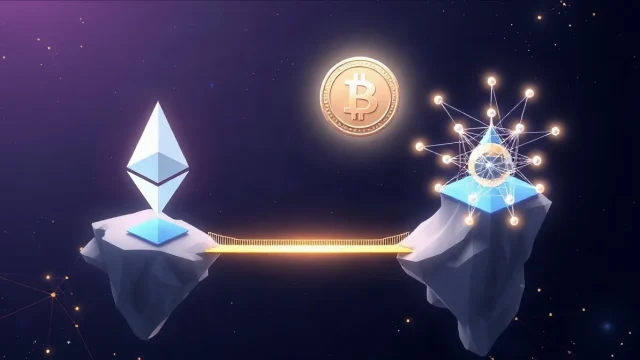
What is Quant (QNT)? A Plain-English Explainer
Quant (QNT) connects blockchains and traditional systems. Learn what QNT is, how it works, what the token does, and the main risks in plain English.

Key points
- Quant is a blockchain interoperability project that links different blockchains and older IT systems.
- QNT is the network's utility token, used to pay for licenses and services on Quant's Overledger platform.
- As of September 29, 2026, Quant's market cap rank was 32, with a circulating supply of 12,072,738 QNT.
What is Quant?
Quant is a project that aims to connect blockchains to each other and to conventional computer systems. Its main product, Overledger, is a kind of translation and routing layer. Instead of forcing every company or developer to rebuild everything on one blockchain, Quant lets separate networks and databases talk to each other.
The project is built around a token called QNT. QNT is not a currency for everyday payments. It is a utility token tied to the use of Quant’s enterprise software and services.
Why interoperability matters
There are many blockchains, and most of them cannot easily exchange data or value with one another. Banks, hospitals, and supply-chain firms also run older systems that were never designed to work with blockchains. This creates silos: separate islands of data.
Quant’s pitch is that businesses should not have to choose one blockchain and abandon everything else. Overledger is designed to let an application work across multiple ledgers at once, while also reaching into traditional databases and APIs.
How Quant works, in plain language
Overledger acts like a universal adapter. A developer writes an application once, using common programming tools. Overledger then translates the instructions into whatever format each connected blockchain or system understands.
Here is a simplified way to picture it:
- Connectors: Quant builds connectors for different blockchains, such as Ethereum, Bitcoin, and others, as well as for conventional systems.
- Translation layer: The platform converts data and commands so each network can process them.
- Routing: Overledger sends the right message to the right place and collects the results.
- Enterprise tools: Quant offers software development kits, a gateway, and other tools so companies can build multi-chain applications without deep blockchain expertise.
Quant also offers a product called Quant Flow, which is aimed at helping financial institutions connect to digital assets and payment networks. The exact technical details are complex, but the core idea is the same: make different systems interoperable through a single layer.
What QNT is used for
QNT is the token that powers the Quant ecosystem. According to the project, it is used in several ways:
- Licensing: Enterprises that use Overledger and related Quant products may need to hold or pay with QNT to access certain features.
- Network fees: QNT can be used to pay for transactions or services within the Quant network.
- Governance: In some designs, QNT holders can take part in decisions about the network’s direction, though the details have evolved over time.
Importantly, QNT is not required for every interaction with Quant’s technology. Some enterprise clients use the software without directly touching the token. That has been a point of debate among investors.
Notable history
Quant was founded in 2018 by Gilbert Verdian, a former cybersecurity and banking technology executive. The project launched its Overledger platform and held a token sale around that time.
Over the years, Quant has announced partnerships and proofs of concept with various organizations, including work related to central bank digital currencies and enterprise blockchain trials. It has also been a member of industry groups focused on interoperability standards.
In 2023, Quant introduced Quant Flow, a product aimed at financial institutions. The project has continued to update Overledger and expand its list of supported networks. As with many crypto projects, some announcements have been more about exploration than full production use.
Main risks and criticisms
Quant faces several challenges that are common to enterprise blockchain projects:
- Adoption is hard to verify: It is often unclear how many companies are using Overledger in live, revenue-generating ways versus testing it in pilots.
- Token demand is uncertain: If enterprises can use Quant’s software without buying QNT, the token’s value may not grow with the company’s success.
- Competition: Other interoperability projects, such as Polkadot, Cosmos, and Chainlink’s Cross-Chain Interoperability Protocol (CCIP), are pursuing similar goals.
- Regulatory risk: Crypto tokens face changing rules in many countries, which could affect how QNT can be used or traded.
- Complexity: Quant’s technology is difficult for non-experts to evaluate, making it harder for investors to judge progress.
There is also the general risk that comes with any crypto asset: prices can be volatile, and the market can be unpredictable.
How Quant compares with alternatives
Quant is not the only project trying to connect blockchains. Here is a quick comparison:
| Project | Main focus | Token role |
|---|---|---|
| Quant (QNT) | Enterprise interoperability between blockchains and traditional systems | Licensing, fees, governance |
| Polkadot (DOT) | Connecting specialized blockchains via a central relay chain | Staking, governance, bonding |
| Cosmos (ATOM) | An internet of blockchains using the Inter-Blockchain Communication protocol | Staking, governance, fees |
| Chainlink (LINK) | Oracles and cross-chain messaging, including CCIP | Paying node operators, fees |
Polkadot and Cosmos are primarily focused on connecting blockchains that are built with their own frameworks. Quant, by contrast, emphasizes links to existing enterprise systems and a wide range of ledgers. Chainlink started with price feeds and has expanded into cross-chain communication, which overlaps with Quant’s goals.
Each project has a different design and different trade-offs. None of them has clearly “won” the interoperability race yet.
Market snapshot
As of September 29, 2026, Quant’s market capitalization rank was 32, and its circulating supply was 12,072,738 QNT. These figures are provided for context only and are not a prediction or recommendation.
What to watch
For anyone following Quant, the key questions are whether more enterprises move from pilots to production, whether QNT becomes essential to using the network, and how the project competes with other interoperability solutions. The answers will likely shape its long-term role in the crypto and enterprise worlds.
Disclaimer: This article is for information only and is not investment, financial or trading advice. Cryptocurrency prices are highly volatile. Always do your own research.