What Is a DAO and How Does On-Chain Governance Work?
A beginner-friendly guide to DAOs and on-chain governance: how they work, real examples, practical steps, and common risks to watch for.
Key points
- A DAO is an organization run by rules encoded in smart contracts, where token holders vote on decisions.
- On-chain governance records proposals and votes on a blockchain, making outcomes transparent and enforceable.
- DAOs face risks like low voter turnout, whale dominance, and smart contract bugs.
What Is a DAO?
A DAO (decentralized autonomous organization) is a group that coordinates through rules written in smart contracts on a blockchain. Instead of a traditional hierarchy, decisions are made by members who typically hold governance tokens. Those tokens give voting power on proposals that range from changing a protocol’s fees to allocating a treasury.
The core idea is simple: rules are public, votes are recorded, and outcomes can be executed automatically. That does not mean DAOs are leaderless or risk-free, but it does change how trust and accountability work.
How On-Chain Governance Works
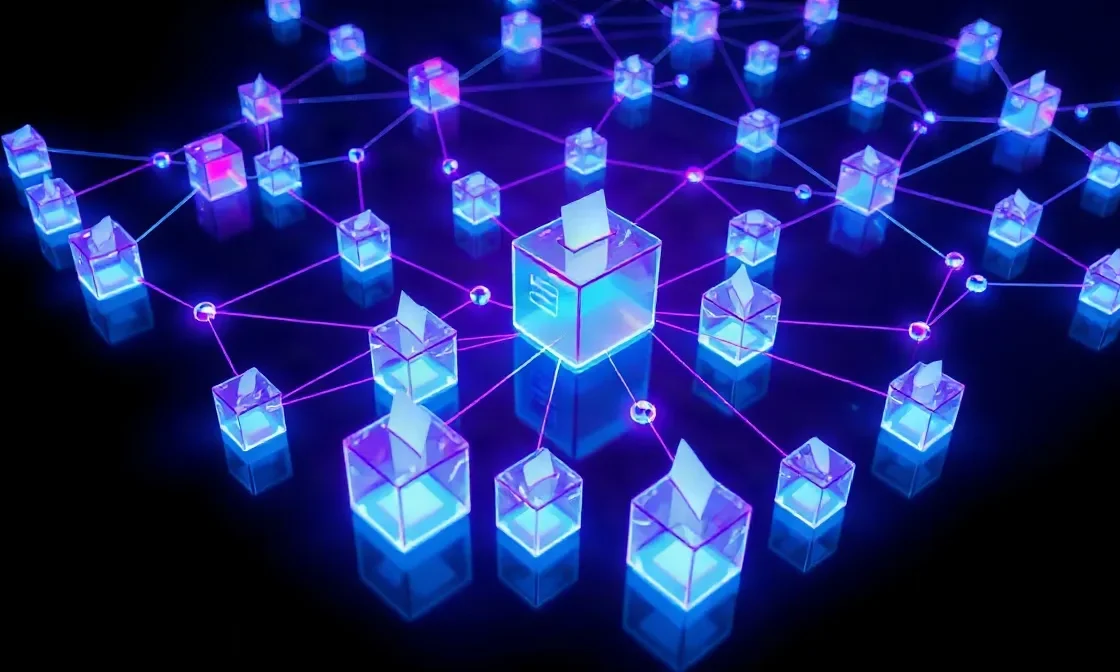
On-chain governance means the proposal, voting, and execution steps happen on the blockchain. A typical flow looks like this:
- Proposal creation: A member submits a proposal. Some DAOs require a minimum number of tokens to submit; others use a forum discussion first.
- Voting period: Token holders vote yes, no, or abstain. Voting power is often proportional to tokens held, though some DAOs use one-person-one-vote or reputation-based systems.
- Quorum and approval: A proposal passes only if a minimum number of tokens participate (quorum) and a required majority approves.
- Execution: If passed, the proposal is executed by a smart contract or a multisig wallet. In many DAOs, execution is automatic; in others, a council or multisig must enact it.
Because everything is on-chain, anyone can audit the votes and the result. That transparency is a key difference from off-chain governance, where votes may be signaled in forums or polls but not enforced by code.
Off-Chain vs. On-Chain Governance
| Feature | Off-Chain | On-Chain |
|---|---|---|
| Where votes happen | Forums, polls, Snapshot | Blockchain |
| Cost to vote | Often free | Gas fees apply |
| Execution | Manual, by a team or multisig | Automatic or multisig |
| Transparency | Depends on the platform | Fully public and verifiable |
Many DAOs use a hybrid: off-chain signaling to gauge support, then an on-chain vote for the final decision.
Practical Steps to Participate
If you want to take part in a DAO, here is a straightforward path:
- Choose a DAO that matches your interests. It could be a DeFi protocol, an NFT collective, a grants program, or a social club.
- Get the governance token. You may need to buy it on an exchange or earn it by contributing. Check the DAO’s docs for details.
- Set up a wallet. Use a self-custody wallet that supports the blockchain the DAO uses. Keep your seed phrase safe.
- Read proposals. Before voting, read the full proposal and any forum discussion. Look for the exact changes, costs, and risks.
- Vote. Connect your wallet to the DAO’s governance interface, cast your vote, and pay any gas fee.
- Delegate if you lack time. Many DAOs let you delegate your voting power to someone you trust.
Some DAOs also reward participation, but rewards vary and are not guaranteed.
Real-World Examples
Several well-known projects use on-chain governance. MakerDAO (now part of the Sky ecosystem) has long used token voting to manage parameters of its stablecoin system. Uniswap token holders vote on proposals that can direct the protocol’s treasury and fee mechanisms. Compound governance lets COMP holders propose and vote on changes to the lending protocol. These examples show that on-chain governance can handle real economic decisions, not just symbolic votes.
Risks and Common Mistakes
DAOs are experiments, and they come with distinct risks.
- Low voter turnout: Many proposals pass with a small fraction of tokens voting. That can let a motivated minority decide outcomes.
- Whale dominance: If voting power is proportional to tokens, large holders can sway votes. Some DAOs cap voting power or use quadratic voting to reduce this.
- Smart contract bugs: A flaw in the governance contract or a malicious proposal can drain funds. Audits help but do not eliminate risk.
- Governance attacks: An attacker might borrow tokens to pass a harmful proposal. Time locks and multisig execution can reduce this risk.
- Voter apathy and complexity: Technical proposals can be hard to evaluate. Delegation helps, but it concentrates power.
- Legal uncertainty: DAO structures may face unclear regulations depending on jurisdiction. This is a fast-changing area.
Common mistakes include voting without reading the proposal, ignoring quorum requirements, and assuming that a passed vote is automatically safe. Always check whether execution requires a multisig and who controls it.
Summary
A DAO is an organization governed by code and community votes. On-chain governance makes proposals, voting, and execution transparent and enforceable on a blockchain. It offers a new way to coordinate, but it also brings risks like low participation, whale influence, and smart contract failures. If you participate, read carefully, understand the rules, and never risk more than you can afford to lose.
Disclaimer: This article is for information only and is not investment, financial or trading advice. Cryptocurrency prices are highly volatile. Always do your own research.